
We know that a person is not justified by works of the law but through faith in Jesus Christ, so we also have believed in Christ Jesus, in order to be justified by faith in Christ and not by works of the law, because by works of the law no one will be justified. [Galatians 2:16 (ESV)]
You see that a person is justified by works and not by faith alone. [James 2:24 (ESV)]
 Christianity seems to be full of paradoxes. We’re saved by faith and not by works but we can’t have faith without works. As for grace and obedience—it’s God’s grace not our obedience that saves us. But, what initially sounds like a free pass isn’t because the saved are expected to have grace-fueled obedience! It’s easy to get confused when we read only isolated verses in Scripture. Rather than inconsistent or even contradictory concepts, however, faith, works, grace and obedience are complementary and interrelated. Perhaps some of the confusion comes from our language rather than our doctrine.
I think back to an exchange between two characters in Perelandra by C.S. Lewis. When the character Ransom is at a loss for words while trying to explain a concept, his companion says, “I realize it’s all too vague for you to put into words.” Looking at his friend sharply, Ransom replies, “On the contrary, it is words that are vague. The reason why it can’t be expressed is that it’s too definite for language.” Faith, works, grace, and obedience are so distinct and yet so interconnected in Christian doctrine that it’s a pity we don’t have a wider Christian vocabulary.
According to The Washington Post, there really are at least fifty Inuit words for snow that describe everything from a soft falling snow to a wet snow that will ice a sled’s runners. Along with having a multitude of words related to snow and ice, the Sami people of northern Scandinavia and Russia have over 1,000 words for reindeer. They have a different word for each year of a male reindeer’s life and I suspect they have one that would perfectly describe the reindeer in today’s picture. It’s done through something linguists call “polysynthesis,” which allows speakers to encode a huge amount of information into one word by plugging various suffixes onto a base word so that one word can encompass a whole sentence
Language evolves to meet the ideas and needs of the people speaking it. If the Sami people can use a single word like sietnjanjunni to describe a reindeer with the hair nearest to its nostrils having a different color than the one you’d expect from the color of the rest of its hair, we should be able to come up with something for the combined concepts of faith, works, grace, and obedience. Using a little polysynthesis, we could try for the whole shebang and come up with “faithorkobegracience,” but it still wouldn’t capture these concepts because we’re talking of something far greater than reindeer, snow, or ice.
We are finite beings trying to capture an infinite, omnipotent, omniscient, and omnipresent being with words. No word in any language can come close to the immensity of all that is encompassed in our salvation. We are saved by grace through faith but true faith is obedient and obedient faith leads to works. Simply put, it is our obedience and works that reveal the authenticity of our faith! We will just have to continue as we have for centuries: by having faith, doing His works, being saved by grace, remaining obedient to His commands and walking the way Jesus walked.
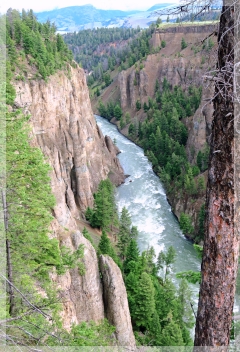 A few miles from our Illinois home, a giant ski jump towered over the treetops. Originally erected in 1905 by Carl Howelsen and a group of Norwegian skiers living in Chicago, it’s been rebuilt over the years and is still used today. In a curious coincidence, in 1913, the man who loved the mountains and deep snow found his way to the Colorado mountain town we once called our winter home. Although Howelsen returned to Norway in 1922, he left an indelible mark on the town by introducing it to recreational skiing and ski jumping. Not far from the hill named for him, stands a statue of the man known as Flying Norseman.
 In ancient times, when an iron tool became dull, another iron implement was used to give it a finer polish and sharper edge. It’s not just tools that can become dulled—so can minds and spirits. Good Christian friends who act as whetstones can make us accountable, keener, stronger, and more enthusiastic and valuable. Rather than allowing us to grow dull and settled in our comfort zones, they sharpen us with challenges that make us better disciples for Christ.
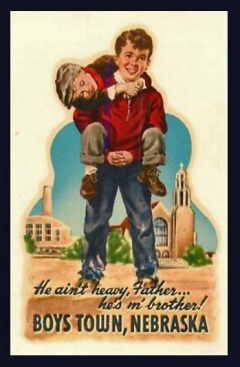 After saying we must carry each other’s burdens, the Apostle Paul seems to reverse himself three sentences later when he tells us we each must carry our own loads. It’s confusing; if we’re all supposed to carry our own loads, then nobody should need help carrying their burdens!
 My father had what’s often described as a Type-A personality. An impatient workaholic, he always took on more than he could handle. Life, for him, was one crucial task after another, none of which anyone else could do, at least not correctly. Always in a hurry, he never wanted to stop for anything, even when his gas gauge read precariously close to empty. Something more pressing always took precedence over a brief stop for gas. As a result, his car was often left on the roadside while he trudged off with a gas can to find the nearest service station. Instead of saving time, his refusal to stop cost him time. Living that way actually cost him his life; he died of a massive coronary at the age of fifty-six. It’s often been said that your in-box still will be full when you die and, indeed, his was. None of us can accomplish everything on our to-do list and we may well destroy both our relationships and ourselves while trying.
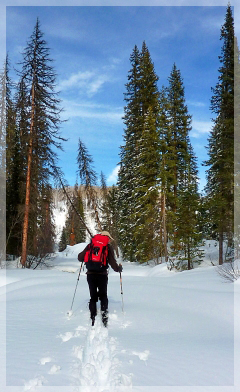 Our pastor recently did a sermon series called “Following Jesus” which reminded me of our first time backcountry skiing in Colorado more than forty years ago. As novices, we knew enough not to venture into the wilderness by ourselves so we hired Wyatt to be our guide. Insisting we delay our trek several days until we’d acclimated to the high altitude and were ready for such a trip, he gave us a long list of items we had to carry in our packs. When I asked why we needed all the survival gear along with additional food, water, and clothing, he said we had to be prepared to spend the night. Protesting that I didn’t want to spend the night out in the cold and snow, he explained, “Neither do I, but we better be prepared to do it.”
