JUST DO IT (Part 3)

“Teacher, which command in God’s Law is the most important?” Jesus said, “‘Love the Lord your God with all your passion and prayer and intelligence.’ This is the most important, the first on any list. But there is a second to set alongside it: ‘Love others as well as you love yourself.’ These two commands are pegs; everything in God’s Law and the Prophets hangs from them.” [Matthew 22:36-40 (MSG)]

IMG_2710awDecades ago, I found an interesting article in a parenting magazine having to do with negative and positive commands. Because our brains tend to best process the end of a sentence rather than its beginning, when a mother says, “Don’t tease your sister,” the child tends to hear “Tease your sister!” Moreover, telling children not to do something requires them to double process. First, they have to figure out what it is they’re not supposed to do and then they have to figure out what it is they’re supposed to do instead! While there are an infinite number of alternatives to not doing something, there is only one alternative when told what to do! Since vague instructions like “Behave!” leave a lot of gray area, a clear course of action should be given.
I recalled that advice when writing about the 615 Old Testament mitzvoth. 365 of those laws were negative commands, one for every day of the year, and that’s a whole lot of “don’ts” and “shalt nots” to remember. Any reading of the Old Testament tells us the Israelites weren’t any more successful in obeying them than were my children when I told them not to do something.

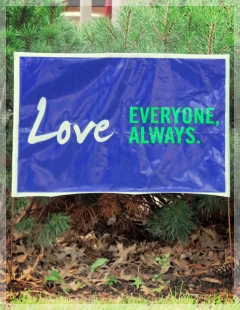
Perhaps those psychologists were familiar with the Bible and the way Jesus put a positive spin on things when he summed up the law in the one word—love—and the two commands—love God and love your neighbor. Two direct laws, stated in a positive way, with no need to split hairs because there are no exceptions. Love—it’s what we do and the power of the Holy Spirit is how we do it

For years, I misunderstood Jesus’ words in Matthew 11 about taking on his yoke. Always anxious to unload my burdens and get some rest, I was happy to dump my problems on Him. This verse, however, isn’t about the burdens of our troubles and fears; it is about the burden of the law laid upon the Jews by the scribes and Pharisees. When following a set of laws is considered the path to salvation, it does, indeed, become a heavy burden. In contrast, Jesus’ yoke is easy because his teaching equips us to live our lives in God’s will. The yoke of discipleship is a light one; it is simply walking with Jesus and allowing him to teach us moment by moment how to live His way. Even though my initial interpretation was incorrect, that verse continues to give me comfort. If love leads my actions, I don’t have to worry about doing the wrong thing. Instead, when led by love, I become the right person—the person God wants me to be.

Don’t run up debts, except for the huge debt of love you owe each other. When you love others, you complete what the law has been after all along. The law code—don’t sleep with another person’s spouse, don’t take someone’s life, don’t take what isn’t yours, don’t always be wanting what you don’t have, and any other “don’t” you can think of—finally adds up to this: Love other people as well as you do yourself. You can’t go wrong when you love others. When you add up everything in the law code, the sum total is love. [Romans 13:8-10 (MSG)]

Copyright ©2021 jsjdevotions. All rights reserved.


WHAT REASON? (Part 1)

If you obey my decrees and my regulations, you will find life through them. I am the Lord. [Leviticus 18:5 (NLT)]

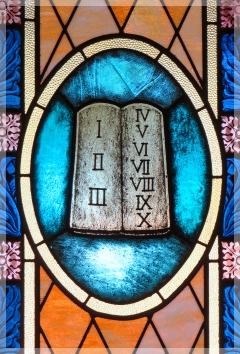
Ten COmmandments windowThe Ten Commandments are the foundation of both Jewish and Christian principles, conduct, and accountability, but they are just ten of the 613 mitzvot or commandments given to the Jewish people. In light of the big ten, many of those commands, such as using accurate scales and weights and fulfilling our promises make perfect sense as do prohibitions about speaking derogatorily of others or standing idly by if another person’s life is in danger. Moreover, laws regarding boundary markers, evidence, assessing property damages, and not perverting justice or accepting bribes certainly were necessary in a new nation. Some laws, like the ones regarding latrine placement, covering excrement, and making a guard rail around a flat roof seem reasonable from a health and safety viewpoint. Other laws may have served as a way to separate the Jews from their pagan neighbors. Perhaps it was because the Hittites, Elamites, and Sumerians were clean-shaven and the Egyptians often were clean shaven or had shaped goatees that Jewish men were not to trim the hair on their temples or shape their beards. Many laws, such as the intricate laws of sacrifice, the blue tassels on hems, reciting the Shema twice a day, and saying a blessing after meals, were related to worship and God.

Many of those laws, however, seem inexplicable. What, for example, makes land animals that don’t chew the cud and have completely split hooves (like the pig) unacceptable food? Why eat only fish with fins and scales but no shellfish or mollusks? If locusts can be eaten, why not ants? Why can’t linen be woven with wool? Why can’t a Nazarite eat grapes or raisins or cut his hair and why did every sacrifice require salt?

As I looked through these ancient laws and tried to understand God’s reasoning behind them, I missed the point. The first rule God made was the simple one he gave to Adam and Eve: don’t eat from that tree. Although He warned that death would be the result of disobedience, God didn’t explain His reasons for the prohibition because obedience to God isn’t supposed depend upon human reasoning. If we have to understand before we obey, rather than obedience, it becomes agreement and dependent on us! God, however, doesn’t require our understanding or agreement; He requires our obedience.

Abraham didn’t know where he was going when he packed up his family nor did he question God’s reasoning when he placed his son on a sacrificial altar. Building an enormous ark on dry land probably made no sense to Noah, wearing out his troops by marching around Jericho for a week seemed a questionable battle plan to Joshua, and Mary didn’t understand God’s reasoning behind her pregnancy; nevertheless, they all obeyed without understanding.

Obedience shows reliance and trust—an acceptance that God knows more than we can ever know or understand—that God is God and we are not! I don’t know God’s reasoning behind those mitzvot nor do I need to. It’s enough that God made them and expected the Israelites to abide by them. The only thing we must understand about God’s commands is that they are divinely decreed and, as such, are to be unquestionably obeyed. Rather than leading us away from God’s blessings, obedience will lead us to them.

Loving God means keeping his commandments, and his commandments are not burdensome. [1 John 5:3 (NLT)]

Trust in the Lord with all your heart; do not depend on your own understanding.  Seek his will in all you do, and he will show you which path to take. [Proverbs 3:5-6 (NLT)]

Copyright ©2021 jsjdevotions. All rights reserved.

RENDERING UNTO CAESAR (Part 1)

And Jesus said to them, “Whose likeness and inscription is this?” They said, “Caesar’s.” Then he said to them, “Therefore render to Caesar the things that are Caesar’s, and to God the things that are God’s.” When they heard it, they marveled. And they left him and went away. [Matthew 22:20-22 (ESV)]

The Pharisees and Herodians set out to trap Jesus into saying something that would offend either the people or Rome. By prefacing their question with flattery about His impartiality and integrity, they pressured Him into giving an answer to their politically charged question—was it right to pay taxes to Caesar. The tax about which they were asking was the tributum capitis, a sort of head tax that had to be paid by every male over fourteen and every female over twelve. Already heavily taxed by Rome, this tax was especially hated by the Judeans because they saw it as a symbol of their servitude and submission to their foreign rulers. 

Jesus’ questioners were sure they’d backed Him into a corner where He’d offend people regardless of His answer. If He said to pay taxes to Caesar, He would be denying God’s sovereign reign over Israel, supporting the hated Roman rulers, and alienating his fellow Jews. On the other hand, if He said not to pay taxes, Jesus would offend Rome and lay himself open to a charge of treason. Requesting to see a denarius, Jesus exposed his questioners’ hypocrisy when they had one. No truly devout Jew would carry a Roman coin with its idolatrous portrait of Tiberius Caesar and inscription that called him the “son of the divine Augustus.” Instead of falling into their trap, Jesus then employed a typical rabbinical technique by answering their question with one of his own. He asked whose picture was on the coin. They had to admit it was the emperor’s. Since, in the ancient world, an image on an object indicated ownership, it clearly belonged to Caesar. “Therefore,” said Jesus, “render to Caesar the things that are Caesar’s, and to God the things that are God’s.” Caught in their own trap, they didn’t yet understand that we can’t outsmart God!

On the surface, Jesus’ answer points out the obligations of dual citizenship—that obligations to both government and God must be fulfilled. Like Jesus’ questioners, we have a dual citizenship and, as citizens of both the Kingdom of God and our nation, we must fulfill our obligations to both. We are to render to whatever Caesar is in power that which is his without turning from our obligations to God. Hidden in Jesus’ answer, however, is the idea that Caesar is only entitled to what is his; he cannot claim what belongs to God! In both Jewish and Christian theology, however, God has dominion and authority over everything. In short, all things belong to God!

Nevertheless, when loyalty to government is not incompatible with loyalty to God, it appears that support of the state is part of being obedient to the Lord. Like it or not, today is tax day and, unless you filed for an extension, today is the last day to do your rendering unto Washington!

For because of this you also pay taxes, for the authorities are ministers of God, attending to this very thing. Pay to all what is owed to them: taxes to whom taxes are owed, revenue to whom revenue is owed, respect to whom respect is owed, honor to whom honor is owed. [Romans 13:6-7 (ESV)]

Copyright ©2021 jsjdevotions. All rights reserved.

THE KINGDOM

One day the Pharisees asked Jesus, “When will the Kingdom of God come?” Jesus replied, “The Kingdom of God can’t be detected by visible signs. You won’t be able to say, ‘Here it is!’ or ‘It’s over there!’ For the Kingdom of God is already among you.” Luke 17:20-21

holy name cathedralDepending on your Bible translation, the Kingdom of God is mentioned at least 68 times in the New Testament. Rather than “Kingdom of God,” Matthew usually used “Kingdom of Heaven.” All four gospels, however, are speaking of the same place. Matthew was a Jew and primarily writing for a Jewish audience. While we tend to interpret the third commandment about not misusing the Lord’s name to mean not using it irreverently, Jews have a much stricter interpretation. Believing God’s name too sacred to say aloud, by the 1st century, His name wasn’t even written or spoken in anything but prayer. Even today, many observant Jews substitute “G-d” rather than write the full name.

Because Jesus continually preached the Kingdom of God (or Heaven), the Pharisees asked Him when it would come. Like the rest of Judah, they were thinking of a materialistic kingdom—one with boundaries and a Jewish ruler—so they missed what was happening in front of them. Looking for a political rather than a spiritual fix, they couldn’t understand that the Kingdom had arrived and God was busy restoring it.

Jesus’ answer to the Pharisees sounds like He’s saying the Kingdom is present and yet He also told His disciples to pray for its coming. Rather than an involved theological explanation to explain a kingdom that was both here and pending, Jesus compared the Kingdom of God to a mustard seed that was planted in a field but hadn’t matured into its future glory. The Kingdom was “already” because believers were taking part in building it but it also was “not yet” because it wouldn’t reach its full expression until the future. To further explain the Kingdom, Jesus used a number of metaphors: a farmer scattering seed, yeast in dough, a fishing net, a merchant in search of fine pearls, treasure in a field, a king settling his accounts, a landowner hiring workers for his vineyard, a king’s wedding feast for his son, ten bridesmaids meeting the bridegroom, and a landowner with tenant farmers. Even then, His own disciples were still thinking of an earthly kingdom when they asked the resurrected Jesus, “has the time come for you to free Israel and restore our kingdom?” [Acts 1:6]

The Kingdom of God is not about going to heaven when we die; it’s about bringing God’s kingdom to earth. We pray, “May your Kingdom come soon. May your will be done on earth, as it is in heaven.” [Matthew 6:10] God is king of everything and everyone and, when He reigns in our hearts and minds, His Kingdom is already here. At the same time, His Kingdom is not yet here until its full realization when paradise is re-created in the New Jerusalem.

The Messiah has accomplished the work of redemption, the Spirit has been poured out, yet evil has not been eradicated, the general resurrection is still future, and the final state of God’s kingdom has not been established. In other words, the new era has begun–has been inaugurated–but it has not yet replaced the old era. [Dr. Peter Cockrell]

Jesus answered, “My Kingdom is not an earthly kingdom. If it were, my followers would fight to keep me from being handed over to the Jewish leaders. But my Kingdom is not of this world.” [John 18:36 (NLT)]

Copyright ©2021 jsjdevotions. All rights reserved.

WHAT ARE THE ODDS? (Part 3)

He [Jesus] rolled up the scroll, gave it to the attendant, and sat down. All eyes in the synagogue were fixed on him. “Today,” he began, “this scripture is fulfilled in your own hearing.” [Luke 4:20-21 (NTE)]

evening primroseIn writing about Blaise Pascal yesterday, I mentioned that he, along with Pierre de Fermat, laid the groundwork for probability theory back in 1654. I remember a school friend writing her term paper on probabilities who began by testing what’s called the “birthday paradox:” in a room of 23 people, there is a 50% chance that two people will have the same birthday and, out of 75 people, there is a 99.9% chance of two people’s birth dates matching. Imagine her surprise when the first two people she asked had the same birth date! That, of course was sheer coincidence but, if the next 30 people she asked also had the same birth date, another explanation would have been necessary.

I know nothing of permutations, exponents, or probability theory, but even I know when coincidence can’t explain the improbable. Consider the improbability of anyone fulfilling the many Messianic prophecies found in the Hebrew Scriptures. The Messiah would come from the seed of a woman (not a man) and be born of a virgin in Bethlehem. He would be from the line of Abraham, a descendant of Isaac and Jacob, of the tribe of Judah, and from the house of David. The Messiah would spend time in Egypt, would be a Nazarene, and a messenger would prepare His way. He would be a light to the Gentiles, give sight to the blind and hearing to the deaf, visit the Temple, and enter Jerusalem as a king on a donkey. The Messiah would be betrayed for 30 pieces of silver, falsely accused, and stand silent before His accusers. He’d be mocked and ridiculed, his hands and feet pierced, dice would be thrown for his clothing, and would die with the wicked but be buried with the rich.

Taking just eight of the some 300 fulfilled Messianic prophecies in Hebrew Scripture, mathematics professor Peter Stoner calculated the odds of one man fulfilling them by coincidence at 1 in 1017 (100,000,000,000,000,000). Putting those many zeros into perspective, Stoner likened it to covering the entire state of Texas with silver dollars piled 2-feet deep, placing one marked silver dollar among them, and expecting a blindfolded person to wander through the state and pick up the marked coin in his first try. Stoner then figured the odds of one man fulfilling 16 of those Messianic prophecies at 1 in 1045 and of fulfilling 48 of those prophecies at 1 in 10157, a truly mind-boggling number. Although the odds against one man fulfilling all those prophecies are astronomical, that’s exactly what Jesus did! Looking at it purely from a mathematical viewpoint, Professor Stoner concluded, “Any man who rejects Christ as the Son of God is rejecting a fact proved perhaps more absolutely than any other fact in the world.”

While probability theory proves that Jesus is the promised Messiah, intellectual assent is not quite enough when it comes to our salvation because it’s not the same as believing in Jesus. Faith is more than an acceptance of facts; it is a commitment to those facts. A profession of intellectual belief is meaningless until it makes a discernible change in us! Nevertheless, Stoner’s use of probability theory to prove Jesus is the promised Messiah helps bolster our own faith. Moreover, it enables us to defend the validity of Scripture and the truth of Jesus’ identity to those who don’t believe.

And we have the prophetic word made more certain. You will do well to hold on to this, as to a lamp shining in a dark place, until the day dawns and the morning star shines in your hearts. You must know this first of all, that no scriptural prophecy is a matter of one’s own interpretation. No prophecy, you see, ever came by human will. Rather, people were moved by the holy spirit, and spoke from God. [2 Peter 1:19-21 (NTE)]

Copyright ©2021 jsjdevotions. All rights reserved.

THE WAGER (Part 2)

They know the truth about God because he has made it obvious to them. For ever since the world was created, people have seen the earth and sky. Through everything God made, they can clearly see his invisible qualities—his eternal power and divine nature. So they have no excuse for not knowing God. [Romans 1:20 (NLT)]

sandhill craneIn researching yesterday’s devotion, I learned some interesting things about Blaise Pascal. Along with building the first digital calculator (c. 1642), he invented the syringe, created the hydraulic press, and, along with Pierre de Fermat, formulated the fundamental principles of probability theory.

It was when reading about Pascal’s Pensées, a compilation of notes and essays about Christian apologetics, that I saw mention of “Pascal’s Wager.” Curious as to what gambling and Christianity had in common, I read on. Perhaps it was Pascal’s interest in probabilities that led him to present the choice between belief and disbelief in God as a coin toss but, instead of betting on heads or tails, the bet is about God’s existence. After pointing out that making a wager is not optional, he asked how we’d bet. In mathematical terms, Pascal explains that, if God exists, and you bet that He does, you have infinite gain (eternal life) but, if you bet He doesn’t, you have infinite loss (loss of paradise and an eternity in hell). If, however, God doesn’t exist and you bet that He does, you lose nothing and, if you win, you gain nothing. Simply put, a winning bet on God pays off far better than a winning bet against Him and, if the bettor happens to be wrong, the one who’s bet against God has far more to lose than the one who’s bet on God.

If it should turn out that God doesn’t exist, Pascal says to the one who made a losing bet on Him: “Now, what harm will befall you in taking this side? You will be faithful, humble, grateful, generous, a sincere friend, truthful. Certainly you will not have those poisonous pleasures, glory and luxury; but will you not have others? I will tell you that you will thereby gain in this life, and that, at each step you take on this road, you will see so great certainty of gain, so much nothingness in what you risk, that you will at last recognise that you have wagered for something certain and infinite, for which you have given nothing.”

Summarizing, Pascal says: “According to the doctrine of chance, you ought to put yourself to the trouble of searching for the truth; for if you die without worshipping the True Cause, you are lost. ‘But,’ say you, ‘if He had wished me to worship Him, He would have left me signs of His will.’ He has done so; but you neglect them. Seek them, therefore; it is well worth it.”

Pascal’s wager does not prove the existence of God and wasn’t intended to do so; it simply tells us that belief in God is the best choice! There are, however, valid Christian criticisms of Pascal’s Wager. True faith doesn’t come from probability theory or a cost/benefit analysis; it comes from being born again. Pascal’s Wager seems to base belief in God on a risk and reward system that speaks of a heavenly reward without mentioning loving Jesus, obedience, or bearing fruit. His wager also fails to mention that there actually is a cost to following Jesus—one that is not always easy to pay. Whether we’re betting or choosing, the one thing about which we can’t argue is Pascal’s very first premise—the choice is not optional. We cannot sit this one out, the consequences are eternal, and the stakes are high.

Belief is a wise wager. Granted that faith cannot be proved, what harm will come to you if you gamble on its truth and it proves false? If you gain, you gain all; if you lose, you lose nothing. Wager, then, without hesitation, that He exists. [Blaise Pascal]

Then, calling the crowd to join his disciples, he said, “If any of you wants to be my follower, you must give up your own way, take up your cross, and follow me. If you try to hang on to your life, you will lose it. But if you give up your life for my sake and for the sake of the Good News, you will save it. And what do you benefit if you gain the whole world but lose your own soul? Is anything worth more than your soul? [Mark 8:34-37 (NLT)]

Copyright ©2021 jsjdevotions. All rights reserved.