
You are members of God’s family. Together, we are his house, built on the foundation of the apostles and the prophets. And the cornerstone is Christ Jesus himself. [Ephesians 2:19b-20 (NLT)]
Four years ago, a Seffner, Florida, man went to bed and disappeared. As he screamed for help, he, his bed and then his entire bedroom vanished into the earth, never to be seen again. A sinkhole some twenty-feet across had formed beneath the house and the house simply collapsed into it. The house was demolished and the hole filled with four truckloads of gravel. Two year later, the hole reappeared, measuring 17-feet across and 20-feet deep and the area now is deemed uninhabitable.
Apparently, sinkholes are a natural component of Florida landscape and pose a geological hazard throughout the state. My “Sunshine State” lies on bedrock made of limestone or other carbonate rock which is dissolved by naturally acidic rainwater. As the rock dissolves, underground cavities or caves form. Eventually, the ceiling of the cavity can no longer support the overlying weight of what’s above it. Since our Florida home is made of poured concrete, I thought our foundation was firm until I learned about sinkholes. Florida is not alone; about 20% of our nation’s land is susceptible to sinkholes.
How firm is your foundation? If you live in the San Francisco area, not very! One of the most dangerous seismological zones in our country is the Hayward Fault in California, running between Richmond, south through Berkeley, Oakland, and Hayward to San Jose. Every year it spreads or creeps about 4.6 millimeters a year. That’s only about an ant’s length, which doesn’t sound like much, but it adds up. In a hundred years, that’s about a foot and a half. That little bit of creep every year moves curbs, creates gaps in roads, and cracks foundations and walls.
When Hayward’s paving crews repave and fill in cracks, they are only treating the symptoms, not the cause, and the pavement continues to crack. Steel bracing rods are inserted into buildings but they, too, are only short term solutions. Hayward’s first City Hall was built in 1931 directly on top of the fault line. Gradually splitting in two, no amount of plaster, cement or steel rods can hold it together; it is now unusable and abandoned. All along the fault line, the ground continually moves and pulls apart sidewalks, pipelines and any structures sitting on it. It’s not just the Hayward fault that endangers structures and people—we have the San Andreas (California), Cascadian (Pacific Northwest), New Madrid (Midwest), Ramapo (East Coast), Wasatch (Utah), Denali (Alaska) faults and numerous others. As the man who sank to his death in Florida learned too late, sometimes we think our foundation is much firmer than it actually is.
While sinkholes and earthquakes are a fact of life and reason for concern, we should be more concerned about the base upon which we build our lives. We may think we’ve got a disaster-proof life built on a firm foundation of money, job, health, family, education, skills, talent, friends, status, or even looks. If Jesus isn’t the cornerstone, watch those bricks start to collapse when even one of those things is removed. When we choose to build our lives on God’s bedrock, even if we live over a sinkhole or the Hayward fault, when disaster hits (and it will), we will neither cave in nor fall down!
Anyone who listens to my teaching and follows it is wise, like a person who builds a house on solid rock. Though the rain comes in torrents and the floodwaters rise and the winds beat against that house, it won’t collapse because it is built on bedrock. But anyone who hears my teaching and doesn’t obey it is foolish, like a person who builds a house on sand. When the rains and floods come and the winds beat against that house, it will collapse with a mighty crash. [Matthew 7:24-27 (NLT)]
Fear not, I am with thee, O be not dismayed, For I am thy God and will still give thee aid; I’ll strengthen and help thee, and cause thee to stand Upheld by My righteous, omnipotent hand. [“How Firm a Foundation” (attributed to Kirkham or John Keene)]
Copyright ©2017 jsjdevotions. All rights reserved.
 The “Last Lecture,” a tradition at many universities, is given by a professor as if it is the last one delivered in the speaker’s lifetime. Hoping to inspire the audience to become better versions of themselves, the lecturer usually reflects on his life’s journey and shares his hard-earned wisdom. New meaning was given to this tradition in 2007 when Randy Pausch, a professor at Carnegie Mellon University, gave what truly was his last lecture. Terminally ill with pancreatic cancer, he was dead less than a year after giving it.
 “We can’t attack those people! They’re too strong for us! … The land we explored is one that devours those who live there. All the people we saw there are very tall. … We felt as small as grasshoppers, and that’s how we must have looked to them.” [Numbers 13:31-33 (GW)]
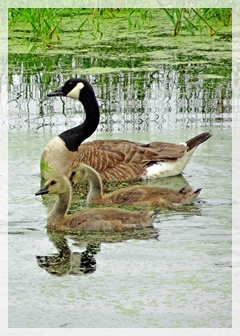 I recently happened upon a YouTube video about a goose and two police officers. A mother goose kept pecking at the window of a parked Cincinnati police car. When the officer opened the door, the goose led him over to one of her babies; it was tangled up in a string tied to a balloon. Concerned that mama goose would attack if he came close to the baby, the first officer stayed back. His partner was a woman and a mother; seeing the anguish of another mother, she went forward and carefully untangled the little gosling while its mama patiently watched and waited. Once free of the twine, the baby rejoined its siblings and the family swam off with their mother.
 I have a friend who worries. Her husband says that even when she has nothing about which to worry, she worries about whatever next could go wrong long before it possibly can. He added that having a “designated worrier” has made his life much easier—while she worries, he can relax and enjoy himself! His comment made me remember a trip we took to the Cayman Islands nearly forty years ago. We were accompanied by a worrying friend.
 An interview with God would appear to be a journalist’s dream opportunity! As I started thinking of questions, I realized I wouldn’t want to know the answers for many. I don’t want to know when or how I’ll die and I certainly wouldn’t want to be privy to that information about anyone else. I wouldn’t want to know exactly what will become of friends who don’t believe or who will go where at judgment. A friend said he might ask how he was doing but, fully aware of his failings, realized he probably wouldn’t want to hear God’s answer. Some friends in Chicago might want to ask Him about the Cubs but, unless they were gamblers, knowing the answer would be a season spoiler. There is much that God could tell me that I wouldn’t want to know because I could never live with the weight of His answers.

