
 Remember the Sabbath day, to keep it holy. Six days you shall labor, and do all your work, but the seventh day is a Sabbath to the Lord your God. On it you shall not do any work, you, or your son, or your daughter, your male servant, or your female servant, or your livestock, or the sojourner who is within your gates. [Exodus 20:8-10 (ESV)]
I’ve always thought of the first four commandments (only one God, no idols, not taking Lord’s name in vain, and keeping the Sabbath) as being about our relationship with God and the next six (honoring parents and the prohibitions on murder, adultery, stealing, false witness, and coveting) about our relationship with people. The fourth commandment, however, seems to be a bridge between the two sections because it has as much to do with people as it does with God. Reminding us that we have six days in the week for work, it tells us to stop work on the seventh and keep the day “holy.” Rather than a “thou shalt not” law, this commandment is a gift to us from God—it is the gift of rest and rejuvenation!
As happened with many of God’s commands, the Israelites took this simple law and added their own restrictions and interpretations. Wanting a clear definition of work, they categorized 39 kinds of activities considered work and then further defined prohibited activities within each category. What was supposed to be a blessing became an inconvenience! Since His hungry disciples plucked grain on the Sabbath and Jesus had no qualms about healing on the Sabbath, He often came into conflict with the Pharisees about His Sabbath observance (or lack thereof). When criticized, Jesus made it clear that the Sabbath was made for man and should not be an onerous legal requirement. The only Sabbath laws He and the disciples broke were the man-made ones of the Pharisees. Jesus, however, never said to ignore the Sabbath; after all, He was the “Lord of the Sabbath.”
For Jesus and the disciples, Saturday was the Sabbath day and it remains the Jewish day of worship and rest today. The mostly Jewish early church continued to worship on Saturday but, by the second century, Sunday (“the Lord’s Day”) became the day of worship. Some branches of Christianity continue to observe Saturday as their Sabbath but, for most of us, Sunday is our “Sabbath.”
In reality, other than possibly attending church, Sundays are pretty much like any other day of the week. Parking lots are full at the grocery, hardware, and mall; cell phones and the internet keep us in touch with work; and the kids have sports and homework. Sundays have become the day to complete everything that didn’t get done during the week. With families scattered every which way, even the traditional Sunday dinner (complete with cousins and grandparents at the table) is but a distant memory. Regardless of which day of the week it is, have we missed some of the beauty of a Sabbath in our busyness?
Does keeping this day “holy” mean sitting quietly all day, reading nothing but Scripture, and doing nothing but praying? Could it be something more? Could keeping it holy simply mean that we rest from our ordinary work, dedicate the day to God, and intentionally make it different from the rest of our week? We can do that by taking something away (as did the Israelites with their many work prohibitions) or by adding something special to it.
Instead of my husband catching up on paperwork or me writing on Sundays, we try to trust God for enough hours in the other six days to do those things. In an attempt to disconnect from the busyness of the world and connect with one another, family, friends, and God, we try to deliberately set aside time for relaxation, laughter, fun, and fellowship by doing something out of the ordinary. That may be a bags tourney with neighbors, a barbecue for friends, or spending the afternoon at the zoo or botanical gardens. It also can be as simple as a game of Rummikub or cribbage or moving from the breakfast bar to the dining room table for a special “Sunday dinner.” Nevertheless, good intentions are not enough and, during the pre-holiday rush, we found ourselves “too busy” to stop and enjoy God’s gift and set His day apart. Perhaps, that’s why God made keeping holy the Sabbath a commandment rather than a suggestion!
How we set our Sabbath apart from the rest of the week in a way that both honors God and nurtures us will vary from family to family. It’s probably naïve to think children won’t have homework and working moms and dads won’t have to play catch-up with chores. Nevertheless, we must remember why God gave us this commandment. He wants us to recharge our batteries—to be still and know that He is God. The Sabbath is our time to rest from the week’s busyness, take a break from our daily routine, connect with one another, find joy in His creation, and rest in Him. When we neglect having a Sabbath, we neglect both God and ourselves and turn whatever it is we do the rest of the week into tedium and drudgery. God doesn’t need a Sabbath, but we surely do.
Thank you, God, for the gift of the Sabbath. May our Sabbaths be days of worship, renewal, connection, rest, peace, and joy.
A world without a Sabbath would be like a man without a smile, like a summer without flowers, and like a homestead without a garden. It is the joyous day of the whole week. [Henry Ward Beecher]
 Every year a friend sends me a bayberry candle to burn on New Year’s Eve. Legend has it that lighting a bayberry candle when the first star appears, burning it past midnight into the new year, and letting it burn all the way down will bring good luck, wealth, and prosperity to a home. We can’t stay awake past midnight and allowing an unattended candle to burn down to its socket seems more a guarantee of fire and disaster than good luck. Nevertheless, in honor of our friend, we light our candle every New Year’s Eve and extinguish it shortly after the new year begins in Greenland (three time zones east).
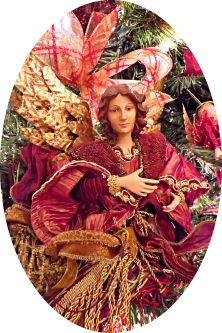 Angels taking on bodily form and appearing to people certainly wasn’t an everyday occurrence. Although they are God’s messengers, the message angels bring can be good news or bad. While they may help God’s people as they did for Elijah and Daniel, angels also execute God’s judgment as they did when striking down the firstborn males in Egypt. I suspect Gabriel looked fiercer and more powerful than the elegant sweet angels hanging on our Christmas trees. When he arrived unannounced in the empty Temple sanctuary, Zechariah was overwhelmed with fear and, when he suddenly appeared in an empty room in Nazareth, Mary was troubled and perplexed. Not knowing whether he was on a mission of judgment or mercy, it’s no wonder both Zechariah and Mary were fearful. Gabriel began his visits by telling them both not to be afraid.
 Back in the days before coronary artery bypass surgery and angioplasty, my father had heart disease and often suffered from the burning chest pain of angina. When that occurred, he would stop briefly, place a nitroglycerin tablet under his tongue, and his pain would ease. Medical nitroglycerin acts as a vasodilator by dilating or expanding the blood vessels so the heart doesn’t have to work as hard to pump blood through those vessels.
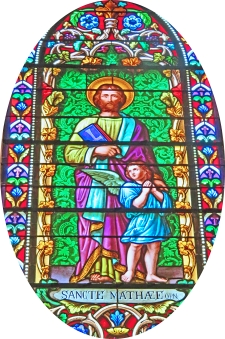 Proof of the truth is no substitute for our faith; nevertheless, it is important to know the truth of what we believe. At some point, we will ask ourselves how we can believe the validity of what we’re reading in our Bibles. Fortunately, we have Christian apologists to help us see its truth. Rather than offering apologies for the wrongs committed by evil people in the name of Jesus, apologists share the objective reasons and evidence that Christianity is true and should be believed. The Apostle Paul was probably the first apologist when he showed that Jesus’ fulfillment of Scripture’s prophecies proved He was the Messiah. Paul knew that the truth could stand up to scrutiny and it still does today. As for those prophecies: by conservative estimate, Jesus fulfilled at least 300 prophecies while on earth.
 Devotions of the Heart