
You yourselves know how plainly I told you, “I am not the Messiah. I am only here to prepare the way for him.” It is the bridegroom who marries the bride, and the bridegroom’s friend is simply glad to stand with him and hear his vows. Therefore, I am filled with joy at his success. He must become greater and greater, and I must become less and less. [John 3:28-29 (NLT)]
 That Jesus chose Cana for His first public miracle and turned water into wine may not be as random as it first seems. By providing wine for the wedding, Jesus took on the bridegroom’s role which foreshadowed things to come.
John the Baptist described Jesus as a bridegroom and himself as the groom’s friend, much like today’s “best man.” In Jesus’ day, the groom’s best friend might have served as master of the banquet. The master of the banquet, however, knew he wasn’t the one hosting the party and the celebration wasn’t about him. By calling Jesus the bridegroom, John accepted his secondary role.
The bridegroom imagery continued when Jesus explained why his disciples didn’t fast. Fasting was for a time of mourning but weddings were a time to rejoice and Jesus compared his relationship with the disciples to that of a bridegroom and his guests. It would be inappropriate for the groom’s guests to fast during the celebration while the groom still was present. The time for fasting would be when He no longer was with them.
At another time, Jesus likened His followers to bridesmaids who were waiting with lamps for the groom to come and collect his bride. Some weren’t prepared with enough oil and, since the groom was a long time coming, their lamps went out. Without the light, they couldn’t accompany the wedding party back to the groom’s house for the celebration. This parable warned Jesus’ followers to be prepared for His return.
We find a bridegroom again when Jesus compared the Kingdom of Heaven to a wedding feast given by a king for his son. Two invitations were sent to such a celebration: the first asking them to attend and the second telling them it was ready. When the guests who initially accepted the king’s invitation refused to come, he sent out a third invitation but the people refused and his messenger was killed. With his invitation rejected, the king extended his invitation to everyone.
In Ephesians, we find Paul continuing the metaphor when he says the way a man and his wife are united is “an illustration of the way Christ and the church are one.”[5:31-32] It comes full circle in Revelation when Jesus, the Lamb of God, is called the bridegroom and His church the bride.
Let us not be like the guests who reject the King’s invitation or the foolish bridesmaids who weren’t ready for the bridegroom’s arrival. We want to join in the celebration. We are, after all, the bride of Christ!

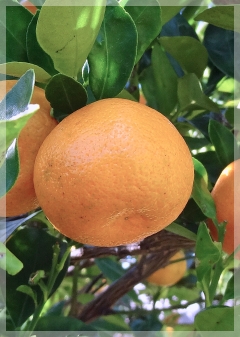 “What’s your orange?” the teacher asked her remote learning class. Before having them answer, she explained the “monkey trap.” In Southeast Asia, hunters capture monkeys by drilling a hole in a pumpkin. The hole is just large enough for a monkey’s hand but too small for his fist. They secure the pumpkin to a tree, put a piece of sweet juicy orange inside the gourd, then retreat and wait. Eventually, an unsuspecting monkey comes along, smells the orange, and reaches through that small hole into the pumpkin. Once he’s grabbed hold of the orange, however, his fist can’t get back through the same hole. The monkey pulls and pulls but can’t free his hand. While he’s struggling to pull out his orange-filled fist, hunters easily throw a net over him. Not understanding that he can’t have both his freedom and the orange, he loses them both. After telling this story, the teacher again asked her students, “What is your orange? What is it you can’t release?”
 Back in 1963, Bob Luman sang “You can take the boy from the country, But you can’t take the country from the boy.” Along the same line, Brookes & Dunn sang that while you could take the girl out of the honkey-tonk, you couldn’t take the honkey-tonk out of the girl. I wonder if Moses thought about singing, “You can take the people out of Egypt, but you can’t take Egypt out of the people!”
 Yet God has made everything beautiful for its own time. He has planted eternity in the human heart, but even so, people cannot see the whole scope of God’s work from beginning to end. [Ecclesiastes 3:11 NLT
