
BEWARE THE YEAST

purple prairie clover“Watch out!” Jesus warned them. “Beware of the yeast of the Pharisees and Sadducees.” [Matthew 16:6 (NLT)]

In Biblical days, rather than using a packet of Fleishman’s yeast for leavening, people kneaded a small amount of old fermented dough called a starter or seor into fresh dough. When a yeast starter gets contaminated by bacteria, however, it gets a moldy odor of decay and, if mixed into new dough, its foulness will spread; the resulting bread will be unpleasant and inedible.

We’re all familiar with Jesus’ warning to the disciples to beware the yeast of the Pharisees. They weren’t bakers so what was their yeast? I’d always thought of it as the Pharisees’ hypocrisy and false teachings. And, while both of those can spread and spoil like bad leavening, I think there’s more to his caution.

The Pharisees and Sadducees, disregarding all of Jesus’ previous miracles, had demanded an impressive miraculous display from Him. Jesus wasn’t an entertainer and His miracles were never for show. Knowing nothing would convince the religious leaders, He refused and left. Shortly after that, Jesus and the disciples departed to the other side of the lake. It was when the disciples realized they’d failed to bring provisions that Jesus first warned them about the yeast of the Pharisees. Thinking He was talking about bread, they then started arguing with one another about not having anything to eat. Imagine their conversation as they pointed accusing fingers at one another for having no food—each man trying to shift the blame for the oversight to someone else. Totally misunderstanding Jesus’ warning, they were bickering about bread and worrying about their next meal when Jesus had just fed thousands with only a few loaves and fish. Our Lord was probably rolling His eyes at their blind foolishness. Like the Pharisees, what part of His many miracles didn’t they understand? Twice they’d ended up with several baskets of leftovers after feeding a multitude; certainly lack of bread shouldn’t pose a problem for just twelve men. Reminding them of His previous miracles of provision, Jesus told them He wasn’t speaking of bread. When He again told them to beware of the yeast of the Pharisees, they finally understood He was speaking of their unbelief.

Although Jesus warned them of this very thing before they’d started to argue, like the Pharisees, they ignored what they knew of Him and His miracles. Instead of allowing their belief to grow into trust, they allowed doubt to taint their faith and their relationship with one another in the same way that bad yeast contaminates bread. A little bit of uncertainty and skepticism swelled into fear, anger, and criticism. They were squabbling about bread for supper when they had the bread of life right beside them.

We all must beware the yeast of the Pharisees: not just false teaching and hypocrisy but also lack of trust!

Faith is not belief without proof, but trust without reservation. [D. Elton Trueblood]

Jesus replied, “I am the bread of life. Whoever comes to me will never be hungry again. Whoever believes in me will never be thirsty. But you haven’t believed in me even though you have seen me. [John 6:35-36 (NLT)]

Copyright ©2018 jsjdevotions. All rights reserved.

STORMS (Mark 5:1-18 – Part 1)

But if I am casting our demons by the Spirit of God, then the Kingdom of God has arrived among you. For who is powerful enough to enter the house of a strong man like Satan and plunder his goods? Only someone even stronger—someone who could tie him up and then plunder his house. [Matthew 12:28 (NLT)]

lake lpouise - canadaMark and Luke tell of Jesus and the disciples crossing the Sea of Galilee to the region of the Gerasenes where they encountered a demon-possessed man. He’d been banished to live in the tombs and was so violent and strong that even shackles couldn’t restrain him. The demoniac would cut himself with sharp stones and his shrieks could be heard night and day. When Jesus restored the man, He sent the demons into a herd of swine that plunged down the steep hillside and drowned in the lake.

Just before arriving in the Gerasenes, Jesus and the disciples had departed Capernaum in clear weather to sail across the Sea of Galilee. We know Jesus wanted to get away from the crowd, but why sail to the Gerasenes? Jesus never seemed to do anything by chance and going five miles across the lake to a predominately Gentile region (one where pigs grazed) seems an odd choice for Jewish rabbi. But this is the rabbi who told of the Good Shepherd—the shepherd who leaves the ninety-nine to save the one lost sheep. Perhaps this trip across the lake to the Gerasenes was a shepherd’s journey to save one of his flock. When Jesus set foot in that boat in Capernaum, I think He knew exactly where He was going, what He would find there, and what He would do about it.

It seems that Jesus deliberately set out for a confrontation with the enemy and Satan did his best to deter Him. Was that squall just another unexpected violent Galilean storm or were those twenty foot waves Satan’s attempt to prevent Jesus from getting to shore and saving the lost soul waiting there? Our good shepherd will go to great lengths to save His children and not even a hurricane can stop Him! Calming the storm revealed Jesus’s divinity and His power over nature but I think it also revealed His power over the spiritual realm. The confrontation between good and evil started in a storm on the lake, long before Jesus set foot on land and sent those demons into the swine.

As Jesus was departing, the healed man begged to go with Him. Jesus, however, told him to go home to his family and tell everyone all that the Lord had done for him. That nameless once demon-possessed man became the first Gentile missionary. Throughout the Decapolis, an alliance of ten cities southeast of the Sea of Galilee, he proclaimed “the great things Jesus had done for him; and everyone was amazed at what he told them.” [Mark 5:20] Just as he did 2,000 years ago, the enemy loves to send storms our way to discourage us from doing God’s work. Satan, however, is no match for Jesus. Our Lord wouldn’t let a storm deter Him and neither should we!

What shall we say about such wonderful things as these? If God is for us, who can ever be against us? … No power in the sky above or in the earth below—indeed, nothing in al creation will ever be able to separate us from the love of God that is revealed in Christ Jesus our Lord. [Romans 8:31,39 (NLT)]

Copyright ©2018 jsjdevotions. All rights reserved.


SENIOR MOMENTS

plumaria - frangiapaniBut that is the time to be careful! Beware that in your plenty you do not forget the Lord your God and disobey his commands, regulations, and decrees that I am giving you today. [Deuteronomy 8:11 (NLT)]

But the people soon forgot about the Lord their God, so he handed them over to Sisera, the commander of Hazor’s army, and also to the Philistines and to the king of Moab, who fought against them. [1 Samuel 12:9 (NT)]

“Are you looking for something?” asked Earl in Brian Crane’s Pickles comic strip. When his wife, Opal, replied, “My glasses,” he suggested looking in her purse. “No,” she said, “I can’t find it. That’s why I’m looking for my glasses, so I can find my purse. I’m hoping that’s where I left my car keys.” Looking down at his grandson, Earl explained, “That’s why it’s a good thing women Gramma’s age don’t have babies.”

Being around Opal’s age, and having had more than my share of “senior moments,” I understand perfectly. Forgetting the Lord, however, is not like misplacing keys, forgetting where the car is parked, or failing to remember the grocery list. It’s way more than absentmindedness, an appointment slipping one’s mind, or drawing a blank at someone’s name.

Forgetting the Lord is a conscious choice to turn our backs to Him and overlook His presence in all things. It is failing to remember His past mercies and how much He loves each and every one of us. It is disregarding His commands and ignoring our responsibilities both to Him and to our fellow man. When we forget God, we rebel, grow impatient, act rashly or imprudently, or begin to think we are self-sufficient and all-powerful. As the Israelites discovered, forgetting God can have serious, even tragic, consequences. Throughout Deuteronomy, Moses warned them not to forget the Lord and yet, from Joshua through Malachi, we continually read of their unfaithfulness, God’s anger, and the consequences of their deliberate amnesia.

As happened with the Israelites, it’s easy to let challenges overwhelm us, wealth and power deceive us, busyness distract us, temptation mislead us, disappointment frustrate us, grief blind us, impatience goad us, and complaint to harden us. Before we know it, we’ve forgotten the Lord. Moses’s many warnings to the Israelites apply to us today. God accepts senior moments—but He will never tolerate our forgetting Him. God never forgot the Israelites and He will never forget us. Why do we find it so easy to forget Him?

God is mindful of man, and it grieves Him that man is not mindful of Him. [Charles Spurgeon]

Pay attention, O Jacob, for you are my servant, O Israel. I, the Lord, made you, and I will not forget you. [Isaiah 44:21 (NLT)]

Let all that I am praise the Lord; may I never forget the good things he does for me. [Psalm 103:2 (NLT)]

Copyright ©2018 jsjdevotions. All rights reserved.

CARE FOR THE LAMBS

And anyone who welcomes a little child like this on my behalf is welcoming me. But if you cause one of these little ones who trusts in me to fall into sin, it would be better for you to have a large millstone tied around your neck and be drowned in the depths of the sea. [Matthew 18:5-6 (NLT)]

tiger swallowtailEarlier this week, the news broke that church leaders in six Pennsylvania Roman Catholic dioceses have protected more than 300 “predator priests.” More concerned with protecting the church and abusers than helping the more than 1,000 victims or preventing further abuse, they failed to report allegations, discouraged victims from reporting abusers, conducted their own biased and faulty inquiries, pressured law enforcement to delay or close investigations, and spun their own versions of the events. Earlier this summer, the Archdiocese of St. Paul and Minneapolis agreed to a $210 million settlement to 450 victims of clergy sexual abuse there. It’s not just the Roman Catholic Church that has failed in this arena. It was just revealed that Willow Creek, a non-denominational Protestant mega-church, paid $3.25 million to settle two lawsuits over sex abuse by a church volunteer. No amount of money, however, can remove the trauma of abuse.
This is neither a Catholic nor a Protestant problem; it is everyone’s problem and it certainly is not limited to churches. We’ve seen institution after institution put reputation before serving and protecting our children. A growing number of Olympic athletes have joined the U.S. women’s gymnastics team in allegations of sexual abuse in their sports. The Chicago Tribune recently reported that the Chicago Public Schools failed to protect their students from sexual abuse and assault. Among other things, ineffective background checks didn’t protect the children from offenders and abuse was not reported. Dozens of lawsuits have been filed against the Boy Scouts over sex abuse and they’ve paid out millions of dollars in settlements. Recently, I watched the news in horror as eleven malnourished children (and the remains of a twelfth) were discovered in a New Mexico compound. Earlier this year, a 17-year old escaped from her house of horrors to make the 911 call that rescued her twelve shackled and severely malnourished siblings from their California home. Sadly, these are but a few of the sickening tales of child abuse we find in the news.

If we ever questioned that we live in a fallen world, these horrifying examples leave us no doubt. Child abuse in any form is the work of Satan: the one who came to “steal and kill and destroy.” He is destroying our young people when he steals their innocence, their physical health, their emotional well-being or takes their lives. Made in God’s image, children are not meant to be used and abused; they are meant to be nurtured and loved.

Whether or not we know those who’ve been hurt and abused, they all are our children and this is our problem. As Christ’s body on earth, we must open our eyes to the children around us and never be silent bystanders. As His body, we can’t stand idly by when abuse of any kind is suspected and the church must never hide the ugly truth even when it occurs within our walls. Abuse can’t be swept under the rug nor can we send offenders off to another parish, school, gym, or scout troop with little more than a rap on the knuckles. Moreover, untrained in forensic interview techniques, we are not the ones to conduct internal investigations. Neither judge nor jury, it’s not our job to determine the validity of an accusation; abuse is both a sin and a crime and our job is to report suspected crimes! We have a God-ordained responsibility to protect and preserve all children (not just the ones in our homes).

We all are called to be shepherds. Father in Heaven, show us how to protect your lambs.

Care for the flock that God has entrusted to you. Watch over it willingly, not grudgingly—not for what you will get out of it, but because you are eager to serve God. [1 Peter 5:2 (NLT)]

Copyright ©2018 jsjdevotions. All rights reserved.

SACRIFICED TO THE GODS

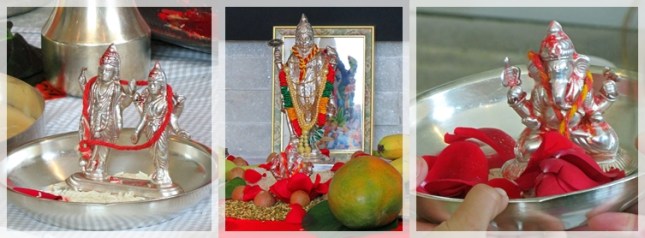
hindu pujaSo then, about eating food sacrificed to idols: We know that “An idol is nothing at all in the world” and that “There is no God but one.” For even if there are so-called gods, whether in heaven or on earth (as indeed there are many “gods” and many “lords”), yet for us there is but one God, the Father, from whom all things came and for whom we live; and there is but one Lord, Jesus Christ, through whom all things through whom we live. [1 Corinthians 8:4-6 (NIV)]

If the multiple gods of Hinduism could be explained in one sentence it is the belief in one supreme being, Krishna, who has appointed many demi-gods with various powers and abilities. I mention this because one of my sons is married to a lovely woman whose heritage is Indian/Hindu. While he and his wife practice neither Christianity nor Hinduism, they try to honor the traditions of both sets of their more religious parents. Saturday, we attended a puja (ritual) to bless their new home. An altar had been placed in front of the fireplace and on it were several statues of Hindu gods and a tray with items like mango leaves, ghee, coconuts, and money. Red threads were tied around wrists and red tilaks applied to the participants’ foreheads, prayers and mantras were chanted in Sanskrit, and Ganesh, Vishnu, and Lakshmi were among the several deities honored. During the puja, things like water, rose petals, milk, uncooked rice, nuts, wheat, fruits, and assorted sweets were offered to all the idols.

My husband and I (as the only two practicing Christians out of thirty in attendance) did not participate in the puja and quietly sat in the back as observers. The ceremony ended with the distribution of prasadam: the remains of the food offerings. When we were handed plates with an assortment of nuts and dried fruits, a beautiful mixture of mango and other fresh fruit, a scoop of cooked wheat, and sweet kaju pista rolls made of cashew and pistachio flour, I began to understand the controversy faced by the early church over food offered to pagan gods. Knowing this was food had been offered to several idols, “What,” I wondered, “would the Apostle Paul say?”

Idols are inanimate and powerless to change food in any way; while they can corrupt hearts, they can’t corrupt food. We weren’t in danger of corrupted hearts and the puja hadn’t tainted the food. Moreover, as ignorant of our faith as we are of theirs, my daughter-in-law’s family wouldn’t judge us as hypocrites for eating the food but they would judge Christianity harshly if we were judgmental or inconsiderate and failed to be respectful of their traditions. This was not the time to evangelize, discuss the first and second commandments, or refuse food offered to us in love. The Apostle Paul wrote of sacrificial meat, eating in pagan temples, not endangering the faith of new Christians, and the relationship between Jews and Gentiles but this seemed to be one of those situations neither clearly addressed nor expressly prohibited in Scripture. It was time to let our consciences guide us.

Christians must accept that people will have different beliefs. We don’t have to accept those beliefs but we must respect their right to have them. Don’t misunderstand; while I joined my extended Hindu family in wishing peace, prosperity, and serenity for my son’s family in their new home, as fascinating as the puja was, I found it distasteful and disturbing. Nevertheless, knowing that we were not endorsing Hinduism or idolatry, we graciously accepted our plates of food.

Were we right? I don’t know. I do know that we let love guide us as we, like many others in today’s multi-cultural world, tried to navigate through a gray area to find a way to honor both God and family.

Tolerance isn’t about not having beliefs. It’s about how your beliefs lead you to treat people who disagree with you. [Tim Keller]

For the Kingdom of God is not a matter of what we eat or drink, but of living a life of goodness and peace and joy in the Holy Spirit. If you serve Christ with this attitude, you will please God, and others will approve of you, too. [Romans 14:17-18 (NLT)]

Copyright ©2018 jsjdevotions. All rights reserved.

UP IN FLAMES

In the same way, the tongue is a small thing that makes grand speeches. But a tiny spark can set a great forest on fire. And the tongue is a flame of fire. It is a whole world of wickedness, corrupting your entire body. It can set your whole life on fire, for it is set on fire by hell itself. [James 3:5-6 (NLT)]

great blue heronRecently, a pastor shared a troubling experience while at the annual conference for his denomination. Along with other ordained ministers, he was to vote as to whether or not candidates for the ministry would be ordained. While usually a gratifying experience as this ministerial board accepts people into their vocation, on occasion the vote can be heartbreaking. If a candidate receives a negative recommendation from his supervisor, he or she is permitted to offer a defense before the vote is taken. At the last conference, such an instance occurred and, sadly, one individual did not receive an affirmative vote for ordination.

In their deliberations of the ministerial candidates, the board considers qualities of faith including evidence of God’s grace in the candidates’ lives, their ability to communicate the Christian faith, their worthiness of people’s faith and confidence, and their accountability to the church, its standards, authority and discipline. Candidates are expected to take responsibility for their actions and exercise self-control, emotional maturity and social responsibility. Unfortunately, this candidate had responded to an unfavorable assessment by a superior with a social media diatribe and Facebook rant. Foolishly, he took a private evaluation into a public forum and launched an attack; as a result, his several years spent in university, seminary and the ministry went up in flames.

In the days before social media (or as this pastor calls it—“unsocial media”), James wrote of how an untamed tongue can set our world on fire. Nowadays, that applies to untamed fingers flying across a keyboard, as well. The pastor who shared this story of a future turned upside down added that he asks his staff to wait a full twenty-four hours before responding to negative comments and always to lead their response with an expression of appreciation for the other person’s words. He also admitted to not always following his own advice!

It’s not just potential candidates for the ministry, pastors, and their staff who should maintain high standards of holy living in the world—we all are called to do just that. Those in the ministry may lose their careers with untamed tongues, but we all can lose relationships, respect, reputations, and our ability to be effective witnesses for Christ. Simply put, if we can’t control the words we use and the way we use them, it appears that other areas in our lives are equally out of control. But, when we allow the Holy Spirit to control our behavior, we have no need to worry about seeing our hopes and dreams go up in flames.

Understand this, my dear brothers and sisters: You must all be quick to listen, slow to speak, and slow to get angry. Human anger does not produce the righteousness God desires. … If you claim to be religious but don’t control your tongue, you are fooling yourself, and your religion is worthless. [James 1:19-20 (NLT)]

For God has not given us a spirit of fear and timidity, but of power, love and self-discipline. [2 Timothy 1:7 (NLT)]

Copyright ©2018 jsjdevotions. All rights reserved.