IN THE VALLEY

Even though I walk through the darkest valley, I will fear no evil, for you are with me; your rod and your staff, they comfort me. [Psalm 23:4 (NIV)]

How sweet the name of Jesus sounds In a believer’s ear!
It soothes his sorrows, heals his wounds, And drives away his fear. [John Newton]
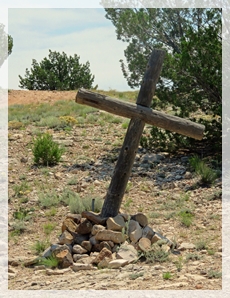
golondrinas penetente NM My mother had been very clear—she was to be cremated and her ashes tossed into our rose garden. I was only fifteen when she died and filled with teen-age indignation when my father interred her ashes in a cemetery plot. Angrily I asked how he could go against her wishes. He simply replied, “Following her wishes is far easier said than done.” What had seemed so easy in theory was, in actuality, far too difficult for the grieving man to do. Burdened by my own grief, I didn’t understand; older and wiser, I do now.

I thought of my father’s reply when a friend mentioned the difficulty of planning her husband’s Celebration of Life Service—she wanted to do one thing but family members insisted on another. A few days later, I overheard two other widows discussing their husbands’ cremains—neither woman felt ready to dispose of them and yet they were being pressured to do so by family members. Grief is hard enough by itself; family dissension only makes it worse.

Each of us grieves in our own way and at our own pace. In his grief and loneliness, my father made some rash and foolish personal choices. I dealt with the loss of my mother in acts of teen-age rebellion and reckless stupidity. A friend reluctantly went off to college just a few weeks after her father died and ended up sitting in her dorm room in tears. Grief-stricken and unready to move on with her life, she flunked out of school. Once done mourning, she returned to school and graduated with honors! While none of us handled our grief well, we all needed to pass through that dark valley the best we could, just as my widowed friends will do in time.

Rather than telling our friends and family what they should do and how to behave in their grief, perhaps we could take a lesson from Abe and Sarah, a long-married couple with whom I attend Bible study. Sitting across the table from me, they’d left an empty chair between them. Jokingly, I asked if they were annoyed with one another. No, they were just leaving a spot for the recently widowed Mary. She and her husband used to sit across from them at Bible study. Not wanting Mary to sit by herself, they now save a place for her between them so she won’t feel alone. That, I thought, is what church family does for one another—they walk together in the dark valley of sorrow.

For those who mourn, that dark valley can seem long, gloomy and desolate. A Christian knows he is never alone in his grief—God is always with him. The Bible, however, is abundantly clear—we are to bear one another’s burdens. When someone is walking in the valley of sorrow, as brothers and sisters in Christ, we are to make their journey easier by offering our love, encouragement and support, and possibly even by saving a chair for them.

Do not mourn the dead, but comfort the living. [Jonathan Lockwood Huie]

Rejoice with those who rejoice; mourn with those who mourn. [Romans 12:15 (NIV)]

 

PUT ON YOUR RED DRESS

Then everyone who believes in him can have eternal life. Yes, God loved the world so much that he gave his only Son, so that everyone who believes in him would not be lost but have eternal life. [John 3:15-16 (ERV)]

Jesus said, “Don’t be troubled. Trust in God, and trust in me. There are many rooms in my Father’s house. I would not tell you this if it were not true. I am going there to prepare a place for you.” [John 14:1-2 (ERV)]

When you hear of my home going… Don’t worry about me. …Hey… I’m just another soldier, going home to be with the Lord. [Gospel hymn – author unknown]

While chatting with a friend, I mentioned how my little black dress has served so well at visitations and funerals. “Well, you better not wear that at my funeral,” she protested. “You better wear a bright red dress; I want a celebration!”

cardinal - CSS2592web“I’ve got a home in gloryland that outshines the sun,” goes the old familiar gospel song. If we believe that, why are we so somber when a believer passes away? Why the long faces? Of course, we mourn the loss of a loved one—their death leaves a void in our lives. I’m not trying to minimize the loss of life or diminish anyone’s sorrow. Life here on earth, however, is just the prelude to an eternal life with God. Rather than focusing on our grief, we need to celebrate the life our loved one lived and rejoice at the beginning of his or her new life. Although we’ve lost a friend or family member, Heaven has gained a new resident. The angels won’t be draping black crepe on the clouds when someone new arrives. They’ll be posting “welcome home” signs and hanging colorful streamers and balloons to celebrate another resident. Picture St. Peter busily painting a new number on the population sign at the Pearly Gates. As beautiful as God made earth, imagine how magnificent heaven will be. Moreover, it will feel more like home than any house in which we ever lived.

I imagine few in my circle, with the exception of my friend, would understand if I attended wakes and funerals in a brightly colored dress, so I will continue wearing the same black one. But, when our time is over here on earth, my friend and I have specific instructions—no dirges, just joyful songs of homegoing and no weeping or somber faces, just tears of joy and a little laughter. Ladies, when it’s time for me to go home, get out your red dresses and have the men come in their favorite aloha shirts!

Some day you will read in the papers that D.L. Moody of East Northfield, is dead. Don’t you believe a word of it! At that moment I shall be more alive than I am now; I shall have gone up higher, that is all, out of this old clay tenement into a house that is immortal- a body that death cannot touch, that sin cannot taint; a body fashioned like unto His glorious body. [D.L. Moody]

We know that our body—the tent we live in here on earth—will be destroyed. But when that happens, God will have a home for us to live in. It will not be the kind of home people build here. It will be a home in heaven that will continue forever. [2 Corinthians 5:1-2 (ERV)]


QUESTIONABLE CHOICES

Today I have given you a choice between life and death, success and disaster. … Today I am giving you a choice of two ways. And I ask heaven and earth to be witnesses of your choice. You can choose life or death. The first choice will bring a blessing. The other choice will bring a curse. So choose life! [Deuteronomy 30:15,19 (ERV)]

There is a way that people think is right, but it leads only to death. [Proverbs 14:12 (ERV)]

wrong way -9773web
Perhaps you’ve seen the television ad that shows a woman who, after taking a taste test, discovers that the spaghetti sauce she’s been purchasing for years isn’t the best one. “I wonder what other questionable choices I’ve made?” she asks as the viewer sees a flashback to her dreadful hairstyles from the past. Having recently gone through our photo albums, I can attest to making several appalling choices in the way of hair, fashion and make-up. Fortunately, my worst choices were never captured on film. Unfortunately, those choices were far worse than the wrong pasta sauce, a frizzy perm, white eye shadow, or a plaid blazer so loud it required ear plugs.

Questionable choices—we all have made them and I suspect we all would rather not make any more of them. Yet, somehow we still do. It’s been said that “ego” is simply an acronym for the phrase “Edging God Out” and I’d have to agree. When we let our egos rule, we’re really telling God that we know better than He does. When egos rule, questionable choices often result. Looking back at my poor choices, I realize they all have something in common: the lack of prayer. Those faulty choices were the result of me trying to edge God out: I was sure I knew what I wanted or needed and how to go about doing or getting it. I was positive I didn’t need any advice, help or guidance from God in my decisions. How mistaken I was!

Fortunately, God is forgiving, generous and caring and my poorest choices, while leaving me a bit battered and scarred, didn’t leave me permanently maimed. Jesus never left my side and the Holy Spirit kept whispering in my ear until I finally understood that God knows best. My questionable choices in fashion may well continue but, if I allow God to lead me, my other (far more important) choices will unquestionably be good ones.

We must make the choices that enable us to fulfill the deepest capacities of our real selves. [Thomas Merton]

Do any of you need wisdom? Ask God for it. He is generous and enjoys giving to everyone. So he will give you wisdom. [James 1:5 (ERV)]

This is my prayer for you: that your love will grow more and more; that you will have knowledge and understanding with your love; that you will see the difference between what is important and what is not and choose what is important; that you will be pure and blameless for the coming of Christ; that your life will be full of the many good works that are produced by Jesus Christ to bring glory and praise to God. [Ephesians 1:9-11 (ERV)]

ON A NEED TO KNOW BASIS

I also saw something else here on earth: The fastest runner does not always win the race, the strongest soldier does not always win the battle, the wisest does not always have food, the smartest does not always become wealthy, and the talented one does not always receive praise. Time and chance happen to everyone. [Ecclesiastes 9:11 (NCV)]

purple coneflower - MHSP087webSometimes, in the hope of protecting the integrity of secret or sensitive information, access to information is limited to a “need to know” basis. Of course, WikiLeaks and a variety of journalists have proven that there’s little that is ever truly confidential. The HIPA Act and all of those forms we sign when visiting a doctor are supposed to keep our medical information private and on a “need to know” basis. Having just learned that my medical insurance records have been hacked, it seems that a “need to know” status isn’t much of a safeguard to one’s privacy. In spite of all sorts of precautions, hackers, whistle blowers, and informants manage to access and leak information whether we need to know it or not!

There are times we think God is keeping certain information from us that we have a need to know. We want to know the answers to “Why?” Why did he get Alzheimer’s? Why did she go into a coma? Why did this child get leukemia? Why does my child have Down’s syndrome? Why the tornado? Why didn’t the driver stop? Why can’t I have children? Why was he at the wrong place at the wrong time? Why is her child in the gifted class when mine struggles to keep up? Why didn’t she listen? Why did he kill himself? Why is there so much hate and hurt? Why did so many die in such a senseless act of terrorism? Why couldn’t you save them? Why do bad things happen to good people? Why?

I freely admit that any sermons I’ve heard that tried to answer those questions failed miserably; they left me dissatisfied and empty. The short answer, of course, is readily available in Genesis: bad things happen because man sinned. That answer, however, is anything but satisfactory. The only sermons that ever made sense were the ones conceding that, while we’re in this world, there never will be an acceptable explanation for why bad things happen.

The answers to the cries of “Why?” are on a “need to know” basis. We’ll only know the facts we need to know at the time we need to know them. If we truly needed to know, God would tell us; but we don’t, so He won’t. It’s in God’s job description to know the answers to those questions; it’s not in ours. Our job description simply requires us to trust in Him and in His plan. It appears that the angels are all rather content with their positions so we shouldn’t count on them leaking any privileged information our way. We just have to accept that when, and if, we ever need to know why, God will supply a satisfactory answer. We don’t need to know why; we just need to know Him!

You are only human, and human beings have no right to question God. An object should not ask the person who made it, “Why did you make me like this?” The potter can make anything he wants to make. He can use the same clay to make one thing for special use and another thing for daily use. [Romans 9:20-21 (NCV)]

We know that in everything God works for the good of those who love him. [Romans 8:28a (NCV)]

NO AMNESTY

Have mercy on me, O God, because of your unfailing love. Because of your great compassion, blot out the stain of my sins. Wash me clean from my guilt. Purify me from my sin. For I recognize my rebellion; it haunts me day and night. Against you, and you alone, have I sinned; I have done what is evil in your sight. [Psalm 51:1-4 (NLT)]

8-6-15DSC05651web
Tonight, we’ll experience what’s called a “blue moon,” a somewhat rare occurrence of two full moons in the same month. A few years ago the Chicago Public Library had what they called the “Once in a Blue Moon Amnesty” program. For three weeks, any late fees were waived on all overdue material, no matter how late it was. Apparently, many people prefer keeping their books, magazines and DVDs rather than paying steep fines as a consequence for their late return. The amnesty was offered in hope of getting more than two million dollars’ worth of media back on the shelves. It had been twenty years since the city ran a similar program of reprieve. Avoiding the consequences of our actions, like the Chicago Public Library’s amnesty offer, usually only happens “once in a blue moon!”

David was famous: he was a musician and shepherd, a giant killer and celebrated warrior, a great king and the author of most of the psalms. Nevertheless, he was human and David, like the rest of us, fell into sin. Adultery with Bathsheba was just one of them; he also murdered Bathsheba’s husband Uriah by sending him to his certain death. When David finally confessed his transgressions, the prophet Nathan assured him that they were forgiven. Nathan added that God’s forgiveness didn’t mean David wouldn’t suffer the consequences of his sins: his child by Bathsheba, conceived while she was still married to Uriah, would die. David’s confession and apology to God were not enough to eliminate the consequences of his actions; there was no amnesty for him.

Hopefully, when we wrong others, we confess, apologize and try to make amends. Nevertheless, our confession, someone’s forgiveness, and even restitution won’t free us from consequences. We may still lose respect, a job, a friend or even a marriage. Our actions may lead to a punishment as simple as a traffic ticket or as serious as time in prison. A child may be put in “time out,” a teenager might be grounded and a college student could be put on academic probation. We may receive a poor performance review, not be allowed to participate in an activity, be expelled from school or find a relationship irrevocably destroyed. We could lose money, status or even our family. If we choose to sin, we must be prepared for the consequences of that sin. Amnesty is rarely an option.

We ask God to forgive our sins and he does. We must never forget, however, that God’s promise of forgiveness is not like a “Get Out of Jail Free” card in the game of Monopoly. Neither God’s forgiveness nor the forgiveness of those we’ve wronged will exonerate us from the consequences of our actions in this game of life.

The people of Samaria must bear the consequences of their guilt because they rebelled against their God. [Hosea 13:16a (NLT)]

But they encouraged my people to worship idols, causing Israel to fall into deep sin. So I have taken a solemn oath that they must bear the consequences for their sins, says the Sovereign Lord. [Ezekiel 4:12 (NLT)]

And because you have forgotten me and turned your back on me, this is what the Sovereign Lord says: You must bear the consequences of all your lewdness and prostitution. [Ezekiel 23:35 (NLT)]

SHIFTING THE BLAME

“I don’t deserve to be called your son anymore. Make me one of your hired men.” … Then his son said to him, “Father, I’ve sinned against heaven and you. I don’t deserve to be called your son anymore.” [Luke 15:19,21 (GW)]

The man answered, “That woman, the one you gave me, gave me some fruit from the tree, and I ate it.” [Genesis 3:12 (GW)]

DSC01629awebAfter brazenly demanding his inheritance while his father still lived, the prodigal son quickly wasted it all in a reckless and immoral lifestyle. Realizing the error of his ways, the ashamed and penniless youth swallowed his pride and returned to his father, hoping to be hired on as a servant. His story, one of repentance, forgiveness and redemption, is quite a contrast to that of a young woman whose tale is circulating on the Internet. She recently called into a radio show and told of getting a $90,000 college fund from her grandparents. In three years, however, she managed to blow through all of it—not just on tuition but also on clothing, college breaks and a trip to Europe. Now, having no way to pay her $20,000 senior year’s tuition, she called the show to complain—not about her recklessness and spendthrift ways but about her parents. Although any fifth grader knows enough to divide ninety by four and figure out how much money can be spent each year, she blamed her parents for not teaching her to budget; it was their fault she was broke. The young woman showed no remorse for her actions and refused to accept responsibility for her predicament. The prodigal son worked at a pig farm before returning home and was willing to work as his father’s servant. This young woman’s response to getting a job in the school cafeteria was, “That’s embarrassing.”

I wonder, however, if we’re really all that different from this young woman. Hopefully, we haven’t squandered $90,000 but we’ve all blamed others for our errors, difficulties, and even our sins. It wasn’t just Eve that Adam blamed for the apple incident; he blamed God for giving him the woman in the first place. We’re not much better. In an effort to excuse our actions, we shift the blame to our parents’ divorce, our ex-spouse’s greed, bad genes, the credit card company that shouldn’t have increased our credit, the loan officer who allowed us to refinance, the persuasive salesman, our idiot co-workers, the teacher who can’t teach, the woman who shouldn’t have been so seductive, the husband who shouldn’t have been so busy, the spouse who just didn’t understand, a troubled childhood, the bartender who over-served, and the other guy who made us angry or started the fight! We shift the blame to justify our own bad behavior and, if we show any remorse, it’s only because of the mess in which we find ourselves once we have to face the consequences.

With a repentant heart, the prodigal son took responsibility for his actions and was welcomed into his father’s house. Make no mistake about it, if we don’t accept responsibility for our actions with a humble and repentant heart, our story, unlike that of the prodigal son, will not be one of forgiveness and redemption.

When someone is tempted, he shouldn’t say that God is tempting him. God can’t be tempted by evil, and God doesn’t tempt anyone. Everyone is tempted by his own desires as they lure him away and trap him. Then desire becomes pregnant and gives birth to sin. When sin grows up, it gives birth to death. [James 1:13-15 (GW)]

If we say, “We aren’t sinful” we are deceiving ourselves, and the truth is not in us. God is faithful and reliable. If we confess our sins, he forgives them and cleanses us from everything we’ve done wrong. [1 John 1:8-9 (GW)]