
LETTING GO

gulf fritillary - Monarch butterfliesBut blessed is the man who trusts me, God, the woman who sticks with God. They’re like trees replanted in Eden, putting down roots near the rivers — Never a worry through the hottest of summers, never dropping a leaf, Serene and calm through droughts, bearing fresh fruit every season. [Jeremiah 17:7-8 (MSG)]

This morning, in a symbolic gesture of turning my worries over to God, I added a name to the “God box” that sits on my desk. Yesterday, I received a photo of my grand proudly holding a bowl of pasta with the text, “I have yet to set off the fire alarm with my cooking.” As I looked at her beautiful smile, I prayed, “Dear God, please let setting off that smoke alarm be the worst thing that happens to her this year!” She just started her freshman year of college, in a large city, in a foreign country, 5,500 miles from home. I know that drinking and drugs are pervasive on all college campuses and, having been a freshman once upon a time, I know how many foolish mistakes can be made when free from parental supervision. Yet, even if every decision my grand makes is a wise one, I know the statistics: with a more than a 20% chance of being sexually assaulted in her college years, she’s most vulnerable to attack her freshman year. Since the day my son left his daughter at her apartment, my concerns have weighed heavily on my heart. Nevertheless, I know that all the worry in the world can’t protect her from harm. Accepting that all I can do is give my concerns to God, I put her name in my box.

“Let go and let God!” is a favorite phrase in recovery but that doesn’t mean we let the troubles of this world run over us like a steamroller. When there’s a fire, we don’t stand idly by and say, “Let go and let God!” With God’s direction, we reach for a hose and do what is within our control. Letting go and letting God is refusing to worry about fires that haven’t started (and might never start) and recognizing when a fire isn’t ours to extinguish. It is, however, more than putting a name on a slip of paper and placing it in a wooden box. It’s surrendering the outcome we desire and letting God manifest His will for the outcome He wants. It’s releasing our concerns and fears to Him and trusting His plan for the lives of those we love.

I can’t protect my grand from poor decisions or the violence and sorrow that comes from living in a fallen world. But, by putting her name in that box, I’ve acknowledged that my job description as grandmother does not include running the world; I’ve relinquished that role to the One whose job it is! I will continue offering prayers on her behalf but those prayers will no longer be ones of fear, anxiety, or apprehension. They will be ones of faith and trust because I know that God loves her even more than I do.

You find no difficulty in trusting the Lord with the management of the universe and all the outward creation, and can your case be any more complex or difficult than these, that you need to be anxious or troubled about His management of it? [Hannah Whitall Smith]

Don’t fret or worry. Instead of worrying, pray. Let petitions and praises shape your worries into prayers, letting God know your concerns. Before you know it, a sense of God’s wholeness, everything coming together for good, will come and settle you down. It’s wonderful what happens when Christ displaces worry at the center of your life. [Philippians 4:6-7 (MSG)]

Copyright ©2018 jsjdevotions. All rights reserved.

STILLING THE WATERS

Their ships were tossed to the heavens and plunged again to the depths; the sailors cringed in terror. They reeled and staggered like drunkards and were at their wits’ end. “Lord, help!” they cried in their trouble, and he saved them from their distress. [Psalm 107:26-18 (NLT)]

sunset - Naples FLMark, Matthew, and Luke all tell the story of Jesus calming the sea. He and the disciples had started to sail the five miles across the Sea of Galilee when a fierce storm struck. Tired from a day of preaching, Jesus remained asleep in the stern while the storm raged. As the waves broke and the boat began to fill with water, the disciples were sure they would perish. After they woke Jesus by shouting, “Teacher, don’t you care that we’re going to drown?” He rebuked the wind and the storm ended.

Since we’ve probably heard more than one sermon on this story, we know that the presence of Jesus in our boat is no guarantee of a storm-free life and that, even when it seems like God is asleep on the job, He has the situation firmly in hand. But think about the storm and imagine the sounds that night: the howling of the wind, waves smacking the sides of the boat, rain pounding down, sails furiously flapping, the crack of thunder, and men shouting to one another as they tried to lower the sails, bail and row. With all that noise and the boat pitching and heaving as the waves tossed it about, even the soundest sleeper would have difficulty sleeping. Jesus, however, was undisturbed by the commotion and remained asleep. Although the storm couldn’t wake Him, the disciples’ call to Him did! Whether we are shouting over the sound of thunder or whispering to Him beside a loved one’s hospital bed, this story tells us God will hear our call.

My final take-away from this story is not to underestimate the power of Jesus, something I think the disciples did. When they spotted the first black clouds on the horizon, they didn’t wake Jesus and ask Him to send the storm elsewhere. They tried to sail through the storm on their own power. It wasn’t until they feared they were at death’s door that they finally called to Him. Did the men wake Him because they thought He could still the storm or because they needed His help bailing and rowing? In spite of the miracles they’d seen Jesus do, their shock and terror when He stopped the wind and calmed the sea instantly (something that normally took 24 to 48 hours after a storm’s end) makes me think they expected a helping hand rather than a supernatural solution.

I wonder how often we, like the disciples, underestimate God’s power to handle the crises in our lives and wait until we’re desperate before calling to Him. While we may not get a miracle, His power is enough to get us through any storm. Even if He doesn’t calm the waters, He will bring us safely into harbor.

He calmed the storm to a whisper and stilled the waves. What a blessing was that stillness as he brought them safely into harbor! Let them praise the Lord for his great love and for the wonderful things he has done for them. [Psalm 107:29-31 (NLT)]

Copyright ©2018 jsjdevotions. All rights reserved.

LET THE VINEYARDS BE FRUITFUL

We give thanks for the cup of blessing, which is a sharing in the blood of Christ. And the bread that we break is a sharing in the body of Christ. Because there is one loaf of bread, we who are many are one body, because we all share that one loaf. [1 Corinthians 10:16-17 (NCV)]

Let the vineyards be fruitful, Lord,
And fill to the brim our cup of blessing.
Gather a harvest from the seeds that were sown,
That we may be fed with the bread of life.
Gather the hopes and dreams of all;
Unite them with the prayers we offer now.
Grace our table with Your presence, and give us
A foretaste of the feast to come. [John W Arthur]

monarch butterfly - common milkweedWhen the ushers brought the offering plates forward, the congregation rose and sang “Let the Vineyards be Fruitful.” Often used in Lutheran churches as an offertory hymn when the gifts are presented at the altar, its references to vine, bread, and table make it especially appropriate on Communion Sundays.

As I sung those familiar words about fruitful vineyards, seeds and harvest, I was struck by the somewhat incongruous words in the middle of the song: “Gather the hopes and dreams of all; Unite them with the prayers we offer now.” I envisioned the congregation’s hopes, dreams, needs, and concerns piled high on top of the offering envelopes in those plates and realized we were presenting more than our checks and cash; we were offering our petitions for things like healing, reconciliation, peace, guidance, recovery, relief, purpose, increase, wisdom, strength, and restoration. While the particulars differed from person to person, our various hopes and dreams were being gathered, united into one prayer, and given to God. It wasn’t until I re-read the hymn’s words after church that I understood what that prayer asked or that our words referred both to the day’s simple meal of wafer and wine as well as to the eternal feast at Christ’s return. In our unified prayer, we were asking that Jesus grace us with His presence and give us a preview of the magnificent banquet that is yet to come in the Kingdom of God.

I’ve probably sung the words to this simple hymn hundreds (if not thousands) of times but last Sunday, as those words exited my mouth, they also settled into my heart and mind in a new way. I doubt that I will sing it again without picturing the congregation’s assorted prayers spilling over the sides of the collection plates and then melding into one unified prayer for both His presence and the coming of His Kingdom. Just as reading a book of the Bible once (or even several times) doesn’t mean we’ve fully grasped the meaning of the passages, the same goes for the hymns we sing or the liturgy we recite during worship. When Jesus warned us about meaningless repetition or babbling on in our prayers, repetition wasn’t necessarily the problem. After all, both the persistent neighbor and widow in His parables repeated their pleas and He repeated the same prayer three times in Gethsemane. The problem occurs when we repeat our words mindlessly or automatically. Let us always remember that knowing the words by heart doesn’t necessarily mean our hearts know the depth of their meaning.

The Lord All-Powerful will prepare a feast on this mountain for all people. It will be a feast with all the best food and wine, the finest meat and wine. On this mountain God will destroy the veil that covers all nations, the veil that stretches over all peoples; he will destroy death forever. The Lord God will wipe away every tear from every face. He will take away the shame of his people from the earth. The Lord has spoken. [Isaiah 25:6-8 (NCV)]

Copyright ©2018 jsjdevotions. All rights reserved.

THE HACKER

Stay alert! Watch out for your great enemy, the devil. He prowls around like a roaring lion, looking for someone to devour. Stand firm against him, and be strong in your faith. [1 Peter 5:8-9b (NLT)]

red shouldered hawkAfter asking us how we protect our personal safety, the cyber-security specialist asked how we protect ourselves from cyber attacks. One woman proudly told how Microsoft had recently saved her from a hacking attempt. After a message popped up telling her to call them, she gave them remote access to her computer. The necessary patch and technical advice only cost $700 and now her computer was secure. Until the speaker told her, she didn’t know the hack was the $700 she’d spent, access to her credit card, and possible malware now active on her computer. While she never would have allowed a complete stranger into her home, she unwittingly opened the door to a criminal and welcomed him into her life.
Following the seminar, I couldn’t help but think about Satan. Scripture describes him as a serpent, lion, liar, thief, and tempter with adjectives like prowling, cunning and crafty. Those same words describe a hacker rather well. Both Satan and the hacker want to take over our lives and they can do it without our even realizing it’s been done. The weakest link in both cases is the user—us. Outside consultants regularly try to hack into our bank and the good news is that their security software works. Unfortunately, in every test, someone (who clearly knows better) was conned into replying, hyperlinking, or opening an attachment. When Satan comes trolling, how often do we err by ignoring God’s guidelines, not examining the source of the message, going somewhere we shouldn’t, or letting curiosity get the best of us?

Our speaker spoke of maintaining the security of the devices and networks we use. Since new hacking techniques are developed continually, once secured doesn’t mean forever secure; software must be updated to stay current with new threats. Once saved doesn’t mean forever safe, either. We must keep updating our soul’s software with regular prayer, Bible study, and church. Where we use our devices and the sort of data we transmit and receive affects their safety and where we go and what we put into our minds affects our souls. We don’t hang around dangerous neighborhoods but, sometimes, that’s exactly what we do with our computers and phones or our friends and media choices! When the considering the importance of backing up data, I thought of the value of Christian friends who have our backs and both encourage and support us in times of trouble—times when we’re most vulnerable to Satan’s attack.

Two-factor authentication (2FA) was another security feature discussed. Although a website can use 2FA to make sure it is us, we should use 2FA to make sure those great ideas we get have come from God rather than the enemy. A little two-factor authentication in the way of seeing whether those thoughts match up with God’s word and Jesus’s actions could keep us out of a lot of trouble.

Good cyber-security habits include malware protection, virtual private networks, cloud storage, secure routers, password protection, 2FA, and common sense. None of those, however, will protect us if we fail to use them. The same goes for the armor of God. We’ve been given the best protection money can’t buy but God’s armor won’t defend us from the enemy if we don’t put it on!

A final word: Be strong in the Lord and in his mighty power. Put on all of God’s armor so that you will be able to stand firm against all strategies of the devil. For we are not fighting against flesh-and-blood enemies, but against evil rulers and authorities of the unseen world, against mighty powers in this dark world, and against evil spirits in the heavenly places. [Ephesians 6:10-12 (NLT)]

Copyright ©2018 jsjdevotions. All rights reserved.

FULLY AWARE

For I hold you by your right hand—I, the Lord your God. And I say to you, “Don’t be afraid. I am here to help you.” [Isaiah 41:13 (NLT)]

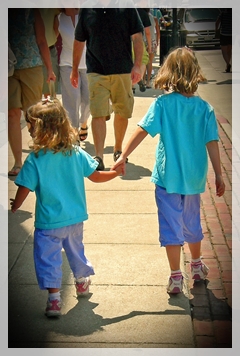
cousinsScientists have found that even a simple hug or the holding of hands can lower both blood pressure and heart rate in stressful situations. Gentle touch also causes a decrease in the stress hormone cortisol and an increase in oxytocin (often called the “cuddling hormone”). Where cortisol might give a “fight or flight” response, oxytocin causes more of a “tend and befriend” one by increasing feelings of trust and connection. Since we were at a funeral and the previous ten days had been a roller coaster of emotion and tension for everyone, the priest’s request to join hands as we stood in prayer benefitted us physically and psychologically as well as spiritually.
While holding hands during prayer wouldn’t be unusual in many evangelical Protestant churches, apparently it is in Roman Catholic ones (especially when done during every prayer) and it has become a point of contention in some dioceses and parishes. Being a rather touchy-feely Protestant, I enjoyed the hand holding and the feeling of solidarity in prayer that came with it. The priest, however, asked us to do more than simply join hands. “Take the hand of the person beside you,” he instructed, “and, fully aware of the soul you are touching, join in prayer.” As I held the hand of the stranger beside me, I thought of those words: “fully aware of the soul you are touching.” I didn’t know the man and will never see him again. From his rosary, I knew we do not attend the same church. Nevertheless, I knew we worshipped the same God and were there for the same reason: to celebrate the life of the man whose body lay in a casket near the altar. As I became more aware of the soul I was touching, my thoughts turned from my own personal sorrow to the sorrow shared by all who were present in the sanctuary. We were one community, united in our thanksgiving for the man we mourned, in our intercessions for his family, in our love for God, and in our belief in the resurrected Christ and the life everlasting.

I appreciate that some people are uncomfortable with the intimacy of holding hands and find doing it during worship an unwelcome innovation. Whether or not we touch one another during prayer is not as important as being fully aware of one another: not just of the people with whom we pray but of all with whom we interact. Fellow travelers through this troubled world, they are struggling as much as we are to navigate the challenges, sorrow, and pain in their paths. Is there some way we can make their journey easier? Sometimes, we find that answer in a simple touch. While we probably won’t bring healing to their bodies, we may bring some healing to their souls.

At the conclusion of the funeral, the deceased’s family followed the casket out of the sanctuary and his sister passed by our pew. My husband stepped into the aisle beside her and they joined hands as they walked out together. Although we hardly know her, fully aware of her mournful soul, he knew her need to be supported during that difficult walk.

Lord, teach us to be fully aware of the souls we encounter each day. Let our words be kind, our actions helpful, and our touch gentle and supportive.

When we honestly ask ourselves which person in our lives means the most to us, we often find that it is those who, instead of giving advice, solutions, or cures, have chosen rather to share our pain and touch our wounds with a warm and tender hand. [Henri Nouwen]

As it happened, Publius’s father was ill with fever and dysentery. Paul went in and prayed for him, and laying his hands on him, he healed him. [Acts 28:8 (NLT)]

Copyright ©2018 jsjdevotions. All rights reserved.

HEARING THE SHEPHERD

I myself will be the shepherd of my sheep, and I will make them lie down, says the Lord God. I will seek the lost, and I will bring back the strayed, and I will bind up the crippled, and I will strengthen the weak, and the fat and the strong I will watch over; I will feed them in justice. [Ezekiel 34:15-16 (RSV)]

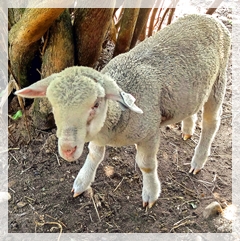
lambThroughout the Bible, there are many references to the Lord as our shepherd and mankind as His sheep. Sheep are not the brightest bulbs in the pasture and, considering the state of the world, it seems a fitting comparison! I came upon a true story that illustrates the need sheep have for a shepherd. In 2005, more than 400 sheep in Turkey died when they followed the lead sheep off a cliff and fell 15 meters. The death toll would have been greater except those first 400 cushioned the fall of the next 1,100 sheep that were stupid enough to follow them! Clearly, that herd of sheep needed someone to tell them when to stop. Unfortunately, mankind seems as willing to blindly follow the lead sheep wherever he leads us, only we call it belonging, accepting, keeping up, staying current, maintaining the status quo, or not rocking the boat, making waves or causing trouble.

I happened upon a cartoon by Mike Waters in which a sun-glassed sheep is relaxing in a lounge chair and wearing ear phones connected to the iPod at his side. The TV is on, a computer rests on his lap, the radio is blaring, and he’s got a copy of Sheep Digest in his hands. Hidden under the stack of magazines at his side is a Bible. In the background, a shepherd is calling. The sheep says, “I wonder why I don’t hear from the shepherd anymore!” The words in the caption beneath the comic are from John 10:27: “My sheep listen to my voice; I know them, and they follow me.” Of course, the sheep need to hear the shepherd to know his voice and nowadays we seem to be listening to everything but our shepherd’s voice (and reading everything but His word)! Worldly distractions, concerns, desires and possessions have drowned out His voice.

In the case of the unfortunate demise of the Turkish sheep, the problem wasn’t that they weren’t listening to the shepherd. The village’s shepherds had briefly abandoned the flock while they enjoyed breakfast. Unlike the Turkish shepherds, our Shepherd never takes a coffee break or goes off duty! He’s more like the shepherd in the cartoon—on the job and calling his flock. Like those suicidal sheep in Turkey, however, we rarely know enough to stop on our own. Fortunately, our Shepherd will step in and lead us. Of course, for that to happen, we have to be listening for His voice.

I am the good shepherd; I know my own and my own know me, as the Father knows me and I know the Father; and I lay down my life for the sheep. … My sheep hear my voice, and I know them, and they follow me; and I give them eternal life, and they shall never perish, and no one shall snatch them out of my hand. [John 10:14-15,27-28 (RSV)]

 Copyright ©2018 jsjdevotions. All rights reserved.