
Carry each other’s burdens; that’s the way to fulfill the Messiah’s law. If you think you’re something when you are not, you deceive yourself. Every one of you should test your own work, and then you will have a reason to boast of yourself, not of somebody else. Each of you, you see, will have to carry your own load. [Galatians 6:2-5 (NTE)]
 These last few days, I’ve been discussing Paul’s instructions both to carry one another’s burdens and to carry our own loads. In between those two directives, we find a warning about the things that can prevent us from doing that: conceit and comparison.
Conceit is thinking we’re better than we are. In carrying another person’s burden, we must never think ourselves too good to help nor should we think ourselves morally or spiritually superior to someone in their weakness and need. Comparison can lead to competition as we try to determine who is the better Christian by carrying his load better! The Lord has given each of us a task and equipped us with a specific set of skills and spiritual gifts to achieve it. The load given us is our responsibility just as the tasks and talents given to others are theirs. Moreover, we must never compare our virtues with other’s imperfections (leading to pride) or our flaws with others’ accomplishments (leading to jealousy). If we’re going to compare ourselves to anyone, it should be to Jesus!
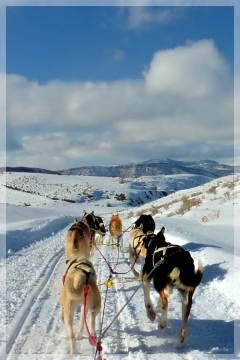
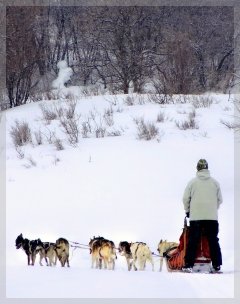
Oddly, this reminds me again of the Alaskan huskies I wrote about on Monday. Like us, each dog on the team has his own strengths (and weaknesses) and is assigned a position and a specific task that fit his attributes. Because they must follow the musher’s commands, set the pace, and keep the gangline taut, the lead dogs are the most intelligent on the team. No less important, however, are the swing dogs behind them. After the lead dogs make a turn, their critical task is to pull the sled in an arc that keeps the other dogs on the trail. They’re responsible for getting the musher and sled safely around curves and corners. Next are the team dogs—the brawn of the team who pull the sled and maintain the speed. Last, but hardly least, are the wheel dogs. Often the largest members of the team, as the first to take on the sled’s weight when starting out or going uphill, they play a crucial role in pulling and steering the sled.
Like us, each dog has a different skill set and position. Nevertheless, regardless of their position, no dog is more important than another and each is essential to the team. Just as the dogs’ responsibility is to the musher, ours is to God. The Apostle Paul tells us to examine ourselves (not others) to make sure we’re doing the work given to us by God. Like the sled dogs, we must be committed to doing our task well without conceit or comparison, Let us faithfully carry our own phortions and always be willing to carry one another’s baros.
 Since we tend to think of burdens as demanding and often unwelcome duties or responsibilities, we’re certainly not anxious to take on a burden, especially one that actually belongs to someone else! Yet, that is exactly what we’re told we must do if we are going to fulfill Christ’s mandate. And what is that command? To love one another in the way God loves us.
 The Synsepalum dulcificum is a West African fruit better known as the “taste berry” or “miracle fruit.” This almost tasteless red berry can make lemons, Dijon mustard, Brussels sprouts, pickles and even vinegar taste sweet. A protein in the berry temporarily binds to the tongue’s taste buds and causes sour or acidic foods to taste sweet. Miracle fruit tablets, powder, freeze-dried berries and plants can be purchased from several websites. Along with suggesting using the berry as a way to get fussy eaters to eat their fruits and vegetables, sellers suggest hosting “flavor-tripping parties” where guests get a berry and a strange buffet of foods like sauerkraut, kimchi, radishes, grapefruit, cheap tequila, goat cheese, vinegar, and Tabasco sauce. Why anyone would want to alter the delicious flavors of kiwi, pineapple, strawberries, Granny Smith apples, grapes, or tomatoes is beyond me and I certainly have no desire to drink pickle juice or Sriracha chili sauce.
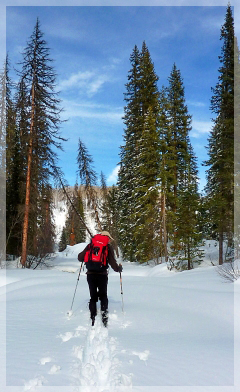 Our pastor recently did a sermon series called “Following Jesus” which reminded me of our first time backcountry skiing in Colorado more than forty years ago. As novices, we knew enough not to venture into the wilderness by ourselves so we hired Wyatt to be our guide. Insisting we delay our trek several days until we’d acclimated to the high altitude and were ready for such a trip, he gave us a long list of items we had to carry in our packs. When I asked why we needed all the survival gear along with additional food, water, and clothing, he said we had to be prepared to spend the night. Protesting that I didn’t want to spend the night out in the cold and snow, he explained, “Neither do I, but we better be prepared to do it.”
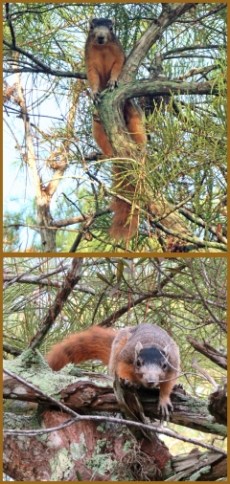 Saturday mornings we usually walk through a nearby park that is home to a unique subspecies of squirrel found here in southwest Florida: the Big Cypress fox squirrel (or BCFS for short). Larger than a common gray squirrel, the BCFS has a black head and back, buff sides and belly, white ears and nose, and a long bushy tail.
 Devotions of the Heart