
And remember, when you are being tempted, do not say, “God is tempting me.” God is never tempted to do wrong, and he never tempts anyone else. Temptation comes from our own desires, which entice us and drag us away. These desires give birth to sinful actions. And when sin is allowed to grow, it gives birth to death. [James 1:13-15 (NLT)]

Super Ghost Orchid (by R.J. Wiley)
Once they start collecting orchids, many seemingly normal people become obsessed with them—something the Victorians called orchidelirium. In spite of the threat of federal and state prosecution, some collectors cannot resist the temptation to possess one of the rare orchids found at Corkscrew Swamp and other Florida parks. Because it’s located 50 feet up on a cypress tree, Corkscrew’s super ghost orchid seems safe from poachers but many of Florida’s exotic orchids are stolen from parks, preserves, and homes every year! This summer, a woman was arrested for stealing $4,000 worth of orchids from homes in a town not far from us. As much as I enjoy flowers, it would take far more than an exotic orchid to make me steal from a neighbor’s yard or trudge through the snake and alligator infested waters of a swamp. But, if not an orchid, what would entice me to do such a thing—to do what I clearly know is wrong?
I thought of the old joke in which a man in a bar asks an attractive woman if she’d have sex with him for a million dollars. After she accepts his offer, He then asks if she’d consider it for ten dollars. “What do you take me for?” she asks indignantly. “My dear,” the man replies, “We’ve already established what you are with your first answer. Now we’re just trying to negotiate the price!” What does it take to tempt any of us to step into sin?
At Corkscrew, the Audubon Society has built a boardwalk to keep visitors where they belong. While it helps protect the park’s flora and fauna, its true purpose is to protect the people from the dangers of the swamp. It is, however, a matter of choice as the whether or not a visitor stays on the trail (and not all of them do). In our daily lives, the Bible tells us how to behave and shows us the way we should go. God’s word isn’t there to keep us from enjoying ourselves—it’s there to keep us on the path of righteousness and protect us from sinking in the swamp of sin. But, just like the orchid hunters, we can choose to succumb to temptation, climb over the railings, and walk where we shouldn’t.
“What would you do for a Klondike bar?” was the question asked in the old commercials for the ice cream treat. Their ad campaign was re-launched last year when actress Anna Faris went undercover as a marketing director. She asked a group of expecting couples if any would sign over the naming rights to their baby for a lifetime supply of Klondike bars. For most of us, it would take more than the promise of a rare orchid or an endless supply of ice cream to succumb to Satan and step off God’s path. Satan, however, is no fool; he knows exactly what would tempt us each and every one of us. The question isn’t what we’d do for a rare flower or a frozen treat, but we better know our answer if we were asked what we’d be willing to do for things like wealth, happiness, beauty, fame, youth, health, security, love, or position.
Satan, like a fisher, baits his hook according to the appetite of the fish. [Thomas Adams]
 So, since God wants us to be prosperous, we’ll get 100 acres of land for every acre we give up or a return of $10,000 for every $100? Sounds too good to be true and it is. Logic tells us Matthew 19:29 can’t be taken literally—we can’t have one hundred fathers and none of us want one hundred children or wives! To make sure the disciples understood, Jesus made it clear that God is not our heavenly banker who dispenses gifts (especially monetary ones) to the most deserving with His parable of the Gracious Landowner. “Do I not have the right to do what I want to do with my own money? Does your eye make you want more because I am good?” asked the landowner. Jesus explained: “So those who are last will be first and the first will be last.” [Matthew 20:15-16] His message was clear: God’s grace can’t be earned or controlled. Moreover, the word often translated as “prosper” in Jeremiah 29:11 is shalom, meaning completeness, soundness, welfare, and peace rather than wealth. Biblical prosperity and prosperity theology are not the same!
 John 21 records Jesus telling Peter to feed His flock three times. The word translated as “feed” in verse 16 is poimaino which refers to the entire process of tending the sheep: feeding, leading, guarding, doctoring, and bringing them into the sheep fold. Although the food of which Jesus is speaking appears to be the word of God, in verses 15 and 17 the word translated as “feed” is bosko, which exclusively meant to feed. Jesus gave Peter these instructions immediately after He’d fed the disciples a breakfast of grilled fish and bread. Could He also have been speaking of providing actual food?
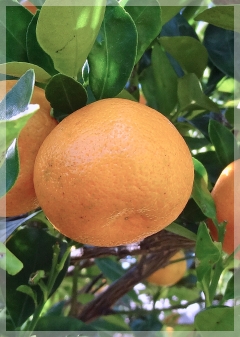 “What’s your orange?” the teacher asked her remote learning class. Before having them answer, she explained the “monkey trap.” In Southeast Asia, hunters capture monkeys by drilling a hole in a pumpkin. The hole is just large enough for a monkey’s hand but too small for his fist. They secure the pumpkin to a tree, put a piece of sweet juicy orange inside the gourd, then retreat and wait. Eventually, an unsuspecting monkey comes along, smells the orange, and reaches through that small hole into the pumpkin. Once he’s grabbed hold of the orange, however, his fist can’t get back through the same hole. The monkey pulls and pulls but can’t free his hand. While he’s struggling to pull out his orange-filled fist, hunters easily throw a net over him. Not understanding that he can’t have both his freedom and the orange, he loses them both. After telling this story, the teacher again asked her students, “What is your orange? What is it you can’t release?”
 Back in March, when this pandemic began, people began thinking seriously about worst-case scenarios. Looking at the death tolls in other countries and seeing them rise in ours, many began scrambling to write their wills and end of life directives. By late April, one on-line estate planning platform reported a 223% increase in customers. When schools announced plans to resume in-person classes, that trend continued as many teachers added will writing to their back-to-school tasks.
 Devotions of the Heart