
No one can serve two masters; for either he will hate the one and love the other, or he will be devoted to the one and despise the other. You cannot serve God and mammon. [Matthew 6:24 (RSV)]
 While walking through the botanic garden recently, I looked up to see the showy flowers of the Money Tree (Pachira aquatica). Although the tree is said to bring good fortune and prosperity, no money was hanging from its branches. Nevertheless, its name reminded me of my father’s frequent caution that money didn’t grow on trees! Perhaps it’s because money doesn’t grow on trees that we frequently seem so obsessed by it.
I’ve read claims that Jesus talked about money more than any other topic. His mention of money, however, doesn’t necessarily mean that was His topic. Although the parable’s good Samaritan gave the innkeeper two coins and promised to pay the injured man’s debt, the parable isn’t about money any more than the Hidden Treasure parable is about investing in real estate or the parable of the Loaned Money about loan sharking! Even though Jesus may have mentioned money when speaking, it seems that He was far more interested in the topics of God’s Kingdom, faith, salvation, and forgiveness than money.
Jesus, however, did tell us that we can’t serve two masters—we can’t serve both God and wealth. The word translated as serve was douleuō, which meant to serve as a slave or one in bondage, and the word translated as master was kuriois, which meant one who possesses uncontested power and absolute ownership and authority over another. In Jesus’ world, the slave had no rights and the master had complete control over him. The master owned both the slave and all of the slave’s possessions including every minute of his time!
Because Jesus’ words make it clear He was speaking of servitude, we mustn’t make the mistake of substituting “work” for douleuō or “employer” for kuriois. For example, as a consultant, my daughter works for several employers at once. Unlike a slave, however, she is free to pick and choose for whom she works and how she divides her time between them. One who serves a master, however, has no such choice because a master demands total commitment and allegiance.
The two masters of which Jesus was speaking are God and mammon (often translated as money or wealth). Nowadays, mammon has the negative connotation of filthy riches or ill-gotten gains but, to Jesus’ listeners, it didn’t. The word used was mamōna, a neutral word encompassing money, possessions, property, earnings, and riches of all kinds. The rabbis even had a saying, “Let the mammon of thy neighbor be as dear to thee as thine own,” which meant we should care for others’ possessions as carefully as our own. Like many things in life, mammon is neither inherently good or bad; how it is regarded and used is what makes it good or bad. Rather than saying wealth is inherently evil, Jesus is telling us that we can’t serve both wealth and God; at some point, the two masters’ interests will diverge.
There is nothing wrong with having a home, car, job, business, fine jewelry, or investment accounts—what is wrong is allowing any of those things (or the desire for them) to own us! We can enjoy them as long as we understand that God alone is our master and all of our possessions and time belong to Him. Although He’s loaned them to us for the time being, we are to serve God with them. When we set our hearts on money or things, however, we’re serving another master. We must never crave wealth more than we desire God, put our trust in money rather Him, love possessions more than we love Him, or choose to serve mammon rather than serve God. We cannot claim Jesus as Lord if our allegiance is to anything or anyone other than Him. He, alone, is our master and He is the one we serve!
Money is in some respects life’s fire: it is a very excellent servant, but a terrible master. [P. T. Barnum]
 You know the generous grace of our Lord Jesus Christ. Though he was rich, yet for your sakes he became poor, so that by his poverty he could make you rich. [2 Corinthians 8:9 (NLT)]
 In a series of negative commands regarding the harvest found in Deuteronomy and Leviticus, we find an ancient form of social justice/economic equity. A landowner was not to return for an overlooked bundle of grain left in the field, olives trees were not to be beaten more than once, grapes vines were not to be repicked after the first fruit was gathered, the edges of the fields were not to be harvested, and any produce dropped by the harvesters or fruit that had fallen or separated from the branch was not to be taken. As the remainders of the harvest, these gleanings were left for the poor.
 When one of his congregation suddenly stopped coming to church, a pastor friend asked him about his absence. The man angrily explained that he’d stopped attending because the pastor hadn’t suitably (and publicly) recognized his large donation to the church’s building fund. My friend assured the miffed man that, had the money been given to the pastor for his personal use, he would have thanked him profusely. But, he added, the money hadn’t been given to him; it was given to God! While the church truly appreciated it (and had acknowledged it in his contribution statement), the issue of both the donation and any recognition or thanks really was between the donor and God. A similar experience was shared by a friend who is in charge of the care ministry for her church. One of her volunteers quit because she felt the church had failed to sufficiently appreciate and publicize her service.
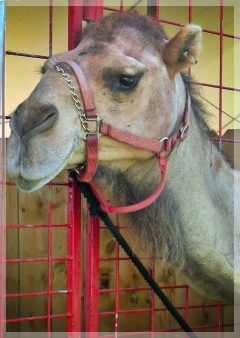 After the rich young ruler departed, Jesus compared the difficulty of a rich man entering heaven to a camel trying to squeeze through the eye of a needle. Because of its impossibility, people find this metaphor troubling. To rationalize it, some scholars speculate that a narrow gate called “The Needle” was located in the wall surrounding Jerusalem. Supposedly used after dark when the main gates were closed, it was so small that a camel had to be unburdened of rider and cargo before getting down on its knees to pass through the gate. They interpret the metaphor as meaning that people must leave behind their baggage, repent, and humble themselves to get through the gate to God’s kingdom. While that’s correct and their explanation makes an excellent Sunday school lesson, no historical or archeological evidence exists that such a gate existed.
 Devotions of the Heart