
Then he said, “Beware! Guard against every kind of greed. Life is not measured by how much you own.” [Luke 12:15 (NLT)]
You say, “I am rich. I have everything I want. I don’t need a thing!” And you don’t realize that you are wretched and miserable and poor and blind and naked. [Revelation 3:17 (NLT)]
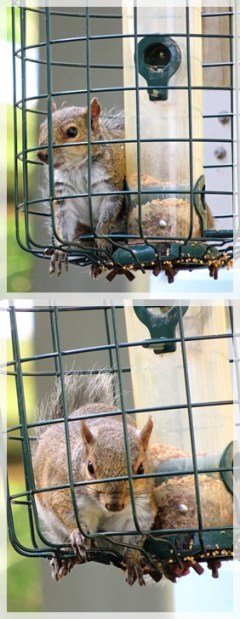 I looked at the greedy squirrel caught in the bird feeder. He’d managed to get himself in but couldn’t get out and wasn’t even able to enjoy the seeds that enticed him there in the first place. Other squirrels, however, were gathered beneath the feeder feasting on the seeds he knocked out of the feeder with his frantic movements. That silly squirrel lives in a bird sanctuary where there is more than enough food in the way of fungi, nuts, seeds, fruit, caterpillars and insects (along with the bird seed that frequently spills from the bird feeders) to keep him plump and happy all year long. Nevertheless, unsatisfied with enough, he hungered for more. We’re not much different.
I thought about King Solomon; while best known for his wisdom, like the squirrel, he was greedy. Although God had warned against a king amassing great amounts of gold, Solomon collected 25 tons of it every year and, unlike those bird seeds, his wealth didn’t even scatter down to his people. After Solomon’s death, they begged King Rehoboam for relief from their labors and heavy taxes. Perhaps hungry for an even more extravagant lifestyle than his father’s, Rehoboam refused and lost it all to the king of Egypt within five years.
Some say wealth brings happiness but, if anyone should know about wealth and happiness, it would be wise King Solomon. His words in Ecclesiastes, however, are not those of a happy man: “Those who love money will never have enough. How meaningless to think that wealth brings true happiness!” [5:10] Amassing money and possessions is like running on a treadmill: a never ending journey. We think that bigger, better or more will bring contentment but what once seemed a luxury soon becomes commonplace and a mere necessity. So, wanting something even more extravagant, we get back on the treadmill of acquisition. So rich that he considered silver worthless, Solomon got rid of his silver goblets and utensils and replaced them with gold. Had platinum been discovered in his time, I imagine he would have replaced the gold with it.
Wealth is not evil; in fact, it can do wonderful things. Wealth, however, is dangerous because loving it and all that comes with it can lead us into temptation and trap us in spots far worse than a bird feeder.
Don’t feel sorry for the squirrel; a naturalist freed him that afternoon. But, chances are, many of us are still on a treadmill of acquisition, foolishly striving for that elusive place over the rainbow where dreams come true, “troubles melt like lemon drops,” and that pot of gold is hidden. The squirrel’s desire for more held him hostage; we mustn’t let our craving for more do the same to us!
You say, “If I had a little more, I should be very satisfied.” You make a mistake. If you are not content with what you have, you would not be satisfied if it were doubled. [Charles Spurgeon]
 In 539 BC, thousands of Medes and Persians were digging outside Babylon’s walls. Thinking they were futilely trying to undermine the city’s impregnable walls, Babylon’s King Belshazzar was unconcerned. While carousing with 1,000 of his nobles, he gave orders to bring out the gold and silver cups that Nebuchadnezzar had looted from Jerusalem’s temple 47 years earlier. The revelers were drinking to their false Babylonian gods with vessels dedicated to the one true God when a human hand appeared and started writing on the plaster wall. No longer so arrogant, the frightened Belshazzar called for his astrologers and diviners but, when the pagans were incapable of deciphering God’s message, Daniel was called to interpret the words.
 If you ever visited the Mayan ruins near Cancun, Mexico, chances are you saw the remains of a stone ball court with sloping walls. Nowhere near as impressive as the Mayan pyramids, I didn’t even take a picture when I saw one. Two stone rings hang about 20 feet up the walls. A ball game called pok-ta-pok was played there. As in volleyball, players passed a solid rubber ball around by hitting it with various parts of their bodies. Unlike volleyball, however, they could not touch the ball with their hands. The goal was to get the ball through one of the rings.
 The eight of us were brainstorming a difficult and heartbreaking situation facing a family we know. We had plenty of ideas about getting them the assistance and guidance they needed but we could only direct them to the resources. They were the ones who needed to take action. Unfortunately, people often want the easy way out of their problems and desire money rather than counsel. Money, however, is usually only a stop gap measure and it frequently enables a bad situation to continue or get worse. The problem we were discussing required change, compromise, work and sacrifice far more than money. These people had to take action and, truth be told, I’m not so sure they wanted to step forward and act.
 The following is a holiday pass-along story that has made the rounds on the Internet. Years ago, little Jimmy was shocked when his big sister told him there was no Santa. He tearfully went to his grandmother and asked her. Assuring Jimmy that Santa existed and she’d prove it to him, Grandma took him to the local department store. Instead of seeing the store Santa, as Jimmy expected they would, his grandmother gave him $10 and told him to use it to purchase a present for someone who needed one. Alone in the store, the boy pondered who should get a gift and finally decided on Robby, a boy in his classroom. Robby never went out at recess; although he said it was because he wanted to study, everyone knew it was because he didn’t have a warm coat. Jimmy found a brown wool coat, took it to the clerk and asked the price. After telling her he hoped he could afford it since it was a gift for a boy at school who didn’t have a coat, the clerk questioned how much he had. Proudly showing her his ten dollar bill, she told him that was the exactly what the coat cost and bagged it up for him.
 “Dream small. Don’t bother like you’ve gotta do it all. Just let Jesus use you where you are, one day at a time,” sang Josh Wilson. Reminding me that a tiny rock made Goliath fall and five loaves and two fish fed them all, he sang that it is simple moments that change the world. I thought of his song when I received an email from a local charity including the sentence, “We may not be able to change the world, but we can change the world for some people.”
 Devotions of the Heart