
 And I will give you a new heart, and I will put a new spirit in you. I will take out your stony, stubborn heart and give you a tender, responsive heart. And I will put my Spirit in you so that you will follow my decrees and be careful to obey my regulations. [Ezekiel 36:26-27 (NLT)]
Last Friday, doctors in Maryland made history when they transplanted a genetically modified pig’s heart into a human in a last-ditch effort to save the life of David Bennett, Sr. A medical first, Bennett was too ill to qualify for a routine heart transplant or an artificial ventricular assist device. The 57-year-old’s prognosis is uncertain and it will be months before doctors know whether the transplant can be deemed a “success.” As with any organ transplant, the main risk is that of organ rejection and Bennett will need potent immunosuppressing drugs for the remainder of his life.
I remember how astonished the world was back in 1967 when Dr. Christiaan Barnard performed the first human-to-human heart transplant. The news that a surgeon had cut open someone’s chest, lifted out a diseased heart, and successfully replaced it with a healthy one from a dead donor was astounding. Although that first heart transplant recipient lived only eighteen days, today’s recipients have an 85% chance of living one year and a 69% chance of surviving five. The survival rate continues to decrease through the years with only 50% of heart transplant recipients living ten years and just 15% making 20 years. In spite of the risks, last year over 50,000 transplant candidates worldwide vied for the 5,000 hearts that were available. Sadly, there just aren’t enough hearts to go around.
54 years ago, the medical journals were wrong when they credited Dr. Bernard with the first heart transplant; God has been replacing hearts for ages! He takes our damaged hearts of stone, hearts unwilling to respond to Him, and replaces them with a new heart and spirit. After accepting His new heart, we have no need for immunosuppressive drugs because the new heart won’t be rejected. Unlike transplant candidates, we don’t have to meet specific criteria or put our names on a waiting list. Everyone qualifies and all we have to do is repent! The best news is that there’s no heart shortage and we don’t have to wait for someone to die; Jesus did that for us 2,000 years ago!
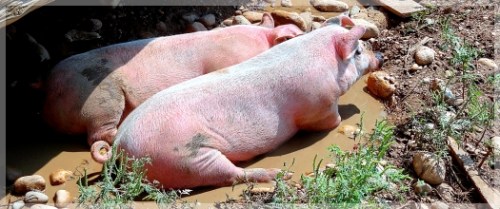
Even with a pig’s heart, Mr. Bennett won’t to want to live in a sty, cool off with a mud bath, snuffle in the soil, or start eating a mix of corn, soybeans, sorghum, and wheat. While his new heart will give him a new lease on life (at least for a short time), it will not change him. He will be the same man with the same favorite activities, world view, media preferences, attitudes, likes and dislikes, morals and principles he had before surgery. On the other hand, the new heart God gives us will make a huge change in us. We will have a new mind, new preferences, new spiritual gifts, new beliefs and morals, a new love for who and what we may have hated, and a new aversion to things we once might have loved. Rather than getting immunosuppressant drugs, we will receive an infusion of love, joy, peace, patience, kindness, goodness, faithfulness, gentleness, and self-control! Getting a new heart in God’s hospital also yields a far better survival rate—no death, only eternal life!
O Holy Spirit, descend plentifully into my heart. Enlighten the dark corners of this neglected dwelling and scatter there thy cheerful beams. [Augustine]
 Jesus said to him, “For sure, I tell you, unless a man is born again, he cannot see the holy nation of God.” Nicodemus said to Him, “How can a man be born when he is old? How can he get into his mother’s body and be born the second time?” [John 3:3-4 (NLV)]
 “A children’s story which is enjoyed only by children is a bad children’s story,” said C.S. Lewis. I agree and admit to enjoying the seven books comprising Lewis’ The Chronicles of Narnia both as a child and an adult. Even though the Narnia books take place in a make-believe world filled with talking animals, mythical creatures, and magic, there are Christian overtones to the entire series. For example, the first book calls up images from Genesis when Aslan, the Great Lion, sings Narnia into existence and evil is introduced to the land. In the second, Aslan willingly dies so that the sins of one boy are forgiven but comes alive again. In another book, Eustace, who had “greedy, dragonish thoughts” becomes a dragon. When Aslan strips away the boy’s scales and throws him into the water, the repentant boy is transformed and images of rebirth and baptism come to mind. Resembling the last book of the Bible, the final story in the series tells of a beast, a false prophet, Narnia’s fall, and a Narnian paradise (where sadness and weariness do not exist).
 Since my 18-year-old grand is a new driver, I was surprised when her parents purchased a new car for her. Remembering the many dings, scrapes, and dents our teens left on their cars, I asked why they’d replaced the 15-year-old car on which she learned to drive with a new one; “safety features” was their simple and logical explanation. This new car offers things like forward collision warning, automatic emergency braking, adaptive cruise control, blind spot monitoring, lane departure warnings, lane-keeping assist, backup cameras, active park assist, rear cross traffic alert, and a whole variety of air bags (front, side, seatbelt, knee, foot, and curtain along with rollover sensors to deploy them.) Knowing that accidents happen to even the best drivers, damage to a new car is far more acceptable than any damage done to their daughter!
 And I will ask the Father, and he will give you another Advocate, who will never leave you. He is the Holy Spirit, who leads into all truth. The world cannot receive him, because it isn’t looking for him and doesn’t recognize him. But you will know him, because he lives with you now and later will be in you. [John 14:16-17 (NLT)]
 “To whom should we pray?” is a common question. People wonder, “If we pray to God the Father, are we leaving out His Son? But if we pray to Jesus, are we leaving out God? And where does the Holy Spirit fit in?”
 Devotions of the Heart