WHOSE SIDE?

When Joshua was near the town of Jericho, he looked up and saw a man standing in front of him with sword in hand. Joshua went up to him and demanded, “Are you friend or foe?” “Neither one,” he replied. “I am the commander of the Lord’s army.” [Joshua 5:13-14 (NLT)]

spiderwortThe Israelites had just crossed the Jordan River and were preparing to conquer Canaan when Joshua came upon an armed man. Joshua was a stranger in a foreign land and, as Israel’s general, he may have been scrutinizing Jericho’s defenses to determine his plan of attack. I wonder if Joshua brandished his sword (while shaking in his sandals) as he queried, “Friend or foe?” The man, however, was neither ally nor adversary. Identifying himself as the commander-in-chief of the Lord’s army, his loyalty was to neither side. His allegiance was to God and the only side he was on was God’s! God wasn’t on Israel’s side any more than He was on Canaan’s. Israel, however, was on God’s side because their conquest of Jericho was part of His master plan of redemption. It was because they were on God’s side that the fortified city’s walls collapsed.

Jump ahead some 500 years to King Asa of Judah. In 2 Chronicles, we find the people of Judah under attack by an Ethiopian army of tens of thousands equipped with 300 chariots. Asa turned to God for guidance. Rather than ask God to be on their side, he prayed that Judah’s side was God’s and confirmed that it was in God’s name that they fought. In spite of overwhelming odds, Judah’s army was victorious, not because God was on their side but because they were on God’s. Asa then committed his kingdom to seeking God with all their heart and soul.

Unfortunately, twenty-one years later, the King forgot whose side he was on when Israel invaded Judah. Rather than turning to God, he committed himself to an alliance with the pagan Ben-hadad of Aram. Although the alliance at first appeared to be a success, the prophet Hanani rebuked the king for violating his covenant to seek the Lord’s side. Sadly, Asa’s foolhardiness meant that Judah would continue to be at war for generations.

When addressing a joint session of Congress in 1984, President Ronald Reagan noted that America was founded by men who believed God was their rock of safety. The President then added, “We must be cautious in claiming that God is on our side, but I think it’s all right to keep asking if we’re on His side.” 120 years earlier, in the midst of the Civil War, one of Abraham Lincoln’s advisors said he was grateful God was on their side. Lincoln replied, “Sir, my concern is not whether God is on our side; my greatest concern is to be on God’s side, for God is always right.” Being on God’s side should be our concern, as well. Our all-powerful God does not choose sides; there only is one side and it is His.

Whether the dispute or disagreement is religious, political, familial, among neighbors or nations, we tend to get behind one side or another. Before taking sides, drawing lines in the sand, making threats, burning bridges, creating alliances, waging battle, or championing a cause, we must prayerfully determine which side is God’s. In many of our disputes, there’s a fair chance that neither side is God’s! While we may not be sure where God stands on every question, we do know He’s on the side of things like love, peace, forgiveness, truth, mercy, compassion, salvation, justice, healing, generosity, humility, decency, righteousness, and kindness. Let His Spirit and Word be our guide. Remember, it doesn’t matter whose side we’re on, if it isn’t God’s!

They always win who side with God. [Frederick W. Faber]

The Lord will stay with you as long as you stay with him! Whenever you seek him, you will find him. But if you abandon him, he will abandon you. [2 Chronicles 15:2b (NLT)]

Don’t copy the behavior and customs of this world, but let God transform you into a new person by changing the way you think. Then you will learn to know God’s will for you, which is good and pleasing and perfect. [Romans 12:2 (NLT)]

Copyright ©2023 jsjdevotions. All rights reserved.

SANCTIFIED

May God himself, the God of peace, sanctify you through and through. May your whole spirit, soul and body be kept blameless at the coming of our Lord Jesus Christ. [1 Thessalonians 5:23 (NIV)]

This life, therefore is not righteousness but growth in righteousness, not health but healing, not being but becoming, not rest but exercise. We are not now what we shall be, but we are on our way. The process is not yet finished, but it is actively going on. This is not the end but it is the right road. At present, everything is being cleaned. [Martin Luther]

white oibos - juvenile - adultOur sons recently visited to celebrate their father’s birthday. As I watched them work their culinary magic in the kitchen, I marveled at how the boys who once thought Kraft mac n’ cheese to be haute cuisine became gourmet cooks. For that matter, when did they get so tall or those wrinkles appear around their eyes? At what point did the tow-headed boy’s hair darken and start receding or his brother’s turn grey? The changes I observed weren’t just physical. As we talked, I wondered when my once irresponsible boys became so sensible and wise. None of it happened overnight and yet each little change was so subtle it barely was noticed. But, when I thought back to the children and young adults they once were, the change was enormous.

When we accept Jesus, we are justified: set free by the blood of Christ, our sins are forgiven and we are spiritually reborn. But, because we still sin, our work has just begun. No parent wants their children to remain helpless infants, unthinking youngsters, or reckless teens and God is the same way with His children. Just as babies must learn to walk, new believers must learn how to walk in the steps of Jesus. We gradually transform from newborn Christians into mature ones through the power of the Holy Spirit in a process called sanctification. While justification is once and done, sanctification is a lifelong journey. Growing in grace, we become obedient to God’s Word, understand His ways and, little by little, become more like Christ.

Although challenges are often accompanied by spiritual growth spurts, for the most part, we transform gradually in barely noticeable ways (as did my boys). If we look back, however, we’ll see the difference our sanctification/spiritual growth has made in the way we conduct our lives. Because of our faith in Jesus, somewhere along the line, we probably developed enough patience to deal with our tiresome neighbor, enough wisdom to counsel a troubled friend, or enough restraint to step away from an argument. At some point, we found the ability to have peace in the midst of turmoil and self-discipline in the face of temptation. We began to love the unlovable, forgive the unforgiveable, and give generously without expecting something in return. When looking back, we’ll realize how the Holy Spirit slowly but steadily matured us from baby Christians into adolescents and beyond.

No matter how far we’ve come in our journey, a little self-examination tells us how far we still need to go. Like the wrinkles that come with age, sanctification it is a gradual, daily, and life-long process. But, unlike those inescapable wrinkles, sanctification isn’t inevitable—it takes effort. To become sanctified, we must actively pursue a holy life. By yielding to God, we become empowered by the Spirit to live a life that honors Him (without becoming self-righteous, legalistic, or proud about doing so). Like a child learning to ride a bike, however, there will be times we fall but, by the grace of God, we keep trying!

Even though I’d prefer the face and body I had twenty years ago to the one I have now, it’s because of Jesus that I much prefer the woman I am today to the woman of decades past. While I don’t look forward to seeing more wrinkles in the mirror, I do look forward to the changes the Holy Spirit continues to make in me. While I’m not who I once was, I’m still nowhere close to the woman God wants me to be.

Yet, though I am not what I ought to be, nor what I wish to be, nor what I hope to be, I can truly say, I am not what I once was; a slave to sin and Satan; and I can heartily join with the apostle, and acknowledge, “By the grace of God I am what I am.” [John Newton]

 But by the grace of God I am what I am, and his grace to me was not without effect. [1 Corinthians 15:10 (NIV)]

Not that I have already obtained all this, or have already arrived at my goal, but I press on to take hold of that for which Christ Jesus took hold of me. [Philippians 3:12 (NIV)]

Copyright ©2023 jsjdevotions. All rights reserved.

HANUKKAH (2) – FEAST OF DEDICATION

Look at my servant, whom I strengthen. He is my chosen one, who pleases me. I have put my Spirit upon him. He will bring justice to the nations. [Isaiah 42:1 (NLT)]

In the same way, let your light shine before others, that they may see your good deeds and glorify your Father in heaven. [Matthew 5:16 (NLT)]
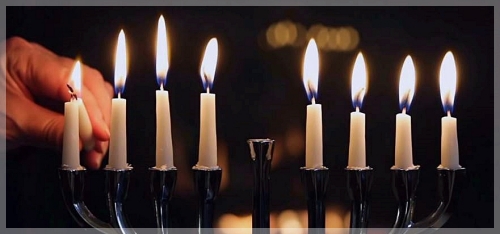
menorah

Most of us associate Hanukkah with Judaism’s menorah. Although the books of the Maccabees mention the relighting of the Temple’s lampstand/menorah, they make no mention of a miracle of oil. However, the Talmud (a collection of discussion and commentary on Jewish history, customs, law and culture) does. It claims that, while only one small flask of consecrated oil was found to light the menorah that first day, the lamp remained lit the entire eight days of celebration until new oil could be consecrated.

Although the Temple’s menorah had seven branches with wicks that burned fresh olive oil, Hanukkah’s menorah usually has nine branches with nine candles. Eight of those candles represent each day of the feast. The ninth candle, often placed in the center and slightly higher than the rest, is called the shamash, meaning servant. Rather than lighting each candle with a match, only the shamash is lit. It is this “servant” candle’s flame that is used to ignite the rest. Upon learning this, I couldn’t help but think of the Messianic prophecies of a suffering servant found in Isaiah 53. That servant was Jesus—He was the shamash who brought God’s light into the world and, like the shamash candle, He gave His light to our lives. By trusting in Him, Jesus said we become  “children of the light,” and, as His children, we are His servants. The Great Commission tells us that we are to be the shamash candles who continue to bring His light into our troubled world.

Thinking of Hanukkah merely as a festival of lights, however, misses the heart of this story—the rededication of the Temple. When a ragtag group of Jewish rebels retook the Temple from the powerful Seleucid army, the Temple had been desecrated and profaned. Before resuming worship there, the Temple had to be cleaned, the idols removed, the pagan altar dismantled, and a new altar consecrated. Only after they made it a fitting place for Jehovah to live did they re-dedicate the Temple to God.

For the people of Judah, the Temple was where God resided. For the people of Jesus, however, it is our bodies—our hearts, minds, and souls—that serve as a temple for God’s Holy Spirit. As believers, we are God’s temple individually and, as the body or church of Christ, we are His temple collectively. As His temple, we should be as holy and pure as were the Temple’s menorah and altar. Nevertheless, it’s difficult to walk through this sinful world and not have some of its filth contaminate us. Things like hate, anger, prejudice, envy, pride, deception, and greed defile us as much as that pig’s blood and idol of Zeus defiled Jerusalem’s Temple. Worse, as the collective temple of God, we’ve seen His church desecrated with things like corruption, exploitation, abuse, hypocrisy, bigotry, and shoddy, distorted and false doctrine. Like the Maccabees, do we need to do some cleaning of His holy temple?

The season of Hanukkah reminds us that Jesus is the servant whose light overcame the darkness of the world. My prayer for this Christmas season is that we allow Hanukkah’s story and traditions to inspire us so that we rid our lives of all that defiles His temple. Let us rededicate ourselves to the Lord and, as His servants, may we glorify Him in all we do.

He that chooses God, devotes himself to God as the vessels of the sanctuary were consecrated and set apart from common to holy uses, so he that has chosen God to be his God, has dedicated himself to God, and will no more be devoted to profane uses. [Thomas Watson]

Don’t you realize that your body is the temple of the Holy Spirit, who lives in you and was given to you by God? You do not belong to yourself, for God bought you with a high price. So you must honor God with your body. [1 Corinthians 6:19-20 (NLT)]

Copyright ©2022 jsjdevotions. All rights reserved.

RELIGIOUS PRIVILEGES

But it is no shame to suffer for being a Christian. Praise God for the privilege of being called by his name! [1 Peter 4:16 (NLT)]


Before my evening prayers, I often reflect on a prayer from The Valley of Vision, a collection of Puritan prayers edited by Arthur Bennett. In a recent selection, the prayer’s author asked the Lord to let him know his “need of renovation as well as of forgiveness,” and confessed, “I am often straying, often knowingly opposing thy authority, often abusing thy goodness….” He went on to admit, “Much of my guilt arises from my religious privileges, my low estimation of them, and my failure to use them to my advantage.” His words gave me pause.

Since a privilege is a special right, advantage, benefit, exemption, or legal immunity granted only to a particular person or group, I pondered the “religious privileges” we enjoy as Christians. The obvious is that even though we remain sinners, our belief in Jesus gives us God’s forgiveness; because Jesus paid the price for our sins, we are exempt from an eternity in Hell. That, however, was God who willingly gave up His absolute power and privilege to take on mankind’s limitations and die a criminal’s torturous death for us! Do we truly appreciate what He did or do we take that privilege for granted and fail to do the spiritual renovation necessary to show our appreciation for His sacrifice and blood? Do we thank the Lord each and every day for what He did on the cross?

Aside from a Christian’s destiny of having a home in heaven and sharing in the glory of God, what other religious benefits do we have? As Christ’s followers, we have the advantages of the peace that surpasses all understanding and the ability to find joy in all circumstances. We have the blessings of His continual presence, guidance, and protection from the enemy. We have the privilege of sharing the Gospel message and even that of suffering in His name!

Do we value the privilege of direct access to God and the advantage of two intercessors: the Holy Spirit who intercedes within us and puts our concerns into words along with Jesus Christ who intercedes for us in heaven? The Holy Spirit, however, is more than an intercessor. He corrects, teaches, sanctifies, strengthens, comforts, protects, and enables us to recognize the truth and obey God. He gives us one or more spiritual gifts and produces His fruit in us. Do we fully appreciate and use the many privileges and benefits that only Christ followers can enjoy or do we ignore and possibly abuse them?

A Christian’s “religious privileges” are offered to all but accepted by few. May we never be unappreciative, neglectful, or careless with God’s gifts or favor by disregarding the privilege of being one of His adopted children.

It is our privilege to know that we are saved. [ D.L. Moody]

Because of our faith, Christ has brought us into this place of undeserved privilege where we now stand, and we confidently and joyfully look forward to sharing God’s glory.[Romans 5:2 (NLT)]

Copyright ©2022 jsjdevotions. All rights reserved.

IN ENEMY TERRITORY

Be alert and of sober mind. Your enemy the devil prowls around like a roaring lion looking for someone to devour. Resist him, standing firm in the faith, because you know that the family of believers throughout the world is undergoing the same kind of sufferings. [1 Peter 5:8-9 (NIV)]

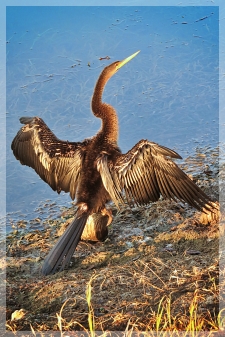
anhingaAnhingas are among my favorites of our lake’s birds. Unlike most birds, their bones are heavy and dense and, rather than waders like the herons and egrets or paddlers like the ducks, they are deep-diving swimmers. Lacking the oil glands that waterproof the feathers of other water birds, anhingas (and their cormorant cousins) become water-logged in the water. While making it difficult to remain afloat, that allows them to dive up to sixty feet deep, swim underwater for several hundred feet, and stay underwater for more than a minute. Eventually, however, the birds become so heavy they will sink unless they return to land to dry their feathers.

Every morning I find anhingas resting along the lake’s shoreline and spreading their wings to dry. The wettest ones get barely out of the water but, as they dry, they waddle further back until dry enough to get up onto a rock, bench, or low hanging branch. As their feathers continue to dry, they move higher up in the trees until they are dry and light enough to take flight.

Unlike the lake’s ducks who nest and sleep in the vegetation along the shoreline, anhingas remain on land only out of necessity. Vulnerable to predators, a soaking wet anhinga is like a “sitting duck.” With its stubby legs and large webbed feet, it can’t run; water-logged, the water isn’t a good option and yet it’s too wet to fly up to safety. While hissing, grunting, and trying to look intimidating by ruffling its feathers, raising its tail, lengthening and waving its long neck, and pointing its spear-like beak may deter some birds of prey, that behavior probably won’t dissuade hungry alligators or crocodiles.

Just as being vulnerable to a predator’s attack is part and parcel of being an anhinga, being vulnerable to our enemy’s attack is an inevitable part of being human in our fallen world. Rather than gators and crocs, that enemy is Satan and he can sneak up on us even more adeptly than the wiliest reptile in the Everglades. Rather than the weight of soaking wet feathers, it is the weight of things like pain, illness, betrayal, weariness, conflict, loneliness, loss, disappointment (and even hurricanes) that make us especially vulnerable to attack. The enemy will use every weapon in his armory including lies, half-truths, fear, despair, hopelessness, and (his favorite) doubt to assault our belief in the goodness of God. Fortunately, in His wisdom, God armed us for battle with more than the saber-sharp beak and intimidating appearance of the anhinga. We wage war with the weapons of our faith: God’s Word and the power of the Holy Spirit.

An anhinga, aware of its vulnerability when wet, only enters the water to hunt or bathe. With neck extended and eyes wide open, it remains watchful when drying along the shoreline and never dawdles there once dry. Like the anhinga, we must be alert to our vulnerability in our fallen world. Unlike the anhinga, however, we often act as if we’re not sitting smack dab in the middle of the enemy’s territory! A. W. Tozer warns us about thinking of the world as a “playground instead of a battleground.” May we never forget that we live in the enemy’s territory and he is as dangerous as a prowling lion or a hungry alligator!

Anyone who serves the Lord is going to be the target of Satan’s attacks. [Zac Poonen]

Finally, be strong in the Lord and in his mighty power. Put on the full armor of God, so that you can take your stand against the devil’s schemes. For our struggle is not against flesh and blood, but against the rulers, against the authorities, against the powers of this dark world and against the spiritual forces of evil in the heavenly realms. [Ephesians 6:10-12 (NIV)]

Copyright ©2022 jsjdevotions. All rights reserved.

KNOWING HE’S THERE

And the believers were filled with joy and with the Holy Spirit. [Acts 13:52 (NLT)]

zebra longwing butterfly
Zebra Longwing butterflies (Heliconius charithonia) live in hammocks and damp forests. Unless they are resting on a plant, however, they are often difficult to spot. Unlike most butterflies, they don’t stay in the sunlight for long. I may see their shadows on the boardwalk but, when I look up, they quickly vanish into the shade they prefer. With their yellow and black colors, shallow wingbeats and languid flight, they float through the woods and often seem to be little more than flickering sunlight glimmering through the trees.

Oddly, I think of the Holy Spirit whenever I get a glimpse of these beautiful creatures. Just as I’ll probably never hold one in my hand, I have difficulty grasping the concept of the Holy Spirit. Nevertheless, I know they both exist and bring me joy. There are times it’s difficult to catch sight of the winged zebras and, unfortunately, there are times I have difficulty detecting the Spirit. Nevertheless, just as I know the butterflies are in the woods, I know that He is present. Some days are better than others when it comes to spotting the Longwings and some days are better than others when it comes to sensing the Holy Spirit’s presence. If I’m jogging down a trail, I’ll never spot the butterflies and, if I’m rushing through life, it’s just as easy to overlook the Holy Spirit.

While I can blame the season, weather, light, or location for not seeing a butterfly, I have only myself to blame when I fail to perceive the Spirit. The times I feel devoid of His presence are when I neglect Scripture and prayer—the times I become so busy with the “me” and “my” of life that I don’t leave room for Him. They are the times I refuse to accept God’s control of my circumstances, ignore His direction, or don’t want to hear His conviction of my unacceptable behavior. Most often, however, I can’t feel the Holy Spirit because I’ve done something that grieves Him. Things like anger, resentment, jealousy, guilt and pride serve as barriers to feeling His presence. Fortunately, unlike the butterflies that disappear as they float through the woods, the Spirit will never leave me, even when I’ve disappointed Him.

In perfect unity with God the Father and God the Son, the Holy Spirit is the power of God that dwells within every believer in Jesus Christ. Just as it’s likely that I’ll catch a glimpse of Zebra Longwings on a certain boardwalk through the mangroves, I’m sure to feel the Spirit’s presence when I walk in His ways throughout the day.

You might as well try to see without eyes, hear without ears, or breathe without lungs, as to try to live the Christian life without the Holy Spirit. [D.L. Moody]

But when the Father sends the Advocate as my representative—that is, the Holy Spirit—he will teach you everything and will remind you of everything I have told you. [John 14:26 (NLT)]

Copyright ©2022 jsjdevotions. All rights reserved.