
 There shall come forth a shoot from the stump of Jesse, and a branch shall grow out of his roots. And the Spirit of the Lord shall rest upon him, the spirit of wisdom and understanding, the spirit of counsel and might, the spirit of knowledge and the fear of the Lord. [Isaiah 11:1-2 (RSV)]
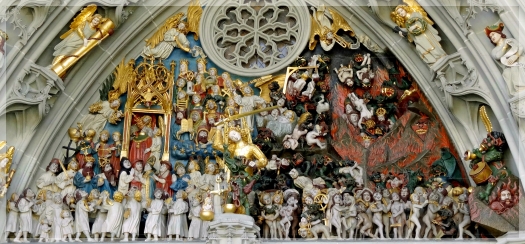
I remember standing in awe in front of an enormous sandstone sculpture of the Last Judgment at the entrance to Bern’s Minster Cathedral. With 294 figures, the naked wicked are on the right while the white-robed righteous are on the left. There are prophets, angels with trumpets, Jesus, Lady Justice, the wise and foolish virgins and both sinners and saints—the condemned and the blessed. In graphic detail, it illustrates God’s final judgment and the horrible fate of the damned!
It’s said that a picture is worth a thousand words and that’s true of the Last Judgment. In fact, much of the art in old European churches was there to illustrate Scripture for the largely illiterate population of the Middle Ages and early Renaissance. Seeing the portrayal of the last judgment, Michelangelo’s image of the outstretched hand of God giving life to Adam or Rembrandt’s picture of a distraught Moses smashing the stone tablets brought those stories to life for a people who couldn’t read them for themselves. Several churches had what was known as a Jesse Tree. Rather than a tree, these were large tapestries, carvings, or stained glass windows that illustrated the Bible’s salvation theme through the Old Testament to the birth of Jesus.
For example, the stained glass Jesse Tree in the Cathedral of Chartres (c.1150) portrays a sleeping Jesse at the bottom of the window. A shoot springing from his loins reaches up into four branches. Above Jesse are four kings (David, Solomon and two unnamed ones) and, above them, is Mary. At the top is Jesus surrounded by seven doves (representing the Holy Spirit and His gifts). Surrounding this center panel are fourteen figures holding scrolls. These are the people like Moses, Zechariah, Isaiah, and Samuel, who foretold the coming of a savior. In this single sixteen-by-five-foot window, the whole of the Old Testament prophecies and their fulfillment in Jesus is represented and God’s faithfulness in keeping His promises is illustrated.
The Jesse tree comes from Isaiah’s prophecy that the Messiah would come from Jesse’s line—the Davidic line of kings. Jesse was David’s father. The prophet referred to the lesser known Jesse rather than his famed son because, by the time of the Messiah, Judah would be a conquered nation and, with no more kings, David’s line would appear chopped off, like the stump of a hacked down tree. There was, however, life within that stump and a new branch, the Messiah, would sprout from it. The Jesse tree art in churches illustrated that Jesus’ story didn’t start in the New Testament. It began in the Old; Jesus was the fulfillment of God’s promises made thousands of years earlier.
Nowadays, some people celebrate Advent with a Jesse tree that serves as a sort of Advent calendar. Each day during December, a different Bible story is read and then a small ornament representing the story is placed on the “tree”—the family’s actual Christmas tree, a bare branch anchored in a stand, a small tabletop tree or even a felt hanging. An apple might accompany the story of the fall; an ark or rainbow, the story of Noah; and a scarlet cord, the story of Rahab.
Although I’m not decorating a Jesse tree, I am reading stories and prophecies from the Old Testament that tell of God’s faithfulness and plan for redemption. Starting in Genesis with God telling the serpent (Satan) that his final defeat will be brought about by one of Adam and Eve’s descendants, I’ll do a quick tour through the Old Testament and read about Abraham, Isaac, Jacob, Joseph, Moses, Joshua and David. As I prepare to celebrate Christ’s birth, I’ll put his arrival in historical context—in the world of Rahab, Gideon, Ruth, Samuel, Isaiah, Jeremiah, Habakkuk, and John the Baptist: a world in desperate need of salvation.
We often think of the Bible as two separate books—the Old and New, the Hebrew and the Christian, but it is one continuous story that leads across thousands of years to Christ’s birth, death and resurrection. Let us never forget that Jesus, as the Alpha, was there at the very beginning and, as the Omega, He will be there at the end.
 My daughter has become quite adept at hiding Christmas gifts from her husband. If she doesn’t, he will find the presents and open them early; patience is not one of his strong suits. It wasn’t one of Sarah and Abraham’s either. Although they’d been promised a son and many descendants, they grew impatient waiting and took matters into their own hands. Sarah gave Abraham her maidservant Hagar with whom to make a child. Although she made the offer, he didn’t have to accept—but he did. The boy Ishmael was the result of their rashness and the rivalry and strife that continue today in the Middle East came from that impatience. Like Sarah and Abraham, when my son-in-law knows a gift is coming, he just can’t wait until the correct time to receive it. Fortunately, while his wife may get annoyed when he takes matters into his own hands, his impulsiveness hasn’t resulted in centuries of international conflict.
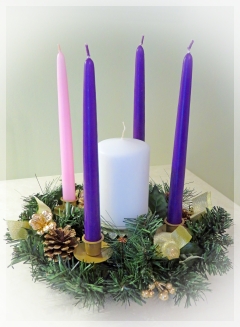 It’s less than a month until Christmas. This Christmas will be vastly different from past ones for us as I imagine it will be for you. Traditionally, our holiday season has been a busy and festive one of concerts, friends, church, fellowship activities, volunteering, entertaining, and family but being in the midst of a pandemic has changed all that. In an attempt to keep the spirit of Christmas alive in what has been a dreary and disappointing year, I’ve started decorating for the holiday and playing Christmas music. Christmas, however, is more than decorations, carols, presents, parties, and peppermint bark. Perhaps not having all of the fun-filled extras of this season will help us focus on its true meaning.
 When an irrevocable law was signed that prohibited praying to anyone but King Darius, Daniel prayed! Knowing he’d be thrown into a den of lions for doing so, the devout man went home, opened the windows, and prayed to God just as he always had done. Rather than starting with a fervent plea for God’s help, however, Daniel began with a prayer of thanks. His prayer of thanksgiving showed Daniel’s faith in a good God who was present in all circumstances!
 Avoid foolish controversies, arguments about genealogies, quarrels, and fights about Moses’ Teachings. This is useless and worthless. [Titus 3:9 (GW)]
 One of the countless questions we have about this pandemic is how God could allow church doors to close throughout the world. 2020 is not the first time the doors to His house have been shut. In 586 BC, the Temple doors closed for the Jews when Judah fell to Babylon; Jerusalem was laid to waste and the Temple destroyed. Its doors didn’t open again until the exiles returned and completed the second Temple in 515 BC. Destroyed by the Romans in 70 AD, all that remains of that Temple is a small portion of an external supporting wall on the Temple Mount.
