
In the beginning the Word already existed. The Word was with God, and the Word was God. He existed in the beginning with God. … So the Word became human and made his home among us. He was full of unfailing love and faithfulness. And we have seen his glory, the glory of the Father’s one and only Son. [John 1:1-2,14 (NLT)]
For in Christ lives all the fullness of God in a human body. [Colossians 2:9 (NLT)]
 He came as a baby! God Himself humbly came into the world as a helpless infant. Our nativity scenes and Christmas cards portray a serene Mary holding her peacefully sleeping child but babies are anything but calm and peaceful. They are messy and incredibly noisy little creatures who, when not sleeping, are crying, eating, drooling, peeing, or pooping (often all at the same time). That was God sleeping in the feed trough and nursing at Mary’s breast but He didn’t have a gold halo around his head. Looking the same as every other newborn, he was doing and feeling the same things every human baby feels. On the eighth day of His life, He was circumcised just like every other little Jewish boy and I’m sure He cried in pain! That crying baby was God!
Jesus came into the world without benefit of a sterile hospital birthing room and Mary didn’t rock Him to sleep in a soothing-motion bassinet or rocking cradle. She didn’t sit in a cushioned glider chair or have a nursing pillow when she fed him. He didn’t have super-absorbent, ultra soft, hypoallergenic disposable diapers covering his bottom nor did Mary use warmed sensitive-skin baby wipes to clean that bottom. In all likelihood God had diaper rash and, with no special baby shampoo, He cried when the soap got in His eyes. Mary carried Him in a simple sling rather than an ergonomically designed carrier. It was God incarnate who had the runny noses, sore throats, tummy aches, stubbed toes, and bruises that came with childhood.
Jesus had to be fed and then learn to feed himself; he probably spilled more than once. He had to learn how to crawl, walk, and run and must have bumped his chin and skinned his knees frequently. He had to be potty trained and, in all likelihood, had more than one accident. The One who was the Word had to learn the Hebrew alphabet and how to read. Picture God singing the Hebrew equivalent of the ABC song: “Aleph, Bet, Vet, Gimel, Dalet, Hey…” At Joseph’s side, Jesus must have gotten a few splinters and sore thumbs as He learned the carpenter’s trade. Fully God and fully human, Jesus got tired, dirty, and hungry just like every other child!
God, being God, could easily have come into the world full grown. Jesus could have skipped the indignities of babyhood and challenges of childhood but He didn’t. When God came into our world, He experienced every human emotion and physical sensation. He knew cold, pain, sorrow, loss, toil, discomfort, fatigue, and temptation as well as love, joy, comfort, and encouragement. Jesus was there when time began and yet the One who created mankind humbled Himself and experienced humanity. That baby—that little baby boy was God Himself!
How can God stoop lower than to come and dwell with a poor humble soul? Which is more than if he had said such a one should dwell with him; for a beggar to live at court is not so much as the king to dwell with him in his cottage. [William Gurnall]
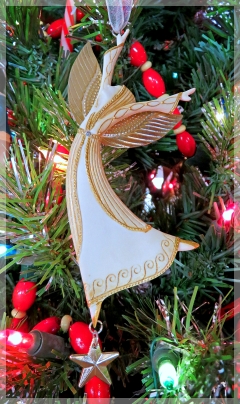
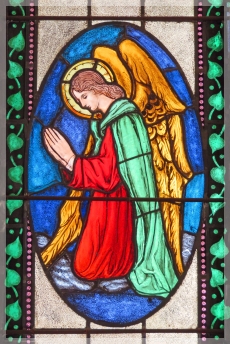 Sunday, we will light our Advent wreath’s fourth candle—the purple one known as the angel or love candle. We’ll read Nathan’s prophecy in 2 Samuel that David’s kingdom would continue forever. Although we know that David’s earthly dynasty ended some 400 years after Nathan’s words, God’s promise was fulfilled in Jesus—David’s direct descendant who now reigns forever. Jesus is tied to the Old Testament prophecies in two selections from Luke 1 in the angel’s words to Mary that her son, a descendant of David, would reign over Israel and His kingdom would never end and Mary’s beautiful song of praise known as the Magnificat in which she expresses her understanding that God is fulfilling His promises with the birth of her son.
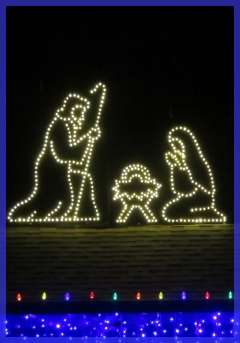 Two nights ago, we joined a long line of vehicles slowly wending their way through a nearby neighborhood famed for its over-the-top holiday light display. Each street follows a theme and over 300 homes are brightly decorated. The streets were aglow with meteor shower, icicle, garland, fairy, net, star, blinking, ball and laser lights along with illuminated blow molds, inflatables, and cut-outs of everything from Santa exiting an outhouse to the Grinch, igloos to elves, and candy canes to Olaf and the Minions. As bright as that neighborhood’s display was, it pales in comparison to one done by the Gay family in Lagrangeville, NY. Holders of the Guinness world record for holiday lights on a residential property, their 2020 display uses more than 670,000 lights that are choreographed to 256 songs.
 Colors have been used to differentiate liturgical seasons since the 4th century and, by the 12th century, Pope Innocent systemized their use in the church. Originally Advent was about penance, prayer and fasting in preparation for baptism so purple (the color associated with sacrifice and repentance from sin) was its liturgical color. Like the Advent wreath, however, liturgical colors are merely traditions and have no basis in Scripture. Most denominations have added more colors to the original five.
 Last Sunday, my husband and I lit the candle of hope on our Advent wreath. This Sunday, we’ll re-light that one along with a second candle, the one we call the peace or Bethlehem candle. Because the Advent wreath custom has been adapted in a variety of ways through the years, there are several names for the candles and explanations for their symbolism that probably have more to do with the selling of wreaths, candles, and devotional booklets than with church tradition. There are no official names, meanings or rituals because an Advent wreath isn’t based on Scripture. It’s merely a tradition to help make this season more meaningful.
