
 These people are false apostles. They are deceitful workers who disguise themselves as apostles of Christ. But I am not surprised! Even Satan disguises himself as an angel of light. So it is no wonder that his servants also disguise themselves as servants of righteousness. In the end they will get the punishment their wicked deeds deserve. [2 Corinthians 11:13-15 (NLT)]
More than four weeks have passed since Hurricane Irma wreaked havoc on southwest Florida. Debris is piled into mini-mountains along the roads and, with over $320 million in damages in our county alone, the storm chasers have descended. Calling themselves restoration specialists, their trucks prowl the neighborhoods. They claim expertise in water extraction, mold removal, window and screen replacement, roofing, landscaping, carpet cleaning, drywall, plaster, demolition and reconstruction. At best they are anything but expert and do shoddy work; at worst, they are scam artists who take their money and run! Desperate to get back to some semblance of normalcy after this devastating storm, people will hire just about anyone who promises speedy restoration. These swinders are having a heyday while leaving behind a mess for the homeowners.
As Christians, we have the genuine restoration specialist: Jesus Christ. Rather than restoring flooded houses, He restores sight to the blind and life to the dead. His death and resurrection restored our relationship with God the Father. Nevertheless, during the hurricanes that occur in our lives—those storms that leave us emotionally battered and bruised—we can fall prey to another team of counterfeit restoration specialists. Called false prophets or false apostles in Scripture, I think of them as the pseudo philosophers and ersatz preachers of today. Some just may be misguided but others are charlatans and hypocrites. Either way, their teachings are incorrect and, like faulty wiring, dangerous!
When desperate, we tend to grab onto the first thing we see and the enemy is no fool; he quickly has his restoration specialists at our doors with their false promises of repair and renewal. Knowing that outright lies are far easier to recognize than half-truths, their deception is usually mixed with a little truth. Rather than denying the entire Gospel, they distort and misrepresent its message. Like storm chasers, they’re great salesmen—friendly, empathetic and smooth talkers who tell us what we want to hear. Instead of a new roof in two days, they promise hope and a means to a better life but, like any scammer, their work is costly and defective!
Knowledge is power. The more we know about our homes, the more knowledgeable we are about their repair. We can recognize a solution that is too easy, too expensive or too cheap to be true. Knowledge is power when it comes to our faith, as well. The more we know about the Bible, the better able we are to recognize incorrect or fabricated doctrine. The entire message—not just a few cherry picked verses—must come from the Bible. Jesus is essential; the only salvation is through Christ and the cross. Rather than asking for a business license, we should make sure our spiritual storm chaser exhibits the Fruit of the Spirit and that his message will yield that same fruit in us. Moreover, we must be wary of any message that promises a quick easy fix. If it promises forgiveness without repentance or heaven without hell, it really is too easy (and too cheap) to be true! Repair and renovation after a hurricane takes time and effort and so does spiritual renewal after we’ve been hit by any storm in life. Just be sure to depend on the number one restoration expert—Jesus Christ!
Satan is the counterfeiter. …He has a false gospel, preached by false ministers, producing false Christians. …Satan plants his counterfeits wherever God plants true believers. [Warren Wiersbe]
 Most of us think of sloth as laziness: a dislike of work or any physical exertion. Having watched the local zoo’s sloth in action (or, rather, inaction), I think the sluggish animal is appropriately named. Spiritual sloth, however, is far different than being a couch potato. Originally, the sin of sloth was two sins: sadness and acedia. Compiled by Evagrius of Ponticus, a 4th century monk, these two “capitals sins” were part of a list of eight he believed to the greatest threats to devout monasticism.
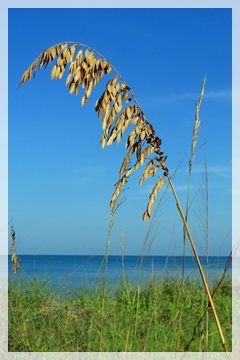 It’s not just light poles that were destroyed by Hurricane Irma’s winds; many trees also met their end at her hands. As I looked at the upended roots of a once mighty oak, I thought of one of Aesop’s fables about an oak in a storm. A proud oak stood by a stream, and like this one, had survived several storms in its many years. One day, a hurricane the likes of Irma arrived and the great oak fell with a thunderous crash. As the water rose, it was carried down to the sea. When the oak eventually came to rest along the shore, it looked up at the sea oats that were waving in the now gentle sea breeze, “How did you manage to weather such a terrible storm?” it asked. “I’m a great oak and even I didn’t have strength enough to battle the wind.”
 Yesterday I mentioned getting an email with the subject, “How firm is your foundation?” Although it was an advertisement for a new study Bible connecting Biblical teachings to Christian beliefs, that very question has been the topic of discussion in our northern church for the last few weeks. The parish is doing a church-wide study of Martin Luther’s Small Catechism. Back in the 1500s, Martin Luther was appalled at the lack of knowledge of both pastors and their congregations. Not especially tactful, he accused some pastors of being “lazy bellies and presumptuous saints!” His words for their congregations, “simple cattle and mindless pigs!” were no more diplomatic. People who called themselves Christians had no idea what that meant. They didn’t know the Ten Commandments, the Apostle’s Creed or even the Lord’s Prayer, let alone anything else in the Bible. Last week, our Pastor asked us what Luther might say if he visited today’s churches. We agreed that his words for our pastors would be more complimentary but that his words for their congregations might be the same or worse!
 The damage done by Hurricane Harvey seemed unbelievable until Irma hammered the entire state of Florida. Fortunately, our Florida home was prepared and we were safely situated in the Midwest during Irma’s tirade. Would that all the storms of life announced themselves a week in advance to give us time to put up storm shutters and evacuate to safety.
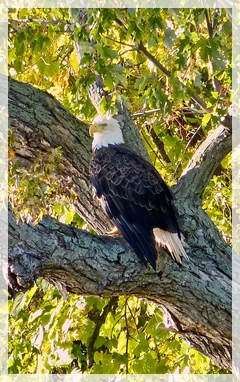 The eagle is mentioned more than any other bird of prey in the Bible. References are made to its swiftness of flight, ability to soar high in the air, excellent vision, the way it sets its nest in high places, and the strength of its wings. The above two verses about eagles, however, are more figurative than literal and have no scientific basis. Although mother eagles do hover over their young, they cannot carry them. A bald eagle’s lifting power is only about a third of its weight. An eaglet ready to fly is as heavy as its parents. If Mrs. Eagle tried to carry junior, they’d both fall! The second verse about being renewed like an eagle is probably connected to an ancient belief that every ten years the eagle disappeared into the sun, dove down into the sea with the setting sun, and emerged young again. There’s a similar urban myth that at 30 years of age, the eagle flies to a high mountain top and makes the difficult decision between death or the painful plucking out of all of its feathers and the destruction of its beak and talons. After waiting several months for everything to grow back again, it will be transformed and the refreshed bird will be able to live another 30 years. Not so; like the rest of us, when it’s time to grow old and die, the eagle has no choice. Like other birds, however, when the eagle molts, old worn feathers will drop and new ones will replace them.
