
 We reject all shameful deeds and underhanded methods. We don’t try to trick anyone or distort the word of God. We tell the truth before God, and all who are honest know this. If the Good News we preach is hidden behind a veil, it is hidden only from people who are perishing. Satan, who is the god of this world, has blinded the minds of those who don’t believe. They are unable to see the glorious light of the Good News. They don’t understand this message about the glory of Christ, who is the exact likeness of God. [2 Corinthians 4:2-4 (NLT)]
Yesterday, when writing about John the Baptist, I said that doubt was not the same as unbelief. In John’s question to Jesus, we have the doubts of a godly man but we see trickery and unbelief in most of the questions of the Pharisees and Sadducees.
Because the Sadducees interpreted Scripture literally and the Pharisees gave equal significance to their oral tradition, the groups frequently argued with one another over Jewish doctrine. They were, however, united in their hatred of Jesus. Unlike the Pharisees, the Sadducees did not belief in an afterlife or the resurrection of the dead. Nevertheless, they asked Jesus a question dealing with resurrection. Jewish law said that, if a woman’s husband died without having a son, the husband’s brother had the responsibility of marrying her. Using this law as their starting point, the Sadducees set up a bizarre scenario in which one brother dies without having children and his widow, who never bears a son, ends up marrying and burying brother after brother until she’s married and buried all seven brothers. The Sadducees want Jesus to tell them which of the seven will be her husband in the afterlife.
Since they didn’t believe in any afterlife, theirs was not an honest question and they’re sure Jesus can’t answer without looking foolish, offending people, or being caught in an inconsistency. He’ll appear arbitrary if he picks one brother over another and immoral if He says they all can have her! His other choice (and possibly the one for which they hope) is to admit that resurrection is a preposterous doctrine. Not only would they score a point against the Pharisees but Jesus would look like a fraud since He couldn’t be the “resurrection and the life” if there were no resurrection!
Imagine their consternation when Jesus corrected them by saying they’d misinterpreted Scripture and had underestimated God’s power with their assumption that resurrection meant a continuation of the same kind of bodies we have in this life. Jesus explained that people would be raised into bodies unlike their present ones and marriage and procreation would be unnecessary. When Jesus added that people will have bodies “like the angels in heaven,” He dug the knife deep into their absurd question because Sadducees didn’t believe in angels any more than they did resurrection.
In His final thrust, Jesus asked the Sadducees if they’d read about resurrection in the Scriptures. He then repeated these words from Exodus: “I am the God of Abraham, the God of Isaac, and the God of Jacob.” [3:6] Even though the patriarchs had been dead for more than four centuries, God’s words to Moses were in the present tense which showed that the men remained alive before Him. Jesus could have found scriptural support in words from Isaiah, Daniel, or Job but He chose a verse from part of the Pentateuch, the section the Sadducees found most authoritative. Having been out-argued by the Son of God, I imagine the Sadducees departed with their proverbial tails between their legs. The crowd that heard Jesus, however, was “astounded at his teaching.”
When comparing the questions posed by John’s disciples and the Sadducees, the differences between doubt and unbelief become clear. Where doubt seeks answers, unbelief isn’t interested in them. Doubt seeks enlightenment; unbelief prefers darkness. Doubt is receptive; unbelief is hostile. Doubt is straightforward; unbelief has ulterior motives. Doubt wants the truth; unbelief just wants to win.
There are those who insist that it is a very bad thing to question God. To them, “why?” is a rude question. That depends, I believe, on whether it is an honest search, in faith, for His meaning, or whether it is the challenge of unbelief and rebellion. [Elisabeth Elliot]
 When the angel promised John’s birth to Zechariah, it was ordained that the child would be named John, that he would be a Nazarite, and that he would prepare the people for the coming of the Lord. After that, other than his circumcision, the only thing we know about John’s youth is that he “grew up and became strong in spirit. And he lived in the wilderness until he began his public ministry to Israel.” [Luke 1:80] We know that Zechariah lived in the hill country of Judea and church tradition places his home in Ein Karem near Jerusalem. Considering Zechariah’s and Elizabeth’s advanced ages, they probably didn’t live to see their boy become a man. Nevertheless, they would have been sure their son knew of his divine calling and made provisions for his care.
 Since it was Easter, along with the oatmeal raisin cookies I made for Sunday treats, I brought a bowl of pastel-wrapped Hershey candy for the little ones. As I placed the candy on the hospitality table, I recalled the last time I had chocolates at church. It was several years ago at our Colorado mountain church. Even though it wasn’t Easter or Valentine’s Day, along with Bibles, the pew book racks were filled with chocolate kisses that morning.
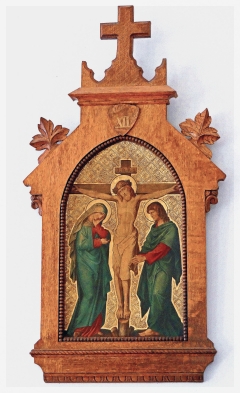 Jesus knew that one would betray Him, another deny Him, and all desert Him. He knew the people He’d fed, healed, taught, and loved—the people who just a few days earlier had greeted him like a king with palm branches and shouts of “Hosanna”—soon would prefer a thief over Him. Because of His anguished prayers later that evening in Gethsemane, we know that He knew the suffering and torment that lay ahead for him. Nevertheless, he sang with the disciples during their Passover meal that last night and it wasn’t a sorrow-filled psalm of lament.
 We always knelt for prayer in the church I attended as a girl so I used to think the only way to pray was on my knees with head bowed and hands tightly clasped. While I now pray in a variety of postures, I wondered if Scripture tells us exactly how we should pray.
 Go therefore and make disciples of all nations, baptizing them in the name of the Father and of the Son and of the Holy Spirit, teaching them to observe all that I have commanded you. And behold, I am with you always, to the end of the age. [Matthew 28:19-20 (ESV)]
