The 8th Day – NAMING HIM

All of this occurred to fulfill the Lord’s message through his prophet: “Look! The virgin will conceive a child! She will give birth to a son, and they will call him Immanuel, which means ‘God is with us.’” [Matthew 1:22-23 (NLT)]

reddish egret

In the first century, the prescribed time for a Jewish boy to be circumcised and officially receive his name was eight days after birth. Joseph and Mary brought their baby boy to be circumcised on the eighth day of His life; at that time, they named him Jesus. As with his cousin John (whose name meant “the Lord is gracious”), Jesus’s name was not chosen by His parents but was directed by a visiting angel.

Even if the God hadn’t chosen it, Jesus was the prefect name for this boy. In Hebrew, “Jesus” means “to deliver or to rescue” or “the Lord saves” and the angel told Joseph the child would save His people from their sins. The message in Jesus’s name was that God would deliver mankind. But, truth be told, the baby’s name wasn’t really Jesus! There was no letter J in either the Hebrew or Greek alphabets so our Savior’s name actually would have been Yeshua (a shortened form of Yehoshua) which translates from Hebrew to English as “Joshua.” The New Testament, however, was written in Greek and the Greek translation of Yeshua is Iesous which translates into English as “Jesus.”

While true meaning came with Jesus’s name, that’s not true of all names. My husband’s, for example, is Robert, which comes from the German Hrodebert. Although it means “bright fame,” he’s not famous and I’ve never seen his name in bright lights. He has other, more descriptive names, as well. I call him “honey,” our children call him “Dad,” the grands call him “Poppie,” his mother calls him “son,” his best buddies call him “friend,” and his employees called him “boss” (and maybe other things behind his back).

Just as my husband can be called many names, Jesus had other designations. Both Joseph and Mary were told that the baby would be called “Immanuel,” meaning “God with us,” but “Immanuel” wasn’t His only other name. Mary also was told that her child would be called both “the Son of the Most High” and the “Son of God.” Jesus referred to himself as “the bread of life, the good shepherd, the light of the world, the resurrection and the life, the true vine” and “the alpha and omega.” At Jesus’s baptism, John the Baptist called Him “the Lamb of God” and God called Him “my dearly loved son.” I imagine the Pharisees had several much less pleasant names for Him. Perhaps my favorite titles given to Jesus are from the book of Isaiah. They are the names we recently heard sung so joyfully from Handel’s Messiah: “Wonderful Counselor, the Mighty God, the Everlasting Father, the Prince of Peace.” Jesus is, indeed, all of that and much more!

There are two hundred and fifty-six names given in the Bible for the Lord Jesus Christ, and I suppose this was because He was infinitely beyond all that any one name could express. [Billy Sunday]

For a child is born to us, a son is given to us. The government will rest on his shoulders. And he will be called: Wonderful Counselor, Mighty God, Everlasting Father, Prince of Peace. His government and its peace will never end. He will rule with fairness and justice from the throne of his ancestor David for all eternity. The passionate commitment of the Lord of Heaven’s Armies will make this happen! [Isaiah 9:6-7 (NLT)]

Copyright ©2019 jsjdevotions. All rights reserved.

FLOWERS AND BIRDS

Look at the birds. They don’t plant or harvest or store food in barns, for your heavenly Father feeds them. And aren’t you far more valuable to him than they are? Can all your worries add a single moment to your life? And why worry about your clothing? Look at the lilies of the field and how they grow. They don’t work or make their clothing, yet Solomon in all his glory was not dressed as beautifully as they are. And if God cares so wonderfully for wildflowers that are here today and thrown into the fire tomorrow, he will certainly care for you. Why do you have so little faith? [Matthew 6:26-30 (NLT)]

cardinal - narrow-leaved sunflower - Corkscrew SwampI’ve never seen a field of lilies in blossom but they couldn’t be any more beautiful than the field of narrow-leaved sunflowers that surrounded me at the bird sanctuary recently. Standing in wonder as their yellow faces smiled down on me, I was reminded of Jesus’s words about the lilies of the field. When I came upon a cardinal pecking away at a large ripe berry, I remembered His words regarding the birds. While watching the bird enjoy his breakfast, the story of Elijah and the ravens that fed him came to mind and I thought about God’s promise to provide.
Having more than enough clothes in my closet and a pantry full of food, I’m not worried about food or clothing. I do, however, tend to worry about God’s provision of words for these devotions. Trust in Him doesn’t come automatically—it is a learned response. Nevertheless, even though God has provided me with fodder for over 1,600 devotions, I’m a slow learner and I still have trouble trusting Him to continue with His provision.

Throughout Scripture, God promises over and over again to provide and, over and over again, people don’t trust Him. Consider the Israelites; after being told there would be manna enough every day, they tried to save it. Even though stored manna turned rotten and maggoty, I would venture a guess that some people continued trying to save it. If I’d been there, I probably would have tried different types of containers, hoping that I’d eventually find the right way to preserve manna (just in case God missed a day)! Later, when God promised to provide the power and strength to take Canaan, the Israelites didn’t believe that God’s provision would be enough and refused to enter. I’m afraid I wouldn’t have trusted God’s promise any more than did the rest of them.

You’re probably not worried about words and maybe not even food or clothing. Even so, we’re all worried about whether God will provide enough of something we need, be it money, health, time, comfort, friends, faith, strength, wisdom, peace or patience. Remember, God promises to provide for the birds and flowers and they’re not even made in His image! Jesus didn’t die on the cross for them and the Holy Spirit doesn’t dwell within them, yet God provides for them! God loves us—we’re created in His image, redeemed by His son, and given eternal life by Him. As His beloved children, we ought to trust Him enough to provide our necessities! When God brings us someplace, as He did with the Israelites and Elijah, He’ll provide us with a way to meet our needs, be it manna on the ground, ravens bringing us food, or wildflowers swaying in the breeze.

God looks at the anxious and says, I tore my Son to shreds for you, and you’re afraid I will not give you what you need? [Timothy Keller]

So don’t worry about these things, saying, “What will we eat? What will we drink? What will we wear?” These things dominate the thoughts of unbelievers, but your heavenly Father already knows all your needs. Seek the Kingdom of God above all else, and live righteously, and he will give you everything you need. So don’t worry about tomorrow, for tomorrow will bring its own worries. Today’s trouble is enough for today. [Matthew 6:31-34 (NLT)]

Copyright ©2018 jsjdevotions. All rights reserved.

ACORNS

The righteous person faces many troubles, but the Lord comes to the rescue each time. [Psalm 34:19 (NLT)]

I have told you all this so that you may have peace in me. Here on earth you will have many trials and sorrows. But take heart, because I have overcome the world. [John 16:33 (NLT)]

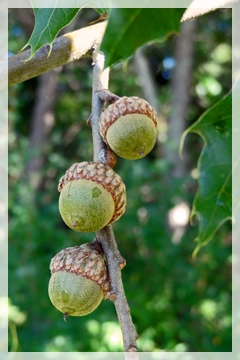
acornsOnce upon a time, when an acorn fell on Chicken Licken’s head, he thought the sky was falling. In a panic, he ran across the barnyard to tell Henny Penny. After the alarmed twosome told Turkey Lurkey the frightening news, the three sped off to warn the rest of the barnyard. Shocked at the scary news, Ducky Lucky and Goosey Loosey joined them in their panic. When the five distraught birds encountered Foxy Loxy, the sly fellow invited them into the safety of his den. Sadly, that was the end of Chicken Licken and the rest of the barnyard birds—all because they didn’t understand that acorns falling from oak trees are an inevitable part of life.

As Christians, we are tempted to think that faith in Jesus will protect us from the slings, arrows, and acorns of this life. We envision easy sailing, level paths, on-time delivery, clear skies, benign lumps, seamless transitions, successful endeavors, perfect fits, spot-on directions, and happy endings. Jesus, however, told us to expect trials and sorrow. The norm of life in our fallen world is that businesses close, jobs are eliminated, families disagree, people disappoint, bodies fail, lines are long, cars break down, cancer spreads, loved ones die, progress grinds to a halt, mistakes happen, grief is unavoidable and, sooner or later, we will step in a least one pile of doggy do!

While I take comfort in the promise of God’s continual presence and peace, I’m not so happy about knowing that Jesus will neither spare nor shield me from troubles. Yet, for even the most righteous believer, a trouble-free life is a myth. Consider the pain and loss experienced by the blameless and upright Job, the persecution and martyrdom of the disciples, and the trials suffered by the Apostle Paul.

At the first sign of trouble, Chicken Licken and his pals panicked and decided the world was coming to an end. Unlike them, we must never let the harsh realities of this fallen world shake our faith. The good news is that we will never walk through our trials alone. God is at our side—encouraging, strengthening, comforting, and guiding us as we mature in our faith. Although it’s a given that we won’t have a trouble-free existence here on earth, we can be confident that we do have one waiting for us in eternity. Jesus has already delivered us from sin, evil, judgment and death. Until then, the next time the sky starts falling, consider it par for the course. Don’t panic or lose faith; make the best of it by putting on a hard hat and gathering acorns with a thankful heart. Be wary of easy solutions offered by the enemy and know that God will see you through your trials.

For God has not given us a spirit of fear and timidity, but of power, love and self-discipline. [2 Timothy 1:7 (NLT)]

And be sure of this: I am with you always, even to the end of the age. [Matthew 28:20b (NLT)]

Copyright ©2018 jsjdevotions. All rights reserved.

SENIOR MOMENTS

plumaria - frangiapaniBut that is the time to be careful! Beware that in your plenty you do not forget the Lord your God and disobey his commands, regulations, and decrees that I am giving you today. [Deuteronomy 8:11 (NLT)]

But the people soon forgot about the Lord their God, so he handed them over to Sisera, the commander of Hazor’s army, and also to the Philistines and to the king of Moab, who fought against them. [1 Samuel 12:9 (NT)]

“Are you looking for something?” asked Earl in Brian Crane’s Pickles comic strip. When his wife, Opal, replied, “My glasses,” he suggested looking in her purse. “No,” she said, “I can’t find it. That’s why I’m looking for my glasses, so I can find my purse. I’m hoping that’s where I left my car keys.” Looking down at his grandson, Earl explained, “That’s why it’s a good thing women Gramma’s age don’t have babies.”

Being around Opal’s age, and having had more than my share of “senior moments,” I understand perfectly. Forgetting the Lord, however, is not like misplacing keys, forgetting where the car is parked, or failing to remember the grocery list. It’s way more than absentmindedness, an appointment slipping one’s mind, or drawing a blank at someone’s name.

Forgetting the Lord is a conscious choice to turn our backs to Him and overlook His presence in all things. It is failing to remember His past mercies and how much He loves each and every one of us. It is disregarding His commands and ignoring our responsibilities both to Him and to our fellow man. When we forget God, we rebel, grow impatient, act rashly or imprudently, or begin to think we are self-sufficient and all-powerful. As the Israelites discovered, forgetting God can have serious, even tragic, consequences. Throughout Deuteronomy, Moses warned them not to forget the Lord and yet, from Joshua through Malachi, we continually read of their unfaithfulness, God’s anger, and the consequences of their deliberate amnesia.

As happened with the Israelites, it’s easy to let challenges overwhelm us, wealth and power deceive us, busyness distract us, temptation mislead us, disappointment frustrate us, grief blind us, impatience goad us, and complaint to harden us. Before we know it, we’ve forgotten the Lord. Moses’s many warnings to the Israelites apply to us today. God accepts senior moments—but He will never tolerate our forgetting Him. God never forgot the Israelites and He will never forget us. Why do we find it so easy to forget Him?

God is mindful of man, and it grieves Him that man is not mindful of Him. [Charles Spurgeon]

Pay attention, O Jacob, for you are my servant, O Israel. I, the Lord, made you, and I will not forget you. [Isaiah 44:21 (NLT)]

Let all that I am praise the Lord; may I never forget the good things he does for me. [Psalm 103:2 (NLT)]

Copyright ©2018 jsjdevotions. All rights reserved.

NO INNOCENT BYSTANDERS

Anyone who isn’t with me opposes me, and anyone who isn’t working with me is actually working against me. [Matthew 12:30 (NLT)]

white tail deerOur family business recently had their annual summer picnic. As part of the festivities, the employees participated in several team-building activities. Various entertaining games, relay races, and obstacle courses required the team members to collaborate and cooperate in order to complete each task and the afternoon ended with an all-out water balloon battle. Although my husband enjoyed the barbecue, at 75, he no longer participates in the games. He stood on the sidelines with those employees who, because of physical limitations, could only observe the day’s antics. Safe from the water balloons, they each were provided with a tee-shirt identifying them as an “Innocent Bystander.”

Matthew 12 and Luke 11 both tell of the scribes and Pharisees confronting Jesus: questioning, disputing and doubting His good work. When they accused him of being a demon, Jesus explained the absurdity of their claim. After pointing out that Satan would hardly give someone the power to destroy any of his kingdom, Jesus demonstrated the inconsistency of their argument by reminding them that even the Pharisees had engaged in exorcisms. Telling them that His work of casting out demons announced the coming of the Kingdom of God, Jesus explained there is no middle ground. Anyone who wasn’t for Him opposed Him and anyone who didn’t work with Him was actually working against Him.

The war between good and evil continues today and, unlike Switzerland and my husband during the games, we are not allowed to be impartial spectators. We are either on God’s side with Jesus or on the side of Satan. If we are not actively gathering souls for God’s kingdom, we are working against Him by scattering them. Either we are friends or foes, followers or opponents, soldiers or deserters, loyal subjects or traitors, supporters or saboteurs, allies or adversaries, builders or destroyers, sheep or goats. There are only two possibilities: believe in and follow Jesus or reject Him. While we can be innocent bystanders at a corporate picnic and stand safely on the sidelines without joining a team, Jesus made it clear that there are no innocent bystanders watching from neutral territory when it comes to Him.

 You not only choose between two ways of life but you choose between two masters. [Billy Graham]

God sent his Son into the world not to judge the world, but to save the world through him. There is no judgment against anyone who believes in him. But anyone who does not believe in him has already been judged for not believing in God’s one and only Son. … And anyone who believes in God’s Son has eternal life. Anyone who doesn’t obey the Son will never experience eternal life but remains under God’s angry judgment. [John 3:17-18,36 (NLT)]

Copyright ©2018 jsjdevotions. All rights reserved.

LET THE VINEYARDS BE FRUITFUL

We give thanks for the cup of blessing, which is a sharing in the blood of Christ. And the bread that we break is a sharing in the body of Christ. Because there is one loaf of bread, we who are many are one body, because we all share that one loaf. [1 Corinthians 10:16-17 (NCV)]

Let the vineyards be fruitful, Lord,
And fill to the brim our cup of blessing.
Gather a harvest from the seeds that were sown,
That we may be fed with the bread of life.
Gather the hopes and dreams of all;
Unite them with the prayers we offer now.
Grace our table with Your presence, and give us
A foretaste of the feast to come. [John W Arthur]

monarch butterfly - common milkweedWhen the ushers brought the offering plates forward, the congregation rose and sang “Let the Vineyards be Fruitful.” Often used in Lutheran churches as an offertory hymn when the gifts are presented at the altar, its references to vine, bread, and table make it especially appropriate on Communion Sundays.

As I sung those familiar words about fruitful vineyards, seeds and harvest, I was struck by the somewhat incongruous words in the middle of the song: “Gather the hopes and dreams of all; Unite them with the prayers we offer now.” I envisioned the congregation’s hopes, dreams, needs, and concerns piled high on top of the offering envelopes in those plates and realized we were presenting more than our checks and cash; we were offering our petitions for things like healing, reconciliation, peace, guidance, recovery, relief, purpose, increase, wisdom, strength, and restoration. While the particulars differed from person to person, our various hopes and dreams were being gathered, united into one prayer, and given to God. It wasn’t until I re-read the hymn’s words after church that I understood what that prayer asked or that our words referred both to the day’s simple meal of wafer and wine as well as to the eternal feast at Christ’s return. In our unified prayer, we were asking that Jesus grace us with His presence and give us a preview of the magnificent banquet that is yet to come in the Kingdom of God.

I’ve probably sung the words to this simple hymn hundreds (if not thousands) of times but last Sunday, as those words exited my mouth, they also settled into my heart and mind in a new way. I doubt that I will sing it again without picturing the congregation’s assorted prayers spilling over the sides of the collection plates and then melding into one unified prayer for both His presence and the coming of His Kingdom. Just as reading a book of the Bible once (or even several times) doesn’t mean we’ve fully grasped the meaning of the passages, the same goes for the hymns we sing or the liturgy we recite during worship. When Jesus warned us about meaningless repetition or babbling on in our prayers, repetition wasn’t necessarily the problem. After all, both the persistent neighbor and widow in His parables repeated their pleas and He repeated the same prayer three times in Gethsemane. The problem occurs when we repeat our words mindlessly or automatically. Let us always remember that knowing the words by heart doesn’t necessarily mean our hearts know the depth of their meaning.

The Lord All-Powerful will prepare a feast on this mountain for all people. It will be a feast with all the best food and wine, the finest meat and wine. On this mountain God will destroy the veil that covers all nations, the veil that stretches over all peoples; he will destroy death forever. The Lord God will wipe away every tear from every face. He will take away the shame of his people from the earth. The Lord has spoken. [Isaiah 25:6-8 (NCV)]

Copyright ©2018 jsjdevotions. All rights reserved.