DIVINE DISCIPLINE (Discipline – Part 1)

And have you forgotten the encouraging words God spoke to you as his children? He said, “My child, don’t make light of the Lord’s discipline, and don’t give up when he corrects you. For the Lord disciplines those he loves, and he punishes each one he accepts as his child.” Hebrews 12:5-6 (NLT)]

lion - tanzaniaIn C.S. Lewis’ fantasy The Horse and His Boy, Aravis, a young noblewoman, is attacked by a lion. After her wounds are cleaned and dressed, she’s told that the cuts on her back are neither deep nor dangerous and no more serious than the cuts of a whip. Aravis later learns from Aslan, the lion who attacked her, that the gashes on her back, stripe for stripe, equal the stripes laid on the back of the maidservant she’d caused to be punished. At first, this seems more like the Old Testament retribution of “an eye for an eye” than something Lewis’ Christ-like character of Aslan would do. What if the maidservant had been hung or beheaded? What then?

I began thinking about God’s justice, judgment, mercy and correction and the difference between them. We have a God of justice and mercy and yet those two words seem totally incompatible. Justice is getting the deserved punishment for the crime and mercy is not getting it. Justice is about penalty and mercy is all about pardon and compassion.  Justice would be the judge finding us guilty of speeding through a school zone and his judgment would be a fine of $1000. Mercy would be the judge coming to the defendant’s table, getting out his checkbook and paying the fine for us. Justice is served because the penalty is paid—mercy is given because we weren’t the ones to pay the fine. That, however, doesn’t mean there might not be some much needed discipline to correct our behavior. The merciful judge might send us to traffic school or require us to do community service as a crossing guard at the school. Moreover,  he will not protect us from the consequences of our offense. The ticket may cause an insurance premium increase or even a license suspension. Nevertheless, we will have been treated mercifully.

Was what happened to Aravis justice or judgment for her past behavior or was it discipline and correction intended the future? While Aravis’ action was rash, it was defensible. She deceived and drugged the maidservant who was watching her so she could escape from a forced marriage to an evil man. Under those circumstances, Aravis’ receipt of those slashes seems like an injustice. It’s easy to miss that those cuts on her back were not because the servant had been whipped. Aravis wasn’t being punished for what her servant had endured. She was being disciplined for her wanton indifference to her maidservant’s fate. Earlier in the story, when asked about the fate of the girl, Aravis coolly replied that she’d be glad if the servant had been beaten. It was only after receiving similar wounds that the once spoiled and haughty Aravis realized her thoughtlessness and showed concern for the servant’s welfare and fate. Within the next few pages, she both apologizes to someone and shows concern for his welfare (something the unwounded Aravis would never have done). Aslan’s discipline helped her become a better version of herself.

Because it’s usually unpleasant, discipline can feel a lot like punishment. While it may look like divine retribution or payback, it isn’t. Its purpose isn’t to make things right; its purpose is to make us right—to turn us from rebellion to obedience. Divine discipline is disapproval, instruction, correction, and direction. As it did with Aravis, discipline causes us to change both our point of view and behavior; it is through discipline that we become the people God wants us to be.

But consider the joy of those corrected by God! Do not despise the discipline of the Almighty when you sin. For though he wounds, he also bandages. He strikes, but his hands also heal. [Job 5:17-18 (NLT)]

Copyright ©2018 jsjdevotions. All rights reserved.
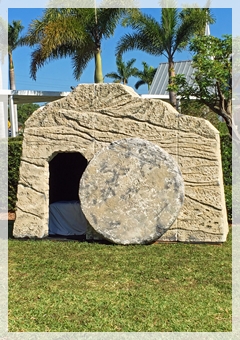
 

THE EMPTY TOMB

You are looking for Jesus of Nazareth, who was crucified. He isn’t here! He is risen from the dead! [Mark 16:6 (NLT)]

empty tomb - north naples churchYesterday I mentioned the wooden cross and rustic nail on my desk that serve as reminders of the terrible price Jesus paid for our salvation. Although early Christian symbols included a dove, ship, lyre, anchor, and fish, the cross has become the universal symbol for Christianity. While Coca-Cola’s logo, Nike’s swish and McDonald’s golden arches may come close, I doubt there is any so recognizable sign in the world. Nevertheless, a gruesome instrument of Roman torture seems an odd symbol for a faith that preaches such things as reconciliation, sacrifice, forgiveness, hope, love, and peace. While I’d never wear a miniature gallows, guillotine, or electric chair on a chain around my neck, I do wear a cross. Although it symbolizes everything that happened to Jesus on that dark Friday two thousand years ago, the cross would be meaningless if the tomb had not been empty Sunday morning.

As we walked out of worship service on Easter morning, we came upon a large replica of a stone tomb. The boulder that had covered its opening since Friday was rolled away and it was empty except for some linen cloth resting on a ledge. Like the women who came early that first Easter morning (and Peter and John who arrived later), a few curious children entered the tomb. No angel was there to reassure them, but they didn’t need one. They’d come from Sunday school and know the Easter story well. At worship services, they’ve joined their parents in saying: “Christ has died; Christ is risen; Christ will come again.” Rather than frighten them, that dark empty tomb reassured them of Jesus’s continual presence in their lives.

Jesus’s death upon the cross is important but it is His rising from the dead that demonstrates triumph over evil, sin, hate, and death. It is the empty tomb that allows us to say these words in the Apostle’s Creed: “I believe in Jesus Christ…[who] was crucified, died and was buried; he descended to the dead. On the third day he rose again… I believe in…the resurrection of the body and the life everlasting.”

Out of curiosity, I searched the stock of several Christian supply stores using the word “tomb.” There were plenty of books, choral collections, CDs, and songs with “tomb” in the title, some Easter stickers depicting an empty tomb, and even a “Raiders of the Empty Tomb” kit, but there were no empty tomb t-shirts, paper weights, jewelry, or wall décor. Apparently, there is no danger of an empty tomb replacing the cross as the universal symbol of Christianity. Nevertheless, when we see a cross, let us never forget that the story of God’s love for us did not end at Golgotha. It didn’t even end with the empty tomb three days later. The story of God’s presence, grace and love continues today.

Christians do not believe in the empty tomb, but in the living Christ. [Karl Barth]

So you see, just as death came into the world through a man, now the resurrection from the dead has begun through another man. Just as everyone dies because we all belong to Adam, everyone who belongs to Christ will be given new life. But there is an order to this resurrection: Christ was raised as the first of the harvest; then all who belong to Christ will be raised when he comes back. [1 Corinthians 15:21-23 (NLT)]

Copyright ©2018 jsjdevotions. All rights reserved.

GONE IN A FLASH – EASTER MONDAY

And just as each person is destined to die once and after that comes judgment, so also Christ was offered once for all time as a sacrifice to take away the sins of many people. He will come again, not to deal with our sins, but to bring salvation to all who are eagerly waiting for him. [Hebrews 9:27-28 (NLT)]

Zermatt - Switzerland - crossAfter warning us not to put them in our pockets and accidentally take them home (or put them in the dryer if we did), small pieces of paper were given to everyone in attendance at last week’s Good Friday service. Following the sermon, we were asked to write a sin (or sins) for which we repent on the papers, come forward, and nail them to a cross resting on the steps before the altar. Listening to the hammering echoing in the sanctuary, I thought of what it must have sounded like two thousand years ago when Jesus and the others were hammered to their crosses: the loud pounding of the hammers, the commotion of the crowd, the mockery of the soldiers, and the cries of agony from the men as those blunt tipped nails pierced their bodies.

Those slips of paper were made of nitrocellulose; often used by magicians, they are commonly known as flash papers. Once we’d nailed our papers to the cross, the pastor ignited them and they instantly disappeared in a brilliant display of fire. Nothing, neither smoke nor ash, was left of them. What a powerful illustration of the way Jesus’s blood, shed on the cross as those nails were hammered into Him, made our sins disappear forever.

Next to the small olive wood cross on my desk, I now have a three-inch square-cut nail, a souvenir from Good Friday’s service. The cross, with its distinctive grain, artistic shape, and smooth finish, is so beautiful that it’s easy to forget it represents an instrument of torture. The dark rustic nail beside it will better remind me of the sacrifice Jesus made for all of us. Paying the price for our sins, His death brought us back into fellowship with God the Father. After the joy of Resurrection Sunday, however, it’s easy to forget the magnitude of that sacrifice until Lent rolls around next year. Let us never forget the miracle of forgiveness that occurred when a suffering bleeding and totally sinless Jesus endured torture and death for the forgiveness of our sins.

He has redeemed me, a lost and condemned human being. He has purchased and freed me from all sins, from death, and from the power of the devil, not with gold or silver but with his holy, precious blood and with his innocent suffering and death. [Martin Luther]

Christ suffered for our sins once for all time. He never sinned, but he died for sinners to bring you safely home to God. He suffered physical death, but he was raised to life in the Spirit. [1 Peter 3:18 (NLT)]

Now all of us can come to the Father through the same Holy Spirit because of what Christ has done for us. [Ephesians 2:18 (NLT)]

Copyright ©2018 jsjdevotions. All rights reserved.

GOD’S GOVERNMENT

Mt. RushmoreThe Lord does whatever pleases him throughout all heaven and earth, and on the seas and in their depths. [Psalm 135:6 (NLT)]

You will be secure under a government that is just and fair. Your enemies will stay far away. You will live in peace, and terror will not come near. [Isaiah 54:14 (NLT)]

Every nation has some system of government and I wonder what system is used in God’s Kingdom. Since He doesn’t govern by committee or with a privileged ruling class, it isn’t an oligarchy or an aristocracy. He is a King, has a Kingdom, and can exercise absolute power, yet His is not a monarchy. His power didn’t come from conquest or birthright, no one gave Him the crown, and no royal scion will follow Him; His reign always has been and forever will be. With all those Old Testament rules, perhaps His is a dictatorship, albeit a benevolent one, in which God exercises absolute power for the good of the population as a whole. That sort of rule, however, would be a one-size-fits-all government. A God who has numbered the hairs on our heads and written our names on his hand knows that one size can never fit all of his unique children.

God’s Kingdom isn’t like our nation, a government “of the people, by the people, and for the people,” with its three branches of government and the checks and balances that come with it. In God’s government, all three branches are rolled into one; He makes the rules, implements them, and decides how they are to be interpreted. There’s no need for checks and balances; God can’t step over the boundaries because He has none. His reign is not dependent upon re-election or approval rating, the majority does not rule, His word is law, and the only being God needs to please is Himself. He didn’t consult with Adam and Eve about the forbidden fruit rule nor with Sodom and Gomorrah about their destruction. The Ten Commandments were not created in committee, voted on by the Israelites, ratified by Moses or tested by an Israelite court. God doesn’t need our advice, consent, or support to make the sun rise or set. Clearly, He runs neither democracy nor republic.

With any sort of earthly government, the ruler’s power is limited to his life span and his nation’s border. God’s power, however, is unlimited. He is the eternal Sovereign God over the entire universe. His is a never-ending government of love, forgiveness, righteousness, peace and justice. Unlike other forms of government, His is truthful, dependable, and free of any corruption or bureaucracy. I don’t think there is a word that describes God’s reign except, perhaps, “perfect.” After all, God is God and we are not.

For the Lord is our judge, our lawgiver, and our king. He will care for us and save us. [Isaiah 33:22 (NL)]

May your Kingdom come soon. May your will be done on earth, as it is in heaven. [Matthew 6:9 NLT)]

Copyright ©2018 jsjdevotions. All rights reserved.

THOUGHT EXPERIMENTS

Jesus always used stories and illustrations like these when speaking to the crowds. In fact, he never spoke to them without using such parables. This fulfilled what God had spoken through the prophet: “I will speak to you in parables. I will explain things hidden since the creation of the world.” [Matthew 13:34-35 (NLT)]

irisYesterday I wrote about Albert Einstein. The physicist was famous for his ability to replace complex scientific ideas with real-life scenarios called gedankenexperiments (thought experiments). For example, imagine that you have an identical twin. Immediately following birth, he is launched into space and travels through the universe nearly at the speed of light. When he returns, he’d be in his teens while you’d be planning your retirement. Time moved slower for your twin because the closer to the speed of light something travels the slower time moves for it. Never having studied physics (and not caring to start now), I think his scenario demonstrates the theory of relativity!

Gedankenexperiments is just a fancy German word for what Jesus did when he told parables; He took complex theological concepts and simplified them into everyday scenarios. When the Pharisees couldn’t understand why the ostracized, outcast and sinful were welcomed by Jesus as His followers, He could have given them a long-winded theological explanation. Instead, Jesus told them three parables. The first was about a shepherd who left his ninety-nine sheep safely in the sheepfold to search for one sheep that strayed. When the shepherd found it, he joyfully returned home with it and celebrated its rescue with friends. Jesus then told of a woman who lost one of her ten coins, searched carefully until she found it, and rejoiced when she did. Just in case the Pharisees didn’t get the point, He then told the parable of the lost son in which the rebellious son repents and returns home to his forgiving and loving father who also throws a party at the recovery of what had been lost. The second part of that parable, in which the elder brother begrudges the celebration welcoming his prodigal brother, was directed at the Pharisees. Did they see their resentment of the sinners at Jesus’s feet in the attitude of the self-righteous and unforgiving brother?

Like Einstein, Jesus used fictitious stories to illustrate a point or teach a lesson. That God doesn’t want to lose one of us, that He loves each of us so much that He seeks us, and that heaven rejoices at the repentance of one sinner were not new concepts to the Pharisees. Jesus presented these simple scenarios so they would understand that sinners are as valuable to God as lost sheep, money, and children are to shepherds, housewives, and fathers. Like Einstein’s thought experiments, however, His parables often weren’t understood. Their understanding, however, had nothing to do with either IQ or righteousness. Both Gedankenexperiments and Jesus’s parables were told in a way that only those who cared would ever understand them. The people who understood the parables, like those who understood Einstein, were the ones who cared enough to ask what they meant (which explains why the Pharisees never did get the point and I still don’t understand relativity!)

Christ taught in parables. Thereby the things of God were made more plain and easy to those willing to be taught, and at the same time more difficult and obscure to those who were willingly ignorant. [Matthew Henry]

Anyone with ears to hear should listen and understand.” Then he added, “Pay close attention to what you hear. The closer you listen, the more understanding you will be given—and you will receive even more. To those who listen to my teaching, more understanding will be given. But for those who are not listening, even what little understanding they have will be taken away from them.” [Mark 4:23-25 (NLT)]

Copyright ©2018 jsjdevotions. All rights reserved.

TAKING THE LONG WAY

Tent Rocks - NMDon’t be afraid, I’ve redeemed you. I’ve called your name. You’re mine. When you’re in over your head, I’ll be there with you. When you’re in rough waters, you will not go down. When you’re between a rock and a hard place, it won’t be a dead end—Because I am God, your personal God, The Holy of Israel, your Savior. [Isaiah 43:2-3a (MSG)]

When visiting New Mexico, we often drive from Albuquerque to Santa Fe. The shortest route is north on I-25. If we’re not in a rush, however, the best way is the longer Turquoise Trail, a national scenic byway on the east side of the Sandia Mountains. In theory, this route should only add about a half-hour to the trip but it always takes longer. The whole point of going that way is to enjoy some breath-taking scenery, take a hike in the high desert hills, check out one of the bizarre roadside attractions (like the Tinkertown Museum), visit various art galleries along the trail, and stop for lunch (and more shopping) in the reborn ghost town of Madrid. Sometimes the journey is as important as the destination.

When the Israelites escaped from Pharaoh, God didn’t lead them the shortest way to the Promised Land; His reasoning, however, had nothing to do with sightseeing or shopping. The most direct route would have taken them northeast along a coastal road and directly into Philistine territory. Instead, God led them south southwest into the desert on the eastern edge of Egypt. Although they were armed for battle, the Israelites were anything but ready to face a military conflict. Having been oppressed for generations, rather than a mighty nation, they were a ragtag band of former slaves. While the longer route made sense, God’s next instructions certainly didn’t! He told Moses that Pharaoh’s men would give chase but that the Israelites should turn back and camp in such a way that they were exposed and trapped against the sea. Although God promised this strange tactic would demonstrate his power and glory, I can’t help but think that Moses was shaking in his sandals when reassuring the people that God had everything under control.

If the Israelites weren’t ready to face the Philistines a few days earlier, they were no more ready to face Pharaoh’s mighty army then. In fact, from a logistical point of view, by turning back, the novice warriors moved into an utterly indefensible position. That, of course, is exactly why God arranged it. Whether facing Philistines or Egyptians, the Israelites’ reaction to either would be panic. With the Philistines, they could have fled, even if that meant returning to Egypt. With Pharaoh’s army, however, they had no escape route. Although their sarcastic complaints to Moses revealed their lack of faith, pinned against the sea as they were, they had no choice but to trust in God. Since we know the rest of the story, that trust was well-founded. The people of Israel walked through the Red Sea on dry ground and Pharaoh’s army perished in its waters. After experiencing God’s miraculous deliverance, the Israelites no longer feared Pharaoh. They did, however, fear, trust, and believe in the Lord!

Sometimes God takes us the long way around for a reason; while it may be for the scenery, there’s a good chance it’s to take us away from trouble. On the other hand, sometimes God takes us on detours that seem to make absolutely no sense because they lead us into trials and difficulty. That usually happens when there’s something we need to learn. When we find ourselves between an army and the sea or a rock and a hard place, there’s no need to panic. We just need to trust in the Lord.

And Israel looked at the Egyptian dead, washed up on the shore of the sea, and realized the tremendous power that God brought against the Egyptians. The people were in reverent awe before God and trusted in God and his servant Moses. [Exodus 14:30-31 (MSG)]

Copyright ©2018 jsjdevotions. All rights reserved.