BLOOD AND GUTS

For the life of the body is in its blood. I have given you the blood on the altar to purify you, making you right with the Lord. It is the blood, given in exchange for a life, that makes purification possible. [Leviticus 17:11-12 (NLT)]

sacred daturaFor most of us, the meat we purchase arrives at the grocery store prepackaged. We’re not used to seeing animals slaughtered, skinned or butchered and, unless we’re phlebotomists, rarely see large amounts of blood. As a result, much of Leviticus makes for rather gory reading since the temple, a place of worship, also served as a ritual slaughterhouse. Perhaps it’s my vegetarian sensibilities but, when the Bible refers to the pleasing aroma of sacrifice, I wince when thinking of the stench of dried blood and burnt meat.

Biblical sacrifices go as far back as Cain and Abel but it is in Leviticus that we read of the sacrifices God required of the Israelites. The book gives complicated instructions for each of the sacrificial rituals: everything from the kind of animal offered and the draining of its blood to splashing that blood around the altar and what to do with the meat. Nowadays, these bizarre rites seem sickening and gruesome. Then again, perhaps that is exactly what they were supposed to be even back then. Watching one’s best lamb have its throat slit and seeing its blood pour out was probably as awful 3,400 years ago as it seems today. Seeing the animal’s life offered as a substitute for the sinner’s symbolized the high cost of sin and could not have been taken lightly. Moreover, as offensive as all that blood and butchering seems, think of how offended God is by our sins! Sin is far uglier and more repugnant than any abattoir.

My 21st century self has difficulty understanding why blood had to be shed in the first place and how blood—something that stains—could ever be considered cleansing. Caught up in picturing all of that blood, gore and smell, it’s easy to forget that the reason for those sacrifices was atonement. The Israelites sacrificed what was precious to them to satisfy God as atonement for their sins. A price had to be paid for mankind’s sins and, without blood, there could be no forgiveness. For God, the aroma was not that of blood and seared meat but of repentance. Those bloody offerings, however, were temporary substitutes. Even though the animal died rather than the sinner, the sacrifice had to be repeated again and again. It is those sacrifices, however, that foreshadowed the one true and everlasting sacrifice that took place on Calvary. Our sins against a holy and infinite God required a holy and infinite sacrifice: the flawless lamb, Jesus Christ. Our atonement is now found in our faith in Christ—the one perfect and final sacrifice.
With his own blood—not the blood of goats and calves—he entered the Most Holy Place once for all time and secured our redemption forever. Under the old system, the blood of goats and bulls and the ashes of a heifer could cleanse people’s bodies from ceremonial impurity. Just think how much more the blood of Christ will purify our consciences from sinful deeds so that we can worship the living God. For by the power of the eternal Spirit, Christ offered himself to God as a perfect sacrifice for our sins. [Hebrews 9:12-14 (NLT)]

Copyright ©2018 jsjdevotions. All rights reserved.

SEIZE THE DAY

Even so, I have noticed one thing, at least, that is good. It is good for people to eat, drink, and enjoy their work under the sun during the short life God has given them, and to accept their lot in life. And it is a good thing to receive wealth from God and the good health to enjoy it. To enjoy your work and accept your lot in life—this is indeed a gift from God. [Ecclesiastes 5:18-19 (NLT)]

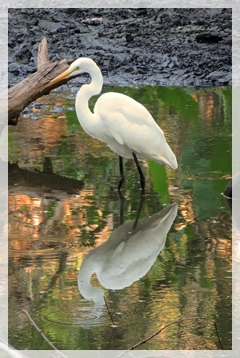
great egretFrom the viewing platform at the marsh, I watched a Cooper’s hawk soar high in the sky. When I turned to leave, I looked down and saw several white egret feathers on the ground below. Whether it was the hawk, a raccoon, or some other predator, the park had one less egret in the pond. Those beautiful white feathers were a stark reminder of how precarious life is, not just for wild birds, but for us all. I was reminded of Ecclesiastes: “For people and animals share the same fate—both breathe and both must die.” [3:19]

Beginning with the words, “Everything is meaningless,” much of Ecclesiastes expresses disappointment, discontent, and a cynical world-weariness. The world is a fallen place where life is unfair: good happens to the bad and bad befalls the good. The future is unknown and filled with uncertainties and satisfaction is not guaranteed. We can strive for a goal and never reach it or attain the goal and discover it wasn’t worth the effort. The pursuit of pleasure, possessions, wealth, achievements, wisdom, or power comes to nothing. As disheartening as the author’s words are, I’m not sure we can really argue with them. Life is capricious and frequently makes no sense and the same destiny—death—awaits both the righteous and wicked. Sadly, sometimes, our efforts really do feel like an exercise in futility.

Yet, hidden in those sobering verses are nuggets of beauty and comfort. Just because life is hard and its meaning is hard to find doesn’t mean life is meaningless. Granted, some seasons of life are perplexing, challenging, or downright unpleasant but, as much as we wish we could control or understand them, they are beyond human control and understanding. The seasons of life are not in our hands but God’s. Rather than knowledge and comprehension of His plan, however, God gives us sort of a consolation prize: the ability to find enjoyment in life. While we can’t control the seasons, we can accept and find contentment in them.

Those feathers on the ground were a reminder to live life with gusto—to accept and enjoy whatever we’ve been given—to seize the day! Yet, Ecclesiastes is not an “eat, drink, and be merry because tomorrow you die!” promotion of hedonism. Woven throughout its verses is one more theme—that of fearing God. We can’t find the meaning to life apart from God and we certainly can’t live life on our own terms. The enjoyment of life neither permits us to disobey God not does it exempt us from His law. Telling us to enjoy life, Ecclesiastes also tells us to fear (i.e., obey, revere, love, serve, honor and worship) God while doing so!

Yet God has made everything beautiful for its own time. He has planted eternity in the human heart, but even so, people cannot see the whole scope of God’s work from beginning to end. So I concluded there is nothing better than to be happy and enjoy ourselves as long as we can. [Ecclesiastes 3:12 (NLT)]

That’s the whole story. Here now is my final conclusion: Fear God and obey his commands, for this is everyone’s duty. Go will judge us for everything we do, including every secret thing, whether good or bad. [Ecclesiastes 12:13 (NLT)]

Copyright ©2018 jsjdevotions. All rights reserved. 

ONLY HE CAN MAKE A TREE FROG

For ever since the world was created, people have seen the earth and sky. Through everything God made, they can clearly see his invisible qualities—his eternal power and divine nature. So they have no excuse for not knowing God. [Romans 1:20 (NLT)]

A friend sent a link to some of the most beautiful landscapes in the world; you’ve probably gotten a similar one and been amazed by photos of the northern lights in Iceland, the red and orange pillars of Bryce Canyon, or the Glowworm caves in New Zealand. Awestruck by God’s amazing creation, I thought of how He makes Himself known through all that He’s made. Unfortunately, we tend to hear God better when He shouts with the exceptional and impressive than when He whispers with the small and familiar. obedient plant (false dragonhead) - green tree frogWe’re sure to notice God in the Grand Canyon, the multitude of stars in the night sky, or when watching two million wildebeest, zebra and gazelles migrate through the Serengeti. We sense Him in extraordinary or exotic things like the peacock’s splendid tail, Devil’s Tower, or spectacular sunsets and sunrises. But do we notice Him in the commonplace and unremarkable?

Yesterday, I watched, spellbound, as several bees visited the flowers I was photographing. A bee would enter one of the purple tubular blossoms and disappear as it inched its way deep into the corolla to gather pollen and nectar. After backing out, it would move on to another bloom. A perfect fit, it was as if bee and flower had been designed for one another (and they were). The flowers’ scent attracted the bees and, while the bees gathered food for their hive, they pollinated the plants. What was happening in these ordinary flowers growing wild by the road was truly extraordinary!

God’s grandeur is revealed in the giant trees of the redwood forest but His attention to detail is found in the one billion bacteria that live in just one gram of the forest’s soil. His greatness is made known in the 1,600 miles of the Great Barrier Reef but also in the 1,500 species of fish, 5,000 species of mollusks, 17 species of sea snakes and 6 species of turtles living there. We see our ingenious Creator in the enormous African elephant but also in the oxpeckers and cattle egrets that ride on its back and in the lice, ticks and parasites living on the elephant that are eaten by those birds. God’s artistry is revealed in the 28,000 species of orchids and but also in His amazing design of the wasps, bees, flies, moths, ants and gnats that pollinate them.

God teaches us, speaks to us, and provides for us through his creation. Let’s not fail to see His marvelous work in the everyday and mundane: wasps building a nest, mushrooms appearing on the lawn after a rain, maple leaves turning red in autumn, raindrops glistening on a flower petal, or a squirrel gathering nuts. You may remember the first line of Joyce Kilmer’s poem Trees: “I think that I shall never see A poem lovely as a tree.” The last line reads: “Poems are made by fools like me, But only God can make a tree.” Only God can make a tree, but He’s also the only one who can make the lichens and fungi living on its bark, the small tree frog hiding in its leaves, and the sparrow nesting in its branches.

Praise God, from whom all blessings flow!

Nature is the living, visible garment of God. [Johann Wolfgang Von Goethe]

All things bright and beautiful, All creatures, great and small, All things wise and wonderful, The Lord God made them all. [Cecil Francis Alexander]

O Lord, what a variety of things you have made! In wisdom you have made them all. The earth is full of your creatures. … I will sing to the Lord as long as I live. I will praise my God to my last breath! May all my thoughts be pleasing to him, for I rejoice in the Lord. [Psalm 104:24,33-34 (NLT)]

 Copyright ©2018 jsjdevotions. All rights reserved.

WE ASK THE LORD’S BLESSINGS

Anna Maria Island beachYou will experience all these blessings if you obey the Lord your God: Your towns and your fields will be blessed. Your children and your crops will be blessed. The offspring of your herds and flocks will be blessed. Your fruit baskets and breadboards will be blessed. Wherever you go and whatever you do, you will be blessed. [Deuteronomy 28:2-6 (NLT)]

When praying for the Church one recent Sunday, we asked our Creator God to bless wild animals and family pets, prairies and kitchen gardens, beaches and sandboxes, mountains and hearths. While I’m used to asking God for spiritual blessings, to bless people and even activities (such as a ministry), I’m not as used to asking Him to bless physical things (and certainly not sandboxes and beaches).

While people may present their pets for a special blessing of the animals, I’ve never thought to ask for God’s blessing on creatures such as the squirrel, panther, skunk, or alligator. I frequently thank God for the beauty of His wildflowers but have never asked Him to bless the prairie displaying those flowers and, when saying grace, I ask Him to bless our food and those eating it but I haven’t thought to ask Him to bless the farmer or the garden that grew that food. I often asked God’s blessing on my children while they dug in their sandbox or played at the shore but I didn’t ask Him to bless either the sandbox or beach. When gazing at the Grand Tetons, in awe of God’s power and majesty, I thanked Him for His magnificent mountains. It didn’t occur to me that I could ask Him to bless those peaks and I’ve never asked Him to bless the slate on my fireplace hearth or the granite on my counters.

Ministers and priests often ask blessings on sacramental objects like baptismal water, bread, wine, and even wedding rings, but I’ve not heard them ask God’s blessing on the reservoir, wheat field, grape arbor or gold mine that produced those things. Yet, asking blessings on things is not so odd. When I asked God to bless my brother-in-law, I didn’t know that the wings he proudly wore on his Navy uniform had been blessed in a special ceremony when he graduated from fight school. An annual Blessing of the Fleet has been a tradition for boaters, sailors, fishermen, and the Navy for generations. The Roman Catholic Church has specific rituals for the blessing of things designated for sacred purposes, such as vestments or a chalice, and also for those designated for ordinary use, such as a cornerstone, houses, schools, and hospitals. Whenever we sing “God Bless America,” we ask God to bless our nation and I suppose we can ask for God’s blessing on anything, as long as it isn’t evil or would lead to sin. Nevertheless, I seriously doubt that God blessed any of the assault rifles brought to a ceremony last February that was sponsored by the Sanctuary Church and Rod of Iron Ministries (offshoot of the Unification Church).

God is the source of all good things and, in that Sunday’s prayer, I think we were asking Him to shower His goodness on all of His creation so that it would sing with joy. We were asking for His divine care and the restoration and protection of the world in which we live. We asked God to reveal Himself in His creation and, as we asked for His blessings on it, we offered Him our praise and grateful hearts. Most of all, the words of that prayer reflected the love that both God and His Church have for all of creation. They also served as a vivid reminder of the obligation and responsibility we have to care for all that has been given to us.

Unfailing love and truth have met together. Righteousness and peace have kissed! Truth springs up from the earth, and righteousness smiles down from heaven. Yes, the Lord pours down his blessings. Our land will yield its bountiful harvest. Righteousness goes as a herald before him, preparing the way for his steps. [Psalm 85:10-13 (NLT)]

Copyright ©2018 jsjdevotions. All rights reserved.

THEY SENT HIM AWAY (Mark 5:1-18 – Part 2)

If you refuse to take up your cross and follow me, you are not worthy of being mine. If you cling to your life, you will lose it; but if you give up your life for me, you will find it. [Matthew 10:38-39 NLT]

pansyThere’s probably no end of sermons and commentary on the swine that went plunging into the lake after Jesus saved the demoniac. “Why pigs?” some ask while others focus on the death of the animals rather than the salvation of a man. Non-believers criticize Jesus for his “wanton destruction” of other people’s property without realizing their criticism implies their belief in the miracle. Theologians respond that since Jesus is God, those pigs actually belonged to Him. I don’t know what the demons wanted when they asked to be sent into the pigs, why they plunged down the hillside to their death, or what happened to the demons after that. What I do know is that the value of 2,000 pigs does not exceed the value of one human soul.
Rather than the pigs, I’d rather consider the townspeople and their reaction to the demoniac’s miraculous healing. A crowd soon gathered around Jesus and the now obviously sane man. Rather than joy over his miraculous restoration, the people only saw their loss and they told Jesus to go away. Since much of their wealth had just perished in the lake, their initial reaction is understandable. Moreover, with the Gerasenes being a Gentile region, the people had no messianic expectations. Understandably, encountering a man so powerful that he could banish demons and send pigs over a cliff frightened them. Yet, there is no record of anyone asking Jesus who He was, why He’d come, what He wanted, or from where His power came. They just pled with Him to leave them alone!

Unfortunately, the people closed their minds and chose wealth and fear over the miraculous healing brought by Jesus. What Jesus could have given them far outweighed the loss of a herd of pigs. Surely, the demoniac wasn’t the only one in the region needing healing and yet no one else approached this amazing healer who’d arrived on their shores. Sadly, the people were so afraid of how Jesus would impact their lives that they rejected Him. I wonder if we, like the people of the Gerasenes, allow fear and materialism to keep us from welcoming Jesus into our lives. As theologian D.A. Carson says of the Gerasenes’ people, “They preferred pigs to persons, swine to Savior.” We must never do the same!

When Jesus steps into our lives, He radically changes us. He will restore us as He did for the demoniac but it will come at a cost, as it did for the townspeople. Jesus doesn’t want just a portion of us and what’s ours—He wants all of us and everything we possess. That means giving up a whole lot more than a herd of pigs. Rather than being afraid of Him and His power, as were the townspeople, we must trust Him and welcome Him with open arms. After all, is anything worth more than a soul?

Then Jesus said to his disciples, “If any of you wants to be my follower, you must give up your own way, take up your cross, and follow me. If you try to hang on to your life, you will lose it. But if you give up your life for my sake, you will save it. And what do you benefit if you gain the whole world but lose your own soul? Is anything worth more than your soul? [Matthew 16:24-26 (NLT)]

Copyright ©2018 jsjdevotions. All rights reserved.

THE GOOD SHEPHERD

I am the good shepherd; I know my own sheep, and they know me, just as my Father knows me and I know the Father. So I sacrifice my life for the sheep. I have other sheep, too, that are not in this sheepfold. I must bring them also. They will listen to my voice, and there will be one flock with one shepherd. [John 10:14-16 (NLT)]

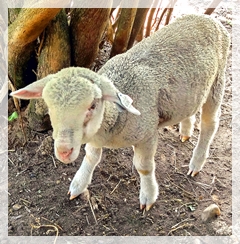
lambIn Ezekiel 34, the Lord commanded Ezekiel to prophesy against the shepherds of Israel—not the caretakers of sheep but the prophets, priests, and leaders who were supposed to protect their people in the same way a shepherd does his sheep. He accused them of not searching for lost sheep and abandoning their flock to be attacked by wild animals.

Surely the people were familiar with Ezekiel’s words when they heard Jesus tell the parable we know as “The Lost Sheep” or “The Good Shepherd.” Told both in Luke 15 and Matthew 18, the shepherd leaves his ninety-nine sheep in the wilderness so he can search for a lost one. Although its point is to illustrate God’s overwhelming concern for saving His people and to explain Jesus’s conduct in associating with sinners, the shepherd’s behavior in abandoning ninety-nine sheep seems irresponsible. Who’s going to keep them from going astray, drowning in a pond of water (that wet wool is heavy), or being devoured by hungry wolves? Won’t the shepherd return with the one stray sheep only to find a dozen or more missing or dead? That’s hardly cause for celebration! Did that shepherd abandon his flock like the shepherds in Ezekiel’s prophecy?

If this was a true story, before heading off into the wilderness, the good shepherd would have entrusted his flock to another shepherd. Biblical scholars, however, remind us that Jesus’s parables weren’t meant to portray real-life situations any more than were Aesop’s fables. We know a tortoise won’t challenge a hare to a race, geese don’t lay golden eggs, and a fox can’t talk to a crow. Yet, in spite of their inconsistencies, both Jesus’s and Aesop’s stories make their points.

Nevertheless, Jesus always seemed to be very concise in His choice of words and I wonder if he deliberately omitted a second shepherd or caretaker for a reason. Perhaps there is only one shepherd because there is only one God. He is not about to share us with another god so the shepherd won’t entrust the care of his beloved flock to anyone else. God is omnipresent, unlimited by time or space, and can be in all places at the same time. When the good shepherd rashly goes into the wilderness for the one lost sheep, he hasn’t abandoned the other ninety-nine. Ever-present, while he’s off saving the stray, he also is there tending the rest of the flock.

The Pharisees never questioned Jesus about those abandoned sheep. Like their predecessors, they’d abandoned their flock and failed to seek the lost; Jesus’s parable made it clear that a new shepherd was in town. Perhaps the parable also helped prepare the disciples for a time when they would feel abandoned. Jesus soon would be leaving them but, like the good shepherd, He would return. His disciples, like the sheep left behind, would remain safe in His care. I’m no longer troubled by those abandoned sheep because I know God will never desert us. Indeed, the Lord is our shepherd and we will not be afraid. Whether or not we are aware of His presence, He is close beside us.

I know the Lord is always with me. I will not be shaken, for He is right beside me. [Psalm 16:8 (NLT)]

I will remain in the world no longer, but they are still in the world, and I am coming to you. Holy Father, protect them by the power of your name, the name you gave me, so that they may be one as we are one. While I was with them, I protected them and kept them safe by that name you gave me. [John 17:11-12a (NLT)]

Copyright ©2018 jsjdevotions. All rights reserved.