IN PRAISE OF HIS WORD

I will meditate on your precepts and fix my eyes on your ways. I will delight in your statutes; I will not forget your word. … The law of your mouth is better to me than thousands of gold and silver pieces. … How sweet are your words to my taste, sweeter than honey to my mouth! [Psalm 119: 15-16, 72, 103 (ESV)]

The more you read the Bible; and the more you meditate on it, the more you will be astonished with it. [Charles Spurgeon]

BiblesPsalm 119, the longest of the psalms, is a song in praise of the Word of God. Since we don’t read this psalm in its original Hebrew, we fail to appreciate its intricate construction. Each of its twenty-two sections begin with a letter of the Hebrew alphabet in sequence. Each of the eight verses in those twenty-two sections begin with the letter that introduced it. For example, the first word of the first section begins with alef, as do the next seven verses. In the second section, every line begins with beth. The psalm continues that way up to the 22nd (and last) section where every line begins with the final letter of the Hebrew alphabet, tav.

Using a variety of synonyms (such as words, ways, precepts, testimonies, commandments, path, and law), the psalmist mentions God’s word no less than 183 times! Believed to have been written by David, Jeremiah, Daniel or Ezra, the psalm’s author refers to himself as God’s servant and claims to praise God seven times a day. Whoever it was, penning a 176-line song about delighting in God’s word as an acrostic was a true labor of love.

I thought of this psalm when reading author Ann Voskamp’s description of the joy with which a nomadic tribe in Northern Kenya reacted when Bibles arrived in their village. Packed in cardboard boxes, God’s Word arrived on the back of a camel and was greeted by more than a thousand Rendille tribespeople along with dozens of their distant neighbors. After waiting 30 years for this day, the Rendille finally had Scripture’s words written in their own language. Having written praise songs specifically for the celebration, the women sang, “We give thanks to the Lord. The Word of God is like a pillar in our life. We give thanks to the Lord for this day for it is the first time we have the Bible in our own language.” Voskamp described how several women even slept with their Bibles under their pillows, “because it was treasured. They had nothing more valuable or priceless in their entire lives than God’s Word.”  For these followers of Christ, their newly translated Bibles were better than “thousands of gold and silver pieces.”

Unlike the Rendille people, we’ve had God’s word in our own language since William Tyndale’s translation of the New Testament in 1525; ten years later, the entire Bible was available in English. As the best-selling book of all time, Lifeway reports that about 85% of American homes have a Bible and the average household owns between four and five! While I suspect those Rendille tribespeople regularly read their Bibles, the Barna Group found that only about 35% of Americans ever read any of it and 36% of Americans never read at all! Yet, last year, the American Bible Society found that 71% of Americans are curious about the Bible and/or Jesus. There seems to be a disconnect here! If we’ve got questions about cooking, investing, bitcoins, or a medical condition, we research those topics. But, when we’re curious about the Bible or Jesus, those four plus Bibles in our homes remain unopened!

Both the psalmist and Rendille tribespeople celebrated God’s beautiful gift of Scripture. Finding it as “sweet as honey” and better than gold, they treasured this lamp to their feet and light for their path. After witnessing the Rendille’s enthusiastic response to the Bibles’ arrival along with their gratitude and joy in the Word, Voskamp asked herself, “How many Bibles do I have that are on my shelf collecting dust? Do I treasure God’s Word like this?”

Hers is a valid question and one we all should ask ourselves. Do we cherish and appreciate God’s word as did the author of Psalm 119? Do we receive God’s love letter to His people with the enthusiasm of the Rendille people? We should! After all, other than Jesus, it is the best gift God gave to man! Scripture’s words belong in our hearts rather than collecting dust in our bookcases!

I venture to say that the bulk of Christians spend more time in reading the newspaper than they do reading the Word of God. [Charles Spurgeon]

Oh how I love your law! It is my meditation all the day. Your commandment makes me wiser than my enemies, for it is ever with me. … Your word is a lamp to my feet and a light to my path. … Therefore, I love your commandments above gold, above fine gold. [Psalm 119:97-98, 105, 127 (ESV)]

Copyright ©2025 jsjdevotions. All rights reserved.

EUCHARISTEO

And he took a cup, and when he had given thanks he gave it to them, saying, “Drink of it, all of you for this is my blood of the covenant, which is poured out for many for the forgiveness of sins.” [Matthew 26:27-28 (ESV)]

The celebration of the Lord’s Supper/Holy Communion/the Eucharist has been central to Christian worship since the early church. While Protestants think of the Eucharist as the sacrament commemorating the Last Supper with bread and wine, for Roman Catholics and some Orthodox, “Eucharist” specifically refers to the consecrated elements, especially the bread. How ever you define it, the word “eucharist” originally had nothing to do with this beautiful sacrament.

Meaning to be thankful, the Greek eucharisteó comes from  meaning “grateful” and charizesthai meaning “to offer graciously”. Charizesthai  comes from charis, meaning “grace” (a gift that cannot be repaid) from chario meaning “to rejoice”. From its etymology, eucharisteó isn’t the kind of thanks we’d say to a friend who saved us a seat at the movie or to someone for opening the door for us. Encompassing the ideas of thanksgiving, grace in receiving a gift that cannot be repaid, and rejoicing or joy, eucharisteó is the kind of thanks that is specifically directed toward God! This is the word the Apostle Paul used whenever he said he thanked God. We find Jesus giving thanks (eucharisteó) before feeding the 5,000 and again before taking the wine at the last supper.

The first sacramental Eucharist took place during a Passover meal (seder) celebrating Israel’s deliverance from bondage to Egypt. The question “Why is this night different from all other nights?” would have been asked early in the seder and would have been answered by a retelling of Israel’s exodus from Egypt. When Jesus took the bread and passed it to the disciples, they didn’t know that the bread symbolizing Israel’s suffering in Egypt would come to represent the Lord’s suffering on Calvary. When Jesus filled the cup and passed it to the disciples, they didn’t know that the wine symbolizing Israel’s redemption from slavery in Egypt would come to represent the blood Jesus shed to purchase mankind’s redemption from sin.

While the disciples didn’t understand what lay ahead for Jesus that night, let’s not forget that Jesus certainly did! He knew that His body, having been defeated by thorns, whip, nails, and cross, would be broken in less than a day. Nevertheless, knowing full well the torment he would suffer and the blood He’d shed, Jesus graciously offered Himself for us and gave thanks—and not just any old thanks. He gave eucharisteó—the sacrificial lamb gave thanks to God with joy!

Like the exodus, the story of Jesus is one of redemption. Israel was in bondage to Pharaoh—mankind in bondage to sin and death. Israel was saved by the blood of a lamb; we are saved by the blood of the Lamb of God. Moses led the people to the Promised Land; Jesus leads us into the Kingdom of God. When we partake of the bread and wine during Holy Communion, let us pause and ask, “What makes this meal different from any other?” Do we recognize God’s grace and give thanks (eucharisteó) with joy?

So the community of the cross is a community of celebration, a eucharistic community, ceaselessly offering to God through Christ the sacrifice of our praise and thanksgiving. The Christian life is an unending festival. And the festival we keep, now that our Passover Lamb has been sacrificed for us, is a joyful celebration of his sacrifice, together with a spiritual feasting upon it. [John Stott]

Therefore, as you received Christ Jesus the Lord, so walk in him, rooted and built up in him and established in the faith, just as you were taught, abounding in thanksgiving. [Colossians 2:6-7 (ESV)]

Copyright ©2025 jsjdevotions. All rights reserved.

THE BRILLIANT THINGS

This is the day that the Lord has made; let us rejoice and be glad in it. [Psalm 118:24 (ESV)]

What would you do if you were six and your father said that your mom is in the hospital because she finds it hard to be happy and “did something stupid”? That question is answered in Duncan Macmillan and Jonny Donahoe’s one-act play, Every Brilliant Thing. In their play, that boy, now a grown man, tells the audience that he made of list of everything that was “brilliant” about the world—everything worth living for—and left it on his mother’s pillow. Reflecting a six-year old’s priorities, the list included ice cream, Kung-Fu movies, laughing so hard you shoot milk out your nose, burning things, construction cranes, and “me.” Although she returns the list with its spelling corrected, the boy’s mother never comments on it. Nevertheless, he keeps adding to his list. Although his mother eventually takes her life, the narrator tells how his list took on a life of its own and eventually saved him from his own depression and suicidal thoughts.
Throughout the play, the audience learns of additions to the list—everything from peanut butter, water fights, and sunlight to peeing in the sea with nobody knowing, someone lending you a book, cycling downhill, and completing a task. Sort of a theatrical and secular version of Ann Voskamp’s One Thousand Gifts, Every Brilliant Thing is a poignant reminder of the importance of noticing and naming the little “brilliant” things in our lives—to step out of ourselves to take in the small blessings with which God blesses us every day—to pause and feel God’s love in a stranger’s smile, a nurses’ gentle touch, the sound of children’s laughter, the smell of lemon zest, the taste of a fresh-baked warm chocolate chip cookie, a mockingbird’s serenade, a compliment, or the smell of a campfire! No one’s list is the same nor should they be.

Nearly three years ago, Voskamp’s book inspired me to start my own list of “gifts” (what Macmillan and Donahoe called “brilliant” things). But, like the play’s narrator, I put it aside after a while. Although there were moments I thought, “That’s one for the list,” I rarely added them and they were forgotten. It wasn’t until my most recent bout with depression and pain that I resumed adding to it. Of course, I couldn’t add to the list without making a point of opening my eyes to God’s presence in the ordinary stuff of life. Some were big things like taking Communion or learning that my girls are visiting in a few weeks. Most things, however, are pretty mundane—the aroma of night-blooming jasmine, the two standard poodles that sit regally beside their person as he chauffeurs them around the community in his golfcart, Savannah Guthrie’s  book Mostly What God Does, whipped cream on a cup of hot cocoa, and monarch butterflies. There’s nothing extraordinary about these “brilliant” things; nevertheless, they bring a smile to my face and remind me of God’s presence in all things.

Although our cups overflow with God’s blessings, it’s been said that joy comes in sips rather than gulps. May we always remember that it wasn’t in the storm that Elijah heard God—it was in His whisper. Indeed, God whispers to us in the seemingly insignificant but “brilliant” things of life. Let us take note of each and every one!

There is not one little blade of grass, there is no color in this world that is not intended to make men rejoice. [John Calvin]

You serve me a six-course dinner right in front of my enemies. You revive my drooping head; my cup brims with blessing. Your beauty and love chase after me every day of my life. I’m back home in the house of God for the rest of my life. [Psalm 23:5-6 (MSG)]

Copyright ©2025 jsjdevotions. All rights reserved.

IN PAIN

So to keep me from becoming conceited because of the surpassing greatness of the revelations, a thorn was given me in the flesh, a messenger of Satan to harass me, to keep me from becoming conceited. Three times I pleaded with the Lord about this, that it should leave me. But he said to me, “My grace is sufficient for you, for my power is made perfect in weakness.” [2 Corinthians 12:7-9 (ESV)]

But pain insists upon being attended to. God whispers to us in our pleasures, speaks in our conscience, but shouts in our pain: it is His megaphone to rouse a deaf world… [C.S. Lewis]

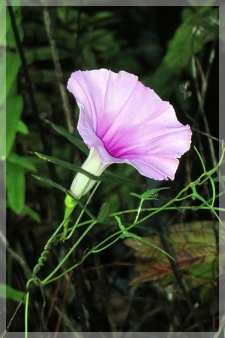
morning gloryDuring that dark time about which I recently wrote, I was in intense pain and it seemed like God had turned His back on me. When I confided to a friend that God seemed deaf to my pleas, she asked the simple question, “Have you turned it over to the Lord?” I assured her I had but, as the day wore on, I wondered if that were true.
In my prayers for relief, I was telling God the outcome I desired, but that really isn’t “turning it over” to Him. If any human had a direct line to God’s heavenly office, it would have been the Apostle Paul and yet God didn’t relieve him of whatever his thorn was! Instead of demanding the result I wanted, I had to place myself in God’s loving hands as did Paul and pray for God’s grace and the power to accept what He’d placed in my lap.

Each morning, I prayed for grace enough for the day—for the strength, endurance, peace, patience, courage, and joy needed to get through the next twenty-four hours. I asked God to reassure me of His lovingkindness and to protect me from the doubt, fear, and negativity Satan was whispering in my ears. The hardest thing, however, was to hand the outcome of my upcoming surgery into His loving hands. I had to trust in His plan and presence regardless of its outcome. The physical pain remained but, with the power of the Spirit, I dealt with it.

I don’t think God decides our fate with a toss of the dice and, while a quick view of my MRI told me the why of my present physical pain, I asked God to help me understand its purpose. Paul knew his thorn was to keep him from being conceited; what was my pain telling me? In The Problem of Pain, C.S. Lewis points out how easy it is to ignore God when all is well. “We will not seek it [our happiness] in Him as long as He leaves us any other resort where it can even plausibly be looked for. While what we call ‘our own life’ remains agreeable we will not surrender it to Him.” Admittedly, I’d been in a state of “meh” and become self-sufficient rather than God-dependent and lax in my spiritual disciplines. Like the Apostle Paul, perhaps I’d become too sure of myself; the intense pain reminded me of my need for God!

As C.S. Lewis wisely pointed out, an intellectual understanding of pain is far easier than the fortitude, courage, and patience needed to endure it. It’s far easier to talk the talk than walk the walk! Nevertheless, endure it we must and through the power of the Holy Spirit, we can!

By the time this devotion is published, I will have had the surgery that, God willing, will relieve my pain. While I don’t know what my future holds, I do know who holds it in His loving hands and I trust that He will supply me with all I need to face whatever it may be.

And we know that for those who love God all things work together for good, for those who are called according to his purpose. … Who shall separate us from the love of Christ? Shall tribulation, or distress, or persecution, or famine, or nakedness, or danger, or sword?… No, in all these things we are more than conquerors through him who loved us. For I am sure that neither death nor life, nor angels nor rulers, nor things present nor things to come, nor powers, nor height nor depth, nor anything else in all creation, will be able to separate us from the love of God in Christ Jesus our Lord. [Romans 8:28, 35, 37-39 (ESV)]

Copyright ©2025 jsjdevotions. All rights reserved.

WHERE IS HE?

How long, Lord? Will you forget me forever? How long will you hide your face from me? How long must I wrestle with my thoughts and day after day have sorrow in my heart? How long will my enemy triumph over me? Look on me and answer, Lord my God. Give light to my eyes, or I will sleep in death, and my enemy will say, “I have overcome him,” and my foes will rejoice when I fall. [Psalm 13:1-4 (NIV)]

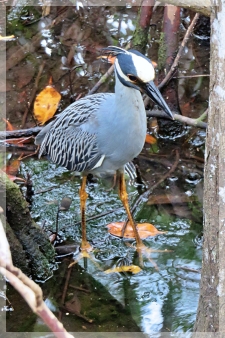
yellow crowned night heronWhen I first started reading the psalms, I suspected David might have been bi-polar—his highs seemed so high and his lows so very low; now I understand that he was just being truthful. In his psalms, David unabashedly expressed his deepest feelings to God. Pouring out his soul, he openly shared his emotions—whether anger, disappointment, sorrow, regret, shame, joy, love, fear, doubt, or even his desire for vengeance upon his enemies. No matter how troubled he was, David never was afraid to speak from his heart. I’m not sure we are willing to be as vulnerable and straightforward in our prayers as was David.
Thinking God had forgotten him (or was deliberately ignoring him), David dared to complain of the Lord’s unkindness in Psalm 13. In A Grief Observed, C.S. Lewis expressed a similar feeling of being ignored by the Lord. After noting how present God seemed in the good times, Lewis asked “where is God?… Go to Him when your need is desperate, when all other help is vain, and what do you find? A door slammed in your face, and a sound of bolting and double bolting on the inside. After that, silence.” He asked, “Why is He so present a commander in our time of prosperity and so very absent a help in time of trouble?”

Indeed, it is easy to see God in times of safety, prosperity, and health. We perceive in Him a hillside of flowers but not when a wildfire destroys an entire town. We see His work in the birth of a child but not in a child’s death at the hands of a school shooter. We feel His presence when a loved one defeats cancer but He seems absent when we suffer from chronic pain. C.S. Lewis warned that the danger we face in those dark times is not so much that we’ll stop believing in God but that we’ll come to believe that God is not good! We’re tempted to give up on Him because it seems He’s given up on us!

In this fallen world, there will be times when, like C.S. Lewis and David, it seems that God has turned his back to us. We feel forsaken and disregarded. Having recently gone through a dark time when it felt like God’s office door was closed to me, I found myself praying the words of Psalm 13. Fortunately, I didn’t stop at the first four verses. After expressing his feeling of being abandoned, David turned to praise and proclaimed his confidence in God’s love, faithfulness, and deliverance.

Like David, I will trust in the Lord’s goodness in all things—even those things I don’t understand. Rather than believing in the goodness of life, I will choose to believe in the goodness of God.

But I trust in your unfailing love; my heart rejoices in your salvation. I will sing the Lord’s praise, for he has been good to me. [Psalm 13:5-6 (NIV])

But this I call to mind, and therefore I have hope: The steadfast love of the Lord never ceases; his mercies never come to an end; they are new every morning; great is your faithfulness. “The Lord is my portion,” says my soul, “therefore I will hope in him.” [Lamentations 3:21-24 (ESV)]

Copyright ©2025 jsjdevotions. All rights reserved.

CHRISTMAS SPIDERS

To all who mourn in Israel, he will give a crown of beauty for ashes, a joyous blessing instead of mourning, festive praise instead of despair. In their righteousness, they will be like great oaks that the Lord has planted for his own glory. [Isaiah 61:3 (NLT)]

Who can add to Christmas? The perfect motive is that God so loved the world. The perfect gift is that He gave His only Son. The only requirement is to believe in Him. The reward of faith is that you shall have everlasting life. [Corrie Ten Boom]

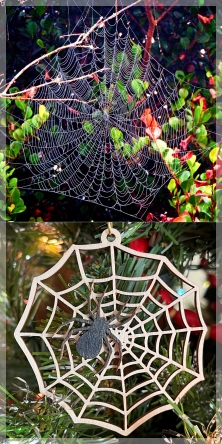
It was a web day at the park and I don’t mean the world-wide kind. It was one of those days when the morning dew, mist, and light cooperated in such a way that we saw beautiful intricate spider webs hanging everywhere. Looking as if they were made of strands of silver rather than proteinaceous silk extruded from a spider’s spinnerets, it seemed like the spiders had decorated all the trees in celebration of Christmas.

The glistening webs reminded me of an old folktale my mother read to me every Christmas. As I remember it, while the mother thoroughly cleaned her house in preparation for Christmas, the spiders fled to the attic lest they be swept away with their webs. Hearing the joyful sound of carols being sung on Christmas Eve, the spiders grew curious. Once the family went to bed, the spiders crept downstairs to see what the commotion had been about. Amazed by the beautifully decorated tree, they crawled up and down the tree all night long as they admired every shiny ornament. Unfortunately, by morning’s light, the tree was covered with gray webs and attic dust and the ornaments were barely visible.

On Christmas morning, when the Christ child came to bless the house, He saw the spiders and their strands of silk covering the tree’s branches. Knowing how sad the family would be to see their once beautiful tree covered with dusty webs, the Christ child touched it. The spiders’ gray threads immediately turned into strands of silver and gold and the exquisite tree shimmered and shone more beautifully than ever.

I love this folktale and not just because it explains how the custom of hanging silver tinsel on a tree began. The Christ child, with His heart full of love, entered the home to bring a blessing to the family. By touching the damaged tree, He transformed it into a thing of beauty and, with His touch, Christ saved their Christmas celebration.

Christ’s love for mankind isn’t limited to legends and folk stories. With a heart full of love for all, He comes into our lives to bless each and every one of us. When He touches our damaged souls, like the tree, they become things of beauty. Unlike the tree, however, we won’t look any different or be adorned with strands of gold and silver. Nevertheless, once He’s touched us, our lives will be beautifully transformed. Jesus doesn’t just save our Christmas; He saves our lives!

Our Christmas tree has no silver tinsel to remind me of Jesus’ miraculous touch, but it does have a spider web ornament to remind me of this story from my childhood. On the other hand, every time I see spider webs glistening in the early morning light, I remember how Christ has transformed my dusty and damaged life into a thing of beauty and joy. Thank you, Jesus.

The first gift of Christmas was love. A parent’s love. Pure as the first snows of Christmas. For God so loved His children that He sent His son, that we might someday return to Him. [Richard Paul Evans]

For this is how God loved the world: He gave his one and only Son, so that everyone who believes in him will not perish but have eternal life. God sent his Son into the world not to judge the world, but to save the world through him. [John 3:16-17 (NLT)]

Copyright ©2024 jsjdevotions. All rights reserved.