
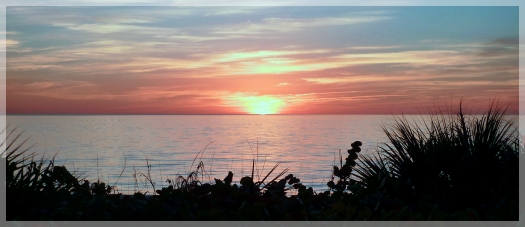
 God makes a huge dome for the sun—a superdome! The morning sun’s a new husband leaping from his honeymoon bed, The daybreaking sun an athlete racing to the tape. That’s how God’s Word vaults across the skies from sunrise to sunset, melting ice, scorching deserts, warming hearts to faith. [Psalm 19:4-6 (MSG)]
Being an early riser, I’m often out walking as the sun rises. Each new day brings amazing new opportunities and, while the mocking birds loudly sing their praises and the mourning doves coo their peaceful song, I thank God for yet another day on this side of the grass. While the morning’s soft pastels are beautiful, it’s the sunsets in our part of the world that are spectacular.
Our Florida lanai faces west and every evening, shortly before sunset, we try to stop whatever we are doing to admire the western sky. We breathe in deeply of God’s glory and majesty as He paints the heavens. We considered turning sunsets into something like an Olympic event and awarding points to God for each day’s sunset. The vibrant red ones that make the sky look as if it’s on fire might get nine or even ten points while a gray one having just a bare hint of pink might get only a two. After discussing it, however, we realized that sunsets, regardless of their colors, are truly magnificent and a cause for thanksgiving. Every sunset, no matter how colorful or dull, is a gift from God deserving of a perfect score and a reason for rejoicing. Sunsets mean we’ve made it safely through yet another day. They bring closure; we know that the day and whatever came with it, both good and bad, is over and done. But they also bring the promise of tomorrow and the wonderful possibilities that will come with a new day. Even our very last sunset will bring the assurance of dawn on the other side: it will be a time when we’ll truly see the Son.
Looking at the sun setting in the west, I recall my years at summer camp when I’d hear the solemn call of the trumpet at sunset and I silently sing the words to “Taps.” Indeed, all is well and I can safely rest because God is near. Tonight, at sunset, wherever you happen to be, pause, if only for a moment, and thank God for the privilege of one more blessed day.
Day is done, gone the sun,
From the lakes, from the hills, from the sky.
All is well, safely rest, God is nigh.
Thanks and praise for our days,
‘Neath the sun, ‘neath the stars, ‘neath the sky.
As we go, this we know, God is nigh.
[Horace Lorenzo Trim]
 As the economy tanks and COVID-19 spreads, we hear economists and politicians speak of making a cost-benefit analysis to determine the cost of a prolonged shutdown of business and industry with millions out of work versus the cost of hundreds of thousands (or millions) of people dying. How do we put a price tag on life, especially if the life is ours or that of someone we know and love?
 Even though we live 1,400 miles away, I still stay in touch with our northern church; after all, it was our church home for forty-six years. Over the last several months, I’ve joined them in a weekly abundance exercise, the purpose of which is to realize the abundance in life promised by Jesus. Reminding me that “love is an action word,” my abundance assignment was: “Be love to a family member or an old friend you haven’t spoken to in a while.” I was to call or visit someone with whom I’d fallen out of touch and the reconnect was to be more than a quick note or text. Since my calendar was already crowded with meetings, guests, deadlines, chores, and other obligations, I griped that the last thing I wanted or needed was another task (even if it was as simple as meeting an old friend for lunch). With an abundance of items on my to-do list, I certainly didn’t need one more to have an abundant life! I figured this exercise could wait for a more convenient time.
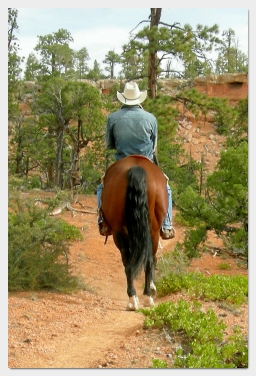 In A Gentle Thunder, author Max Lucado compares the hero of the Bible, the shepherd, with the hero of the American west, the cowboy. They both herd livestock, their home is the range, and they sleep under the stars. The difference, says Lucado, is that the shepherd knows and loves his sheep because he leads them to be shorn. The cowboy, however, doesn’t get attached to his cattle because he’s leading them to slaughter! While several cowboys drive a herd of cattle and know one another’s names, just one shepherd leads a flock of sheep and it is their names that he knows!
 When Jesus finished the Sermon on the Mount, the crowds were astounded at his teaching because, unlike the scribes and Pharisees, He taught with “authority.” When the people wondered at Jesus’ authority, they weren’t referring to His ability to speak confidently and persuasively. The Greek word translated as “authority” was exousia which meant power or right; the people wondered at Jesus’ authorization to say the things He said. Rather than teach on their own authority, most rabbis taught on the authority of earlier sages. The Moody Bible Commentary depicts them as virtual “walking footnotes” who merely cited famous teachers and repeated what had been said before by others.
 The story has been told of a shoemaker who dreamt that Jesus would come to his shop the following day. His dream was so realistic that he washed his shop windows and dusted every shelf in preparation for his holy guest. The man patiently waited at his bench for the Lord to arrive but the only person to come through his door that morning was an old man seeking shelter from the icy winter rain. When the cobbler looked down at the man’s wet feet, he saw toes poking out of his beat-up shoes. Selecting a new pair of shoes, the shoemaker sat the old man down, dried off his feet, gave him a fresh pair of socks, and fitted him with the new shoes. When the rain stopped, the old man went on his way.
 Devotions of the Heart