FILLED WITH JOY

Light shines on the godly, and joy on those whose hearts are right. [Psalm 97:11 (NLT)]

I will be filled with joy because of you. I will sing praises to your name, O Most High. [Psalm 9:2 (NLT)]

CLOWNSWhat makes us happy? Could it be a phone call from a good friend? Is it when we’ve made a profit in the stock market or received a large commission check? Are we pleased when our checkbook balances on the first attempt or when the accountant informs us that a large tax refund will be in the mail? Are we happy when someone sends us flowers or our child brings home a good report card? Does finding the ideal gift for our spouse’s birthday or receiving the perfect gift for ours give us happiness? Would we be happier if we could enjoy two weeks at a luxury resort or had a state-of-the-art home theatre or gourmet kitchen?

Happiness tends to depend on external circumstances. Joy, however, is something we can have regardless of what is occurring around us. We are made happy by something that happens to us. In contrast, we are filled with joy by something that happens in us: God’s love.

We’ve all known people who almost radiate with joy. They seem to light up a room when they enter it. When we analyze their lives, however, we often find situations that would surely bring us unhappiness. Their family might be in debt, the husband may be unemployed, or a child might be developmentally disabled. They may have a chronic illness or be in physical pain. In spite of their troubles, however, these people seem incredibly blessed—they’re so much at peace and so full of joy. Why? Because, true joy is not dependent on circumstances. It comes from a steady relationship with God. Whenever I get to know people who sparkle with joy, I discover that they are radiating the joy that comes from a relationship with God. When our lives are linked with God, they will be filled with joy, no matter what our condition may be.

Our God is so wonderfully good, and lovely, and blessed in every way that the mere fact of belonging to him is enough for an untellable fullness of joy! [Hannah Whitall Smith]

Don’t be dejected and sad, for the joy of the Lord is your strength! [Nehemiah 8:10b (NLT)]

Copyright © 2016 jsjdevotions. All rights reserved.

THE INTERESTS OF OTHERS

Love is patient. Love is kind. Love isn’t jealous. … It isn’t rude. It doesn’t think about itself. [1 Corinthians 13:4a,5a (GW)]

First of all, I encourage you to make petitions, prayers, intercessions, and prayers of thanks for all people. [1 Timothy 2:1 (GW)]

hibiscus While writing yesterday’s meditation, I remembered back to my high school days when I studied theater at an arts academy in northern Michigan. I should have been happy for my friend when she got the lead in a play, but I wasn’t. Instead, I was annoyed because I thought that role should have been mine. While the play was still being rehearsed, my friend returned to Ohio with a medical emergency. Did I pray for her? Of course not; I was a self-involved teenager and my only prayer was one of thanks because the lead role became mine. The emergency, however, wasn’t that serious and she returned to school (and her part in the play) several days later. Did I say a prayer of thanksgiving for her? Of course not; being a self-involved teenager, I pouted and gave her the cold shoulder.
Several years later, I was in the hospital after giving birth to my third child. This was back in the days before all those prenatal tests and when women spent five days in hospital before going home with their little one. My roommate was much younger and had just given birth to her first child. As I listened to the pediatrician explain that her baby had Down’s syndrome, I heaved a great sigh of relief. I was the older woman with three children—statistically, I was the mother more likely to hear that diagnosis. Were my first prayers for her and her child? Regrettably, no; my first prayers were ones of thanks that it wasn’t me getting that troubling news!

When misfortune or adversity hit someone else, I readily admit that my first prayers often are not for the injured, distressed, or troubled. Quite likely, they are prayers of thanksgiving that it wasn’t me or my loved ones that were affected. I doubt that I am alone. We hear the sirens and say a prayer of thanks we know where our kids are, a co-worker is down-sized and we heave a sigh of relief that it wasn’t us, a friend is diagnosed with breast cancer and we say thanks for our negative mammogram, we pass by a car accident and are thankful we weren’t in it. While thanksgiving is always a worthy prayer, something tells me God would prefer hearing our intercessions for others before hearing our thanks for escaping accident, illness or hardship.

The Apostle Paul reminds us that love doesn’t think about itself; it thinks about others. We must think beyond ourselves, just as Jesus did when He hung on the cross. With great compassion, He comforted the thief, forgave the angry crowd, and looked to the needs of His mother. While ever grateful for our blessings, compassion and concern for others should always come first.

Worship and intercession must go together, the one is impossible without the other. Intercession means that we rouse ourselves up to get the mind of Christ about the one for whom we pray. [Oswald Chambers]

Don’t be concerned only about your own interests, but also be concerned about the interests of others. Have the same attitude that Christ Jesus had. [Philippians 2:4-5 (GW)]

Copyright ©2016 jsjdevotions. All rights reserved.

TESTING THE FAITHFUL

Examine yourselves to see if your faith is genuine. Test yourselves. Surely you know that Jesus Christ is among you; if not, you have failed the test of genuine faith. [2 Corinthians 13:5 (NLT)]

Netherlands How would we prove we are Christians? If we were Islamic converts to Christianity, seeking asylum in the United Kingdom or several other nations, an assessor would interview us to determine whether or not we actually are believers. Unfortunately, many of those doing the interviewing have no real understanding of Christianity themselves. Worse, as new Christians, we probably won’t know the answers to the sort of questions that are asked while those who are pretending to be Christian might have all the answers memorized. After all, back in Jesus’ time, the Pharisees had all the answers but were sorely lacking in faith. If we failed our interviews, we’d be subject to deportation. For a Christian, especially a Christian convert (an apostate), returning to one’s Islamic homeland could have dire (even fatal) consequences.

The following are actual questions asked by U.K. immigration officers. Can you answer them?
How many books in the Bible? 66—although the Catholic Bible has 73
How many books in the New Testament? 27
How many chapters in the book of John? 21
What is the date of Pentecost? Seven weeks after Easter
Who were the disciples? Simon Peter, Andrew, James son of Zebedee, John, Philip, Bartholomew, Thomas, Matthew, James son of Alphaeus, Thaddeus, Simon the Zealot, and Judas Iscariot

How did you do? Does knowing Bible minutiae define a true believer? If so, there are many (including me) who wouldn’t qualify. According to the American Bible Society and the Barna Group, only 60 percent of practicing Christians can name the first five books of the Bible, fewer know that Solomon was David’s son and less than half know that Elizabeth was John the Baptist’s mother. As Americans, we have no excuse for our lack of knowledge—nearly 90% of us own more than one Bible and we can openly gather in worship and Bible study. Consider the underground Christian church in Islamic nations—they must meet in secret and are lucky to have one or two Bibles shared by everyone.

If knowing Biblical details doesn’t prove one’s Christian faith, what does? If we had to do so, how would we prove our belief in Christ? Does church membership make us followers of Christ? Does being baptized make us true Christians? Does being raised by Christian parents make us believers? Instead, is it an unwavering love of God and belief in Jesus Christ as Lord and Savior that is proof of our faith? Is the real evidence found not in knowing Bible facts but rather in our repentance from sin, obedience to God, humility, active prayer life, exhibition of the fruit of the Spirit, devotion to God’s glory and the love we have for one another?  I wonder—how well would I pass a test of faith? How well would you?

Your strong love for each other will prove to the world that you are my disciples. [John 13:35 (NLT)]

But the Holy Spirit produces this kind of fruit in our lives: love, joy, peace, patience, kindness, goodness, faithfulness, gentleness, and self-control. There is no law against these things! Those who belong to Christ Jesus have nailed the passions and desires of their sinful nature to his cross and crucified them there. Since we are living by the Spirit, let us follow the Spirit’s leading in every part of our lives. [Galatians 5:22-25 (NLT)]

Copyright ©2016 jsjdevotions. All rights reserved.


DOING A MITZVAH

Jesus replied, “‘You must love the Lord your God with all your heart, all your soul, and all your mind.’ This is the first and greatest commandment. A second is equally important: ‘Love your neighbor as yourself.’  The entire law and all the demands of the prophets are based on these two commandments.” {Matthew 22: 37-40 (NLT)]

florida cooter laying eggsIn Hebrew, mitzvah means command and the mitzvoth are the 613 commandments that came from God in the Old Testament. In Reformed Judaism (and Yiddish), mitzvah has come to mean “good deed.” In actuality, I’m sure any good deed falls somewhere within one of those 613 original commands! Moreover, isn’t every good deed a way to connect with God and express both our love for Him and for our neighbor?
Recently, we did what my Jewish friends would call a “mitzvah.” As my husband and I started out on the boardwalk, we politely greeted a young woman. Hoping to walk by ourselves, we headed in the opposite direction. The woman, however, asked if she could join us. Although not what we’d planned, something about her told me she needed more than a guide through the swamp; she needed someone with whom to talk. My husband walked ahead, occasionally stopping to wait for us at various benches along the way. She and I strolled along, taking pictures and chatting. Although I pointed out birds and flowers, most of the conversation centered on her, her pain and uncertainty. We talked about trusting God, having faith, and church.

As a result of her joining us, our walk at the swamp took more than twice the usual time. Our mitzvah, however, came with a reward. Yes, we saw the usual: anhingas, herons, and a limpkin. Then, as we arrived at the raised viewing platform, we glanced up to see three swallow-tail kites. Had we been anywhere else in the swamp, we’d never have spotted them. Seeing those graceful birds with their long pointed wings and forked tails as they soared effortlessly in the sky was an “Aha!” moment from God. After a few minutes, the birds flew off and we walked on. Later, we stopped to look over the prairie. Our new-found friend saw a green anole and we patiently waited while she tried to get a shot of it. Had we not paused, we wouldn’t have seen a doe and her fawn as they pranced across the field, kindly stopping once for a photo opportunity. This rare sighting was another one of God’s “Aha!” moments. As we continued our walk along a side trail, we warned our companion that we’ve never seen any wildlife there. To our surprise, we came upon a Florida cooter just starting to make her nest. We stopped and watched as she dug in the soft dirt. Then, to our delight, she dropped her eggs and carefully buried them. While I’ve seen turtles laying eggs, this was the first time I’ve ever watched the whole process, start to finish, and from the “business end” of the turtle. This was the “hat trick” of “Aha!” moments for the day. Yet, we wouldn’t have been witness to any of them had we not taken the time to give a little of ourselves to someone who needed some companionship.

Jesus told the Pharisees the two greatest commands: love God and love your neighbor. Those two mitzvoth were the basis for all the rest of those 613 Old Testament commands. Every time we are helpful, generous, kind, compassionate, responsive, caring, supportive, and obliging we are obeying His command and doing a mitzvah! Cynics often say, “No good deed goes unpunished.” I prefer thinking that a good deed is its own reward! Moreover, while every good deed is its own reward, God usually puts a little something extra there for us, even if it is three kites, two deer, and a turtle in labor!

Kind deeds often come back to the givers in fairer shapes than they go. [Louisa M. Alcott]

Give, and you will receive. Your gift will return to you in full—pressed down, shaken together to make room for more, running over, and poured into your lap. The amount you give will determine the amount you get back. [Luke 6:38 (NLT)]

Copyright ©2016 jsjdevotions. All rights reserved.


BEATITUDES AND ATTITUDES

Blessed are the poor in spirit, for theirs is the kingdom of heaven. Blessed are those who mourn, for they will be comforted. Blessed are the meek, for they will inherit the earth.  Blessed are those who hunger and thirst for righteousness, for they will be filled. Blessed are the merciful, for they will be shown mercy. Blessed are the pure in heart, for they will see God. Blessed are the peacemakers, for they will be called children of God. [Matthew 5:3-9 (NIV)]

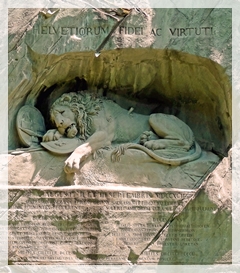
Lion Monument - Lucerne I don’t know about you, but I’m about ready to unplug the televisions until after the elections in November. It doesn’t matter which party or which candidate, the conduct and rhetoric has become nearly unbearable. Today’s Bible reading took me to Matthew 5 and the Beatitudes—those declarations of blessedness given by Jesus at the beginning of His Sermon on the Mount. I couldn’t help but contrast His words with the behavior of our politicians, their supporters and the news media. I then remembered A.W. Tozer’s observation that, if we were to take the Beatitudes and turn them inside out, we’d have the “very qualities which distinguish human life and conduct.”

Our society doesn’t seem to admire those who are modest and meek; we seem to prefer those filled with bombast and swagger. Rather than grief and heartache at our failures, we prefer witticisms, applause and celebration of our successes. Rather than meekness, humility and respectful behavior, we seem to favor assertiveness and pretentiousness. Instead of seeking justice, we pursue self-interest; instead of striving to rectify wrongs, intolerance seems to reign. Rather than compassion, there is indifference and vindictiveness instead of forgiveness. Deceit, guile and vulgarity are more prevalent than frankness, honesty, and morality and it appears that we admire instigators and agitators more than conciliators and negotiators.

Although there has been a large amount of condemnation, disparagement and attempts to discredit one another, I don’t think Jesus was thinking about that sort of mocking and persecution when he gave His message and I doubt that God is blessing anyone for their abysmal behavior just because it results in their disgrace or embarrassment. If we expect blessings for persecution, it should be for following Jesus and righteousness sake and not for pursuing power and self-righteousness.

Pride, greed, selfishness, arrogance, ruthlessness, dishonesty, bickering, and meanness—all of these are contrary to the Beatitudes. I admit that I need to remove the plank in my eye before criticizing the specks in the eyes of others and confess that much of my life is also spent on the opposite side of the Beatitudes. I imagine a part of your life is spent there as well. Let us never forget that Jesus’s words were neither His suggestions nor His opinions—they were and are God’s Truth.

Lord…Deliver me from the urge to compete with another for place or prestige or position. … Deliver me from pose and pretense. Forgive me for thinking of myself. Help me forget myself and find my true peace in beholding Thee. That Thou mayest answer this prayer I humble myself before Thee. Lay upon me Thy easy yoke of self-forgetfulness that through it I may find rest. [A.W. Tozer]

Blessed are those who are persecuted because of righteousness, for theirs is the kingdom of heaven. Blessed are you when people insult you, persecute you and falsely say all kinds of evil against you because of me. [Matthew 5:10-11 (NIV)]

Copyright ©2016 jsjdevotions. All rights reserved.

KEEPING “CHRIST” IN CHRISTIAN

Then, calling the crowd to join his disciples, he said, “If any of you wants to be my follower, you must turn from your selfish ways, take up your cross, and follow me. [Mark 8:34 (NLT)]

In the same way, let your good deeds shine out for all to see, so that everyone will praise your heavenly Father. [Matthew 5:16 (NLT)]

IMG_5540web

I opened the paper this morning to read an article about a school district in Kentucky that is being sued for not including a biblical reference in a school production of “A Charlie Brown Christmas.” Apparently, due to a single complaint, one of Linus’s lines had been deleted by the school. The suit, filed by an attorney for the Alliance Defending Freedom, attests that when there is an educational purpose (in this case teaching theater, music, and the origins of Christmas), every court has said religious elements can be included. The contested words in the script come from the gospel of Luke: “Ye shall find the babe wrapped in swaddling clothes lying in the manger. And suddenly, there was with the angel a multitude of the heavenly host praising God, and saying, ‘Glory to God in the highest, and on earth peace, good will toward men.’” Linus later adds, “That’s what Christmas is all about, Charlie Brown.” After all, the play is not titled “A Charlie Brown Holiday.” It is about Christmas and there can be no Christmas without that little baby, the Christ child, in a manger.

In 1st Corinthians, the Apostle Paul reminded the church at Corinth to resolve their differences with one another outside of the secular courts. This situation (and many like it), however, is not a difference of opinion between believers; it is a difference between those who believe and those who don’t. Something tells me that Paul, who appealed to the legal system more than once to exercise his rights as a Roman citizen, would applaud this law suit.

On the same page as the article about keeping mention of Christ in a Christmas play was another mention of Christ. Sponsored by area businesses, it was a religious message that is written by a different local pastor each week. This week’s message was titled “Putting ‘Christ’ Back in Christian”. The author pointed out that it is not the responsibility of our secular society to keep Christ in Christmas; rather, it is the responsibility of every follower of Christ to put “Christ” back into being a Christian. In effect, while we call ourselves Christians, we seem to talk the talk far better than take the walk. Unfortunately, our lives often bear little resemblance to the Christ we are called to emulate.

While displaying nativity scenes rather than Santa’s sleigh or snowmen in our yards is a way of keeping Christ in Christmas, let’s be sure our priorities are correct. Perhaps we should put more effort into displaying Christ in our lives rather than on our lawns.

Rather than pressing to have our secular society put “Christ” back in Christmas, we who know Christ should concern ourselves with putting ‘Christ” back in Christian, beginning with our own lives, striving to be “little Christs.” [Pastor Michael Bannon]

Those who say they live in God should live their lives as Jesus did. [1 John 2:6 (NLT)]

Imitate God, therefore, in everything you do, because you are his dear children. Live a life filled with love, following the example of Christ. [Ephesians 5:1-2a (NLT)]

Copyright ©2015 jsjdevotions. All rights reserved.