ALEXAMENOS

“I’ve said these things to you,” Jesus went on, “to stop you from being tripped up. They will put you out of the synagogues. In fact, the time is coming when anyone who kills you will suppose that they are in that way offering worship to God. They will do these things because they haven’t known the father, or me. But I have been talking to you about these things so that, when their time comes, you will remember that I told you about them.” [John 16:1-4 (NLT)]
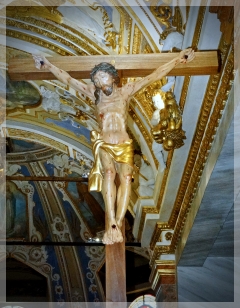
Locarno-Madonna del SassowIn any cathedral or art museum, we’ll find many pictures of Jesus and even rather graphic depictions of Him on the cross. None of them, however, tell us anything about His appearance because they were created long after His time. Still, in a world where we seem to memorialize everything with pictures, you’d think one of Jesus’ followers would have sketched Him while blessing the children, giving the Sermon on the Mount, or feeding the multitude! 1st century rabbis in Judah, however, vehemently objected to the depiction of human figures because the second commandment prohibited making a “graven image.” With its Jewish roots, this prohibition carried into the early church and inhibited early Christian art.

At first, Jesus was represented indirectly by symbols such as the peacock, lamb, dove, and anchor. One of the most common was the ichthus (fish) because the Greek word served as an acronym “Jesus Christ, Son of God, Savior.” While making the sign of the cross dated from sometime in the second century, because of its connection with the horrific death of criminals, the cross did not became a symbol of Christianity until the 4th century; crucifixes and other depictions of the crucifixion did not occur until the 6th.

One earlier depiction of Jesus’ crucifixion, however, does exist. Crudely scratched into a stone wall, it was discovered in 1857 during an excavation of the Paedagogiumon (a school for the training of slaves) on Rome’s Palatine Hill. Dating from around 200 AD, it shows a man (or boy) worshiping a figure on a cross; the figure, however, has the head of an ass. The inscription reads, “Alexamenos worships his God.” This derisive graffiti gives us an idea of the way early Christians were ridiculed for worshiping a man who had been executed as a criminal.

Along with claims of onolatry (donkey worship), the early Christians had to deal with several other disparaging, malicious, and false accusations such as incest, cannibalism, and drinking the blood of infants. Roman orator Marcus Cornelius Fronto (c. 100-160) wrote that Christians were “initiated by the slaughter and the blood of an infant” and that Christianity was “foolish” because, “they worship a crucified man, and even the instrument itself of his punishment” and “are said to worship the head of an ass.”

This was the world—a world that misunderstood, slandered, ridiculed, hated and persecuted them—of the early Christians. And yet, they proceeded in faith and spread the gospel. I wonder how the 21st century church would do in similar circumstances! As for Alexamenos, the fellow mocked by that ancient graffiti—more graffiti was found on a wall in an adjacent room. In Latin it said, “Alexamenos is faithful.”  In the face of opposition, we must be the same!

Think back on those early days when you first learned about Christ. Remember how you remained faithful even though it meant terrible suffering. Sometimes you were exposed to public ridicule and were beaten, and sometimes you helped others who were suffering the same things. You suffered along with those who were thrown into jail, and when all you owned was taken from you, you accepted it with joy. You knew there were better things waiting for you that will last forever. So do not throw away this confident trust in the Lord. Remember the great reward it brings you! [Hebrews 10:32-35 (NLT)]

Copyright ©2021 jsjdevotions. All rights reserved.

IN ALL CIRCUMSTANCES

Be thankful in all circumstances, for this is God’s will for you who belong to Christ Jesus. [1 Thessalonians 5: 18 (NLT)]

With his words, the Apostle Paul doesn’t give us any exceptions—we are to give thanks in all circumstance (rather than some or most and certainly not just in the ones we like)! Right now, however, I’m not feeling particularly thankful. In the span of a week’s time, two dear friends died—men that were like brothers to us. Distance and COVID meant that we couldn’t even grieve in person with their families. As I sit here tearfully, I realize that in the past eighteen months a dozen people who were important parts of our lives are no longer with us. Grief weighs heavy on my heart. When I consider my prayer list and the people on it who are struggling with the devastating aftereffects of a stroke or suffering from cancer, Parkinson’s, chronic pain, dementia, and heart failure, I realize that number will soon grow. I want to stomp my feet and shout at God that it’s not fair and ask Him how He expects me to give thanks!

As a Christian, I know I should be in a permanent state of thanksgiving for God’s grace in my salvation and I am thankful for that. It’s things like the suffering and loss in life that pose the problem for me. I should be reassured by the words of Romans 8:28 that, “We know that God causes everything to work together for the good of those who love God and are called according to his purpose for them.” In theory, I know that even in the worst of circumstances, God can take a bad thing and make it work for a good purpose. I know He is in full control of all of life’s happenings and that He can put all of those horrible events together to achieve a beautiful God-designed purpose. Nevertheless, that knowledge is of little comfort to those who mourn. Finding comfort in Paul’s words is a great deal harder than repeating them.

That David could say he was “worn out from sobbing” and his vision was “blurred from grief,” [Psalm 6:7-6] tells me that neither grief nor calling out to God in sorrow means a loss of faith; sorrow is an unavoidable part of life. One thing that frequently keeps us from giving thanks in our grief is that pesky question of “why?” I’ve written enough about Job to know that I have no business asking why and that I’ll never know the answer. Yet, even knowing God’s reasons wouldn’t take away the sense of loss or make the grief disappear.

Where do we find the ability to give thanks? Perhaps by looking more closely at the Apostle’s words. Paul tells us to be thankful in everything not for everything. While there’s a fine line between the two, we don’t have to be thankful for things like heart attacks, strokes, car accidents, COVID, or cancer but we do need to have a grateful heart in the midst of those afflictions.

Giving thanks in all circumstances requires a change of heart. Without that change, we might stop crying, start smiling, and even laugh at times but something sour will begin growing in our hearts—bitterness, anger, resentment, or self-pity. Giving thanks is the only way out of the pit of grief; yet it seems impossible until I remember the simple truth that God is good. Regardless of the circumstances, He remains the same loving, wise, and good God that He always has been.

Pauls’ admonition to give thanks in all circumstances follows two other directives—to rejoice always and to pray continually. In prayer, I asked the Spirit for guidance, strength and peace and then listed the names of those for whom I mourn. Thinking of each one by name, I rejoiced in the privilege of having those beautiful people in my life—to have talked, worked, agreed, and disagreed with them—to have touched and been touched by them—to have both taught and learned from them—to have shared good times and bad, gain and loss, secrets, sorrow, and laughter with them—to have loved and been loved by them. As I thanked God for the blessing of bringing each and every one them into my life, I found that I am, indeed, thankful in even this circumstance!

Give thanks to the Lord, for he is good! His faithful love endures forever.… You are my God, and I will praise you! You are my God, and I will exalt you! Give thanks to the Lord, for he is good! His faithful love endures forever.  [Psalm 118:1, 28-29 (NLT)]

And let the peace that comes from Christ rule in your hearts. For as members of one body you are called to live in peace. And always be thankful. [Colossians 3:15 (NLT)]

Copyright ©2021 jsjdevotions. All rights reserved.

WHAT REASON? (Part 1)

If you obey my decrees and my regulations, you will find life through them. I am the Lord. [Leviticus 18:5 (NLT)]

Ten COmmandments windowThe Ten Commandments are the foundation of both Jewish and Christian principles, conduct, and accountability, but they are just ten of the 613 mitzvot or commandments given to the Jewish people. In light of the big ten, many of those commands, such as using accurate scales and weights and fulfilling our promises make perfect sense as do prohibitions about speaking derogatorily of others or standing idly by if another person’s life is in danger. Moreover, laws regarding boundary markers, evidence, assessing property damages, and not perverting justice or accepting bribes certainly were necessary in a new nation. Some laws, like the ones regarding latrine placement, covering excrement, and making a guard rail around a flat roof seem reasonable from a health and safety viewpoint. Other laws may have served as a way to separate the Jews from their pagan neighbors. Perhaps it was because the Hittites, Elamites, and Sumerians were clean-shaven and the Egyptians often were clean shaven or had shaped goatees that Jewish men were not to trim the hair on their temples or shape their beards. Many laws, such as the intricate laws of sacrifice, the blue tassels on hems, reciting the Shema twice a day, and saying a blessing after meals, were related to worship and God.

Many of those laws, however, seem inexplicable. What, for example, makes land animals that don’t chew the cud and have completely split hooves (like the pig) unacceptable food? Why eat only fish with fins and scales but no shellfish or mollusks? If locusts can be eaten, why not ants? Why can’t linen be woven with wool? Why can’t a Nazarite eat grapes or raisins or cut his hair and why did every sacrifice require salt?

As I looked through these ancient laws and tried to understand God’s reasoning behind them, I missed the point. The first rule God made was the simple one he gave to Adam and Eve: don’t eat from that tree. Although He warned that death would be the result of disobedience, God didn’t explain His reasons for the prohibition because obedience to God isn’t supposed depend upon human reasoning. If we have to understand before we obey, rather than obedience, it becomes agreement and dependent on us! God, however, doesn’t require our understanding or agreement; He requires our obedience.

Abraham didn’t know where he was going when he packed up his family nor did he question God’s reasoning when he placed his son on a sacrificial altar. Building an enormous ark on dry land probably made no sense to Noah, wearing out his troops by marching around Jericho for a week seemed a questionable battle plan to Joshua, and Mary didn’t understand God’s reasoning behind her pregnancy; nevertheless, they all obeyed without understanding.

Obedience shows reliance and trust—an acceptance that God knows more than we can ever know or understand—that God is God and we are not! I don’t know God’s reasoning behind those mitzvot nor do I need to. It’s enough that God made them and expected the Israelites to abide by them. The only thing we must understand about God’s commands is that they are divinely decreed and, as such, are to be unquestionably obeyed. Rather than leading us away from God’s blessings, obedience will lead us to them.

Loving God means keeping his commandments, and his commandments are not burdensome. [1 John 5:3 (NLT)]

Trust in the Lord with all your heart; do not depend on your own understanding.  Seek his will in all you do, and he will show you which path to take. [Proverbs 3:5-6 (NLT)]

Copyright ©2021 jsjdevotions. All rights reserved.

ARE THERE RIGHTEOUS LIES (Lies – part 1)

You shall not steal; you shall not deal falsely; you shall not lie to one another. [Leviticus 19:11 (ESV)]

canna - bandana of the evergladesA 2010 study on “Human Communication Research,” found that people average 1.65 lies per day. I suspect the 1,000 they people surveyed were not completely truthful and the number is probably higher! We’re all liars but are all lies equal? Is a POW’s lie to his interrogator about his platoon’s position the same as a thief’s lie to a detective? Is an undercover policeman’s lie to a drug dealer the same as not reporting all your income on your 1040? Is deceiving someone so you can give him a surprise party the same as saying the check’s in the mail when it isn’t?

Many theologians and Biblical scholars hold that, regardless of the circumstances, a falsehood of any kind is never condoned by God and is a sin. Be that as it may, there are some notable episodes of lying by some of the Bible’s heroes. We have Rahab, the prostitute/innkeeper in Jericho who saved the lives of Joshua’s spies with a blatant lie to the king’s men. Some theologians (like Calvin and Augustine), insisting that no lie ever is permissible, condemn Rahab. In that case, perhaps Joshua and his spies should be condemned. Joshua sent his men out secretly and a spy’s purpose is to deceive people into thinking he is friend rather than foe. As long as we’re condemning liars, we might as well condemn the two midwives, Shiprah and Puah, who lied to Pharaoh and spared the lives of Hebrew baby boys. Let’s add Elisha to the list since he lied to the Aramean army before leading the blind troops straight into the city of Samaria.

Is there such a thing as a “righteous lie?” Are there situations when deception is permissible? Can it ever be the morally right thing to do? The hardliners hold that we are to obey God first and foremost—even before we look to our neighbor. For them, regardless of its size or the reason behind it, a lie is a sin. They maintain that the lies of Rahab, the midwives, and Elisha showed their lack of faith in God and they should have trusted Him enough to tell the truth regardless of the consequences.

While Augustine said, “A lie consists in speaking a falsehood with the intention of deceiving,” the other side defines a lie as an intentional falsehood that denies someone’s moral or legal right to know the truth. For them, not all falsehoods are lies and, on those occasions when people have forfeited their right to the truth (such as during a war or a criminal act),  a falsehood is ethically permissible. For this camp, whether or not a falsehood is a lie, depends on the circumstances.

Clearly, a lie for personal gain is wrong, as evidenced by the leprosy inflicted on Gehazi for lying to Elisha and the deaths of Ananias and Sapphira for their lies to Peter. But, rather than being displeased with the lies told by Rahab, the midwives, and Elisha, God seemed to reward them. Rahab and her family were saved, she married an Israelite, was an ancestor of both David and Jesus, and became one of two women listed in the Hebrews 11 “Hall of Faith.” God blessed Shiprah and Puah with families of their own and Elisha went on to perform twice as many miracles than did Elijah.

Were their falsehoods sinful lies or, because of circumstances, were they excusable and possibly commendable? In Rahab’s case, although an arrow had not yet been shot, war between Jericho and the Israelites was on the horizon and, once she hid the spies, she’d taken Israel’s side. In the case of the midwives, Pharaoh had declared war on the Hebrews by instructing the women to kill all male infants. As for Elisha, his lie occurred during a time of war between the king of Aram and Israel. The lies they told were the kind of lies told by Oskar Schindler that saved over 1,000 Jews in Germany, by the Benedictine monk Father Bruno that safeguarded 300 Jewish boys in Belgium, and by Corrie ten Boom that hid and protected Jews in the Netherlands. Would God condemn them (or others like them) for lying in the war between good and evil?

Are there ever times when deception is permissible? Can a higher moral good outweigh the sin of a lie? Can we lie to protect a life? When lying is the only way to prevent a horrible evil, is it acceptable to God? Or is such a lie a failure of our faith? I’m not sure I know the answer. John Wesley famously claimed that he would not tell one lie to save the souls of all the world. I wonder if he would lie to save a life so that he then could save a soul.

Keep your tongue from evil and your lips from speaking deceit. Turn away from evil and do good; seek peace and pursue it. [Psalm 34:13-14 (ESV)]

Copyright ©2021 jsjdevotions. All rights reserved.

WHAT CHANGED THEM? (Easter – Part 2)

But beware! For you will be handed over to the courts and will be flogged with whips in the synagogues. You will stand trial before governors and kings because you are my followers. … Then Jesus said to his disciples, “If any of you wants to be my follower, you must give up your own way, take up your cross, and follow me.” [Matthew 10:17-18,16:24 (NLT)]

rabbitThe Federal Trade Commission is charged with enforcing truth-in-advertising laws so that all advertisements are truthful, not misleading, and backed by scientific evidence. Although drug companies abide by the FTC’s regulations by listing their products’ side effects, between the fine print and the announcer’s fast talk, most consumers don’t understand them. Jesus didn’t resort to fast talk, deceit, or ambiguity when he told His disciples the cost of following him. He was brutally honest and told the disciples they would arrested, persecuted and hated because of Him.

While the disciples may not have comprehended completely, they couldn’t say they weren’t warned and Jesus told them the possibility of losing their lives was very real. Nevertheless, I imagine they thought He was speaking figuratively when He spoke of them carrying a cross. Even though He’d predicted His own death, I suspect his followers really didn’t understand what lay ahead until that fateful night when Jesus was arrested. Once He’d been tried, sentenced, and crucified, I’m sure the Lord’s cautionary words echoed in their minds and they finally understood the reality of that cross they’d be expected to carry! No wonder they cowered together in a locked room. The next step after arresting a revolutionary was to arrest his followers.

It was only John and a few women followers at the foot of the cross and it was a stranger, not a follower, who carried the cross for Christ. Jesus’ disciples, the men with whom he’d lived for three years, weren’t there to carry his heavy load or share his final hours. Rather than His friends, it was a secret follower of Jesus, Joseph of Arimathea, who placed Him in a borrowed tomb. Rather than a day of rest, the disciples’ Sabbath probably was a day of mourning, disappointment, confusion, and fear. Sunday morning, with the Sabbath over, some followers returned home while the rest continued to cower together in fear.

What turned a veritable group of despondent deserters into men who bravely spread the good news of Christ the Savior? These are the same men who fled from Jesus when He was arrested and Peter publicly denied knowing Him three times that night. What caused the two disheartened men from Emmaus to return to Jerusalem and the disciples in that locked room? What turned Jesus’ followers into people who courageously faced persecution and martyrdom? Of the disciples, all but John are thought to have been martyred. They had nothing to gain from a lie but everything to lose with the truth. What turned a bunch of deserters into evangelists? They saw the risen Christ! They spoke with Him, touched his scars, and broke bread with Him. They knew it to be the truth!

We haven’t walked with Jesus, but we’ve read the words of those who have. We haven’t been in the same room with Him, but we’ve heard His voice. We’ve not touched Him, but He has touched us. We haven’t seen his wounds, but He’s healed ours. We didn’t see His ascent into heaven, but we’ve experienced his Holy Spirit. No—we haven’t actually seen the risen Christ but, as Jesus people, “We live by believing and not by seeing.” [2 Corinthians 5:7]

You can kill us. But you cannot hurt us. [Justin Martyr (c. AD 150)]

During the forty days after he suffered and died, he appeared to the apostles from time to time, and he proved to them in many ways that he was actually alive. And he talked to them about the Kingdom of God. [Acts 1:3 (NLT)]

Then Jesus told him, “You believe because you have seen me. Blessed are those who believe without seeing me.” [John 20:29 (NLT)]

WHEN GOD MOVES A STONE (Easter – part 1)

On the way they were asking each other, “Who will roll away the stone for us from the entrance to the tomb?” But as they arrived, they looked up and saw that the stone, which was very large, had already been rolled aside. [Mark 16:3-4 (NLT)]

Easter tombAlthough Jesus repeatedly predicted that He’d rise from the dead, the women didn’t bring clean clothes for a living man that Sunday morning when they went to the tomb. Instead, they brought burial spices of their own with which to anoint His dead body. Because of the Sabbath, Jesus’ burial was rushed and His body laid in a borrowed tomb. Although Joseph and Nicodemus had anointed Him, perhaps the women were concerned that, in the men’s haste to finish before sunset, they hadn’t done a proper job of preparing the body. The spices they brought would conceal the stench of decay and, out of love for Jesus, they wanted to complete the burial rites properly.

Not knowing about the guards Pilate had posted at the tomb, the women wondered how they would manage entry into it. Many Judean tombs were caves. The opening was covered by a large disc-shaped stone set into a groove cut in the bedrock. Getting the stone in place was fairly easy as it was rolled down a slight incline to cover the tomb’s opening. Several men, however, would be needed to roll it up the incline. “Who will roll the stone away?” they asked. Even though the women didn’t know how it would be done, they trusted that it could be done and proceeded in faith.

For a moment, consider that heavy stone at the cave’s opening. It was impossible to remove from within the tomb but it wasn’t removed so Jesus could exit the tomb. The Messiah who raised the dead, walked on water, and healed the sick certainly didn’t need anyone to move the stone for Him. Regardless of size, no boulder could block the way of the one whose resurrection meant that death had been conquered. That stone wasn’t moved so He could get out; it was moved so that His followers could get in, find the tomb empty, and share the good news!

The women didn’t let their reservations about moving the stone stop them from going to the burial site and serving their Lord. What about us? When we are called to serve Him, do we worry about the stones that might block our way and allow them to stop us? Let the Easter story remind us that, just as that stone was removed for the women so they could tell the good news, God will remove the barriers blocking our way from sharing the resurrected Christ!

Then the angel spoke to the women. “Don’t be afraid!” he said. “I know you are looking for Jesus, who was crucified. He isn’t here! He is risen from the dead, just as he said would happen. Come, see where his body was lying. And now, go quickly and tell his disciples that he has risen from the dead, and he is going ahead of you to Galilee. You will see him there. Remember what I have told you.” [Matthew 28:5-7 (NLT)]

Copyright ©2021 jsjdevotions. All rights reserved.