
But let all who take refuge in you be glad; let them ever sing for joy. Spread your protection over them, that those who love your name may rejoice in you. [Psalm 5:11 (NIV)]
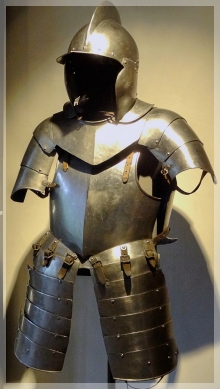 A Latin word, lorica originally meant armor or breastplate. Because of an ancient practice of inscribing a prayer on the armor or shields of knights who then recited the prayer before combat, lorica came to mean a prayer of protection.
Although there are many such prayers, the most famous is the Lorica of St. Patrick (also known as St. Patrick’s Breastplate). Legend has it that around 433 AD, St. Patrick wrote this prayer for protection. As the story goes, on Easter morning, Patrick led his fellow missionaries in a procession to the court of the pagan King Laoghhaire. Suspecting that they would be ambushed by the army of his pagan adversary, Patrick took his men through the woods while chanting this prayer/lorica. Rather than seeing the missionaries amid the trees, their enemies saw a mother deer followed by twenty fawns and let them pass. Having been brought safely through the ambush by God, Patrick and his companions marched into the king’s presence while chanting: “Let them that will, trust in chariots and horses, but we walk in the name of the Lord.”
Whether the story is fact, legend or, as I suspect, somewhere in-between, this beautiful hymn (also known as The Deer’s Cry) appears to be the first one ever written in Gaelic and quite likely by the beloved Patrick. In 1889, Cecil Alexander produced a metrical version of the prayer from an earlier English translation and the resulting hymn was set to traditional Irish tunes. Called “I Bind Unto Myself Today,” this beautiful old lorica can be found in the hymnals of many denominations and heard on You Tube.
Prayers for protection and deliverance are found throughout Scripture. Moses, David, Ezra, and Nehemiah all prayed for protection for themselves and others and Jesus prayed for the protection of His followers. We may not be facing Druids in the woods, but we enter into battle against evil every day. While we don’t wear armor or carry shields, we can proceed as did Patrick and his men: by wearing the armor of God, binding ourselves to Him in prayer, and walking in the name of the Lord.
I bind unto myself today
The strong name of the Trinity,
By invocation of the same
The Three in One and One in Three. …
I bind unto myself today
The power of God to hold and lead,
His eye to watch, His might to stay,
His ear to hearken to my need.
The wisdom of my God to teach,
His hand to guide, His shield to ward,
The word of God to give me speech,
His heavenly host to be my guard. …
Christ be with me, Christ within me,
Christ behind me, Christ before me,
Christ beside me, Christ to win me,
Christ to comfort and restore me.
Christ beneath me, Christ above me,
Christ in quiet, Christ in danger,
Christ in hearts of all that love me,
Christ in mouth of friend and stranger.
I bind unto myself the name,
The strong name of the Trinity,
By invocation of the same,
The Three in One and One in Three.
By whom all nature hath creation,
Eternal Father, Spirit, Word:
Praise to the Lord of my salvation,
Salvation is of Christ the Lord.
[St. Patrick’s Breastplate (Attributed to St. Patrick)]

 When writing about Esther last week, I thought how terrified she must have been when Mordecai asked her to step out of her comfort zone to save the Jews. Even though she was queen, her access to Xerxes was severely limited. Living secluded in a private chamber in the women’s quarters, she didn’t regularly dine with the king. Powerless, she was the one to be summoned rather than the one who did the summoning and she hadn’t been summoned by Xerxes for a month. She was just one of many beautiful women in the king’s harem and perhaps someone else had caught his eye. The previous queen was banished when she defied the king; Esther could expect nothing less if her presence wasn’t welcomed. The young queen had a simple choice: comfort or courage. She chose courage and saved a nation!
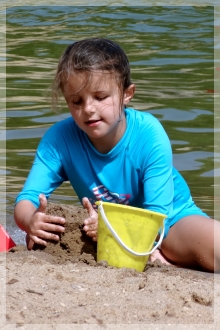 Once upon a time, a little boy was busy digging in the sand at the beach. Like other youngsters through the years, he thought he even might be able to dig all the way to China. His steadfast excavations got so deep that he encountered a large rock. With great determination, he dug and dug with his plastic shovel in an attempt to free it from the ground. Unfortunately, the little boy and his small shovel were no match for the rock. When the shovel broke in two, the boy let out a howl and burst into tears. Hearing the child’s cries, his father immediately went to comfort him. Through his sobs, the boy told how he’d tried and tried to free the rock but was too weak, his arm was too short, and he’d broken his only shovel. His father gently asked why he hadn’t used all of his strength. “But I did, Daddy, I really did!” exclaimed the boy. “No, son, you didn’t,” explained the man as he reached into the hole, grabbed the rock with his large hands, and pulled it from the ground. “You should have called me!”
 I came across an article questioning whether we have to believe certain things to be a Christian or is it enough just to trust God. The author believed that Christians don’t have to “assent intellectually” to the facts of traditional Christian teaching or agree with the Christian creeds. “Faith” to the author is simply placing one’s confidence in “Spirit” (not the Holy Spirit) and following Jesus’ teaching is more important than believing certain things about Him. Having nothing to do with dogma or creeds, Christianity was seen as a wisdom tradition and way of life rather than a belief. Claiming they were “man-made” and date from the 4th century and Emperor Constantine, the author believed Christianity’s creeds should be disregarded.
 Devotions of the Heart