THE BARBER

This is what the Lord says: “Cursed are those who put their trust in mere humans, who rely on human strength and turn their hearts away from the Lord. They are like stunted shrubs in the desert, with no hope for the future. They will live in the barren wilderness, in an uninhabited salty land. [Jeremiah 17:5-6 (NLT)]

 If God is, why is there evil? But if God is not, why is there good? [Saint Augustine]

Kuchenhof Gardens netherlandsThe story is told of a barber who vehemently denied the existence of God while cutting his customer’s hair. “Look at this troubled world,” he said. “School shootings, terrorism, wars, genocide, pain, poverty, hatred, prejudice, and deceit: they all prove your so-called God doesn’t exist!” The customer tried to reason with him but the atheist would have nothing of it.

When the customer left the shop, he saw a man sitting on a nearby bench. His hair was long, filthy and matted; his eyebrows were so shaggy they nearly covered his eyes; his face was so dirty his skin color was undistinguishable; and his mustache and beard were long, mangy, and disgusting. Returning to the shop, the customer announced to the barber, “There are no barbers; you do not exist!” The shocked man replied, ”But, I do; I’m right here in my shop. Here’s my chair and sink, towels and wash cloths, shampoo and shaving cream, scissors and razors, combs and brushes. How can you say I don’t exist?” The customer then pointed to the unkempt man sitting outside on the bench. “Well, that’s what happens when people don’t come to me,” said the exasperated barber. “My point exactly,” replied his customer. “This troubled sinful world is what happens when people don’t go to God!”

It’s been said that someone once asked Billy Graham how Christianity could be valid when there is so much evil in the world. The famous preacher replied, “With so much soap, why are there so many dirty people in the world? Christianity, like soap, must be personally applied if it is to make a difference in our lives.”

 A Christian is nothing but a sinful man who has put himself to school for Christ for the honest purpose of becoming better. [Henry Ward Beecher]
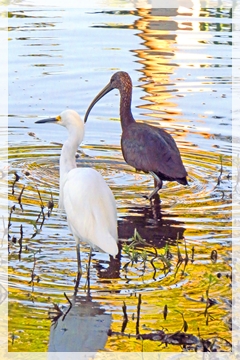
But blessed are those who trust in the Lord and have made the Lord their hope and confidence. They are like trees planted along a riverbank, with roots that reach deep into the water. Such trees are not bothered by the heat or worried by long months of drought. Their leaves stay green, and they never stop producing fruit. [Jeremiah 17:7-8 (NLT)]

Copyright ©2018 jsjdevotions. All rights reserved.

PARTNERS

Whenever I pray, I make my requests for all of you with joy, for you have been my partners in spreading the Good News about Christ from the time you first heard it until now. And I am certain that God, who began the good work within you, will continue his work until it is finally finished on the day when Christ Jesus returns. [Philippians 1:4-6 (NLT)]

snowy egret - glossy ibisSeveral years ago, my husband came upon a wonderful opportunity to buy a business in another state. He also knew a talented young man capable of running it there. Rather than simply buying the business and hiring the fellow as CEO, my husband loaned him money so that he could buy a share in the business. A firm believer in having what he calls, “skin in the game,” my husband found that partners in a business care about its success far more than any employee ever will. When he and his partner retired, they sold the business to the employees through an ESOP program—now everyone working there is a partner and has “skin in the game.”

Just as there’s a difference between being an employee and a partner, there is a difference between being a member of an organization and being a partner in it. In our northern community, we have 52 members in our home owners’ association. By virtue of moving here and paying their association fees, a resident is a member yet many have little commitment to the welfare of the community and the only time they’re heard from is if they have a complaint. The partners in our community, however, are the ones who attend the meetings, respond to surveys, serve on committees, volunteer on work days, pick up loose trash or broken branches, and show concern for their neighbors. Caring about more than their property, they have invested in their community.

We find a difference between membership and partnership in our churches, as well. Members are names on a roster; partners have a place in the church community. Members are passive but partners are active. Members take and use but partners invest and share. Members complain and criticize but partners build, encourage, and work to correct problems. Members walk away in difficult times but partners stay and try to improve the situation. Members attend church but partners are the church. Reflecting this subtle difference, when people join our old mountain church, rather than becoming members, they now become partners. As partners, they have a vested interest in the success of the church and the welfare of its members.

The church being a partnership is Biblical. There may have been only twelve Apostles and seven elders in the first church but they all were partners in Christ. Luke tells us the believers dedicated themselves to learning about Jesus and their responsibilities as His followers. They worshipped and fellowshipped with one another, shared their resources, and prayed, ate, and celebrated the Lord’s Supper together. People were partners with one another in their common belief and mission and churches partnered with one another by welcoming Christian travelers into their homes, sending relief to those in need, planting new churches, and sharing doctrine, teachers, and resources.

We continue to share a common belief and mission in today’s church but church attendance is only the beginning of achieving that mission. By partnering with the pastor, church staff, and the rest of the congregation, we can bring our unique abilities and gifts together to work toward a common vision and goal: to be God’s hands, mouth and feet.

Member or partner—which one are you?

For you are all children of God through faith in Christ Jesus. And all who have been united with Christ in baptism have put on Christ, like putting on new clothes. There is no longer Jew or Gentile, slave or free, male and female. For you are all one in Christ Jesus. [Galatians 3:26-28 (NLT)]

Copyright ©2018 jsjdevotions. All rights reserved.

CARE FOR THE LAMBS

And anyone who welcomes a little child like this on my behalf is welcoming me. But if you cause one of these little ones who trusts in me to fall into sin, it would be better for you to have a large millstone tied around your neck and be drowned in the depths of the sea. [Matthew 18:5-6 (NLT)]

tiger swallowtailEarlier this week, the news broke that church leaders in six Pennsylvania Roman Catholic dioceses have protected more than 300 “predator priests.” More concerned with protecting the church and abusers than helping the more than 1,000 victims or preventing further abuse, they failed to report allegations, discouraged victims from reporting abusers, conducted their own biased and faulty inquiries, pressured law enforcement to delay or close investigations, and spun their own versions of the events. Earlier this summer, the Archdiocese of St. Paul and Minneapolis agreed to a $210 million settlement to 450 victims of clergy sexual abuse there. It’s not just the Roman Catholic Church that has failed in this arena. It was just revealed that Willow Creek, a non-denominational Protestant mega-church, paid $3.25 million to settle two lawsuits over sex abuse by a church volunteer. No amount of money, however, can remove the trauma of abuse.

This is neither a Catholic nor a Protestant problem; it is everyone’s problem and it certainly is not limited to churches. We’ve seen institution after institution put reputation before serving and protecting our children. A growing number of Olympic athletes have joined the U.S. women’s gymnastics team in allegations of sexual abuse in their sports. The Chicago Tribune recently reported that the Chicago Public Schools failed to protect their students from sexual abuse and assault. Among other things, ineffective background checks didn’t protect the children from offenders and abuse was not reported. Dozens of lawsuits have been filed against the Boy Scouts over sex abuse and they’ve paid out millions of dollars in settlements. Recently, I watched the news in horror as eleven malnourished children (and the remains of a twelfth) were discovered in a New Mexico compound. Earlier this year, a 17-year old escaped from her house of horrors to make the 911 call that rescued her twelve shackled and severely malnourished siblings from their California home. Sadly, these are but a few of the sickening tales of child abuse we find in the news.

If we ever questioned that we live in a fallen world, these horrifying examples leave us no doubt. Child abuse in any form is the work of Satan: the one who came to “steal and kill and destroy.” He is destroying our young people when he steals their innocence, their physical health, their emotional well-being or takes their lives. Made in God’s image, children are not meant to be used and abused; they are meant to be nurtured and loved.

Whether or not we know those who’ve been hurt and abused, they all are our children and this is our problem. As Christ’s body on earth, we must open our eyes to the children around us and never be silent bystanders. As His body, we can’t stand idly by when abuse of any kind is suspected and the church must never hide the ugly truth even when it occurs within our walls. Abuse can’t be swept under the rug nor can we send offenders off to another parish, school, gym, or scout troop with little more than a rap on the knuckles. Moreover, untrained in forensic interview techniques, we are not the ones to conduct internal investigations. Neither judge nor jury, it’s not our job to determine the validity of an accusation; abuse is both a sin and a crime and our job is to report suspected crimes! We have a God-ordained responsibility to protect and preserve all children (not just the ones in our homes).

We all are called to be shepherds. Father in Heaven, show us how to protect your lambs.

Care for the flock that God has entrusted to you. Watch over it willingly, not grudgingly—not for what you will get out of it, but because you are eager to serve God. [1 Peter 5:2 (NLT)]

Copyright ©2018 jsjdevotions. All rights reserved.

TELL THEM WHY

In the same way, let your light shine before others, so that they may see your good works and give glory to your Father who is in heaven. [Matthew 5:16 (ESV)]

monarch butterfly - whorled milkweed

“Simply by being in your presence, non-Christians ought to be able to tell that you have spent time in God’s presence,” were the week’s words of wisdom in my email. In Bible study, one woman echoed the week’s wisdom when saying that she behaved so that the light of Christ could be seen in her conduct all day. Although actions speak louder than words and all of our actions should shout “Praise the Lord!” I wonder if, by depending solely on our examples, we are taking the easy way out of Jesus’ command to let our lights shine. After all, what good does our light do if no one ever learns the source of its power? Eventually, we need to open our mouths and share the gospel message with words as well as actions.

“Christian” as a noun means someone who professes specific belief in the doctrine of Christianity. When “Christian” is used as an adjective merely to describe good behavior (i.e. “he did the Christian thing”), the word loses its power. After all, we haven’t cornered the market when it comes to being good people. Being respectful, helpful, caring or kind is not limited to Christians. Some of the most compassionate, loving, moral, and generous people I know are of other faiths or of no faith at all. While I’d like to think that believers usually exhibit better behavior than non-believers, the difference between Christians and non-Christians is not behavior; the difference is Christ! Unless we open our mouths and talk about Jesus, people won’t know what makes us the way we are.

When reading the cast notes in a Playbill recently, one actress finished her brief resume with these words: “All glory to God! 1 John 4:19.” Hopefully, her demeanor among the rest of the cast and crew reflects the light of Christ. But, just in case they weren’t sure from where her light comes, she told them (as well as the audience): “We love because He first loved us.” Indeed, she said, “Praise the Lord!” and told us why.

Preach the Gospel at all times, and when necessary, use words. [St. Francis of Assisi]

And he said to them, “Go into all the world and proclaim the gospel to the whole creation.” [Mark 16:15 (ESV)]

Go therefore and make disciples of all nations, baptizing them in the name of the Father and of the Son and of the Holy Spirit, teaching them to observe all that I have commanded you. And behold, I am with you always, to the end of the age. [Matthew 28:19-20 (ESV)]

Copyright ©2018 jsjdevotions. All rights reserved.

LET THE VINEYARDS BE FRUITFUL

We give thanks for the cup of blessing, which is a sharing in the blood of Christ. And the bread that we break is a sharing in the body of Christ. Because there is one loaf of bread, we who are many are one body, because we all share that one loaf. [1 Corinthians 10:16-17 (NCV)]

Let the vineyards be fruitful, Lord,
And fill to the brim our cup of blessing.
Gather a harvest from the seeds that were sown,
That we may be fed with the bread of life.
Gather the hopes and dreams of all;
Unite them with the prayers we offer now.
Grace our table with Your presence, and give us
A foretaste of the feast to come. [John W Arthur]

monarch butterfly - common milkweedWhen the ushers brought the offering plates forward, the congregation rose and sang “Let the Vineyards be Fruitful.” Often used in Lutheran churches as an offertory hymn when the gifts are presented at the altar, its references to vine, bread, and table make it especially appropriate on Communion Sundays.
As I sung those familiar words about fruitful vineyards, seeds and harvest, I was struck by the somewhat incongruous words in the middle of the song: “Gather the hopes and dreams of all; Unite them with the prayers we offer now.” I envisioned the congregation’s hopes, dreams, needs, and concerns piled high on top of the offering envelopes in those plates and realized we were presenting more than our checks and cash; we were offering our petitions for things like healing, reconciliation, peace, guidance, recovery, relief, purpose, increase, wisdom, strength, and restoration. While the particulars differed from person to person, our various hopes and dreams were being gathered, united into one prayer, and given to God. It wasn’t until I re-read the hymn’s words after church that I understood what that prayer asked or that our words referred both to the day’s simple meal of wafer and wine as well as to the eternal feast at Christ’s return. In our unified prayer, we were asking that Jesus grace us with His presence and give us a preview of the magnificent banquet that is yet to come in the Kingdom of God.

I’ve probably sung the words to this simple hymn hundreds (if not thousands) of times but last Sunday, as those words exited my mouth, they also settled into my heart and mind in a new way. I doubt that I will sing it again without picturing the congregation’s assorted prayers spilling over the sides of the collection plates and then melding into one unified prayer for both His presence and the coming of His Kingdom. Just as reading a book of the Bible once (or even several times) doesn’t mean we’ve fully grasped the meaning of the passages, the same goes for the hymns we sing or the liturgy we recite during worship. When Jesus warned us about meaningless repetition or babbling on in our prayers, repetition wasn’t necessarily the problem. After all, both the persistent neighbor and widow in His parables repeated their pleas and He repeated the same prayer three times in Gethsemane. The problem occurs when we repeat our words mindlessly or automatically. Let us always remember that knowing the words by heart doesn’t necessarily mean our hearts know the depth of their meaning.

The Lord All-Powerful will prepare a feast on this mountain for all people. It will be a feast with all the best food and wine, the finest meat and wine. On this mountain God will destroy the veil that covers all nations, the veil that stretches over all peoples; he will destroy death forever. The Lord God will wipe away every tear from every face. He will take away the shame of his people from the earth. The Lord has spoken. [Isaiah 25:6-8 (NCV)]

Copyright ©2018 jsjdevotions. All rights reserved.

FULLY AWARE

For I hold you by your right hand—I, the Lord your God. And I say to you, “Don’t be afraid. I am here to help you.” [Isaiah 41:13 (NLT)]

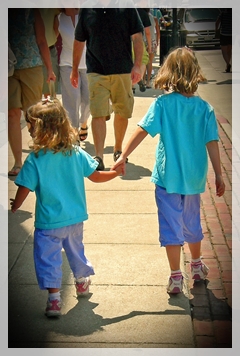
cousinsScientists have found that even a simple hug or the holding of hands can lower both blood pressure and heart rate in stressful situations. Gentle touch also causes a decrease in the stress hormone cortisol and an increase in oxytocin (often called the “cuddling hormone”). Where cortisol might give a “fight or flight” response, oxytocin causes more of a “tend and befriend” one by increasing feelings of trust and connection. Since we were at a funeral and the previous ten days had been a roller coaster of emotion and tension for everyone, the priest’s request to join hands as we stood in prayer benefitted us physically and psychologically as well as spiritually.

While holding hands during prayer wouldn’t be unusual in many evangelical Protestant churches, apparently it is in Roman Catholic ones (especially when done during every prayer) and it has become a point of contention in some dioceses and parishes. Being a rather touchy-feely Protestant, I enjoyed the hand holding and the feeling of solidarity in prayer that came with it. The priest, however, asked us to do more than simply join hands. “Take the hand of the person beside you,” he instructed, “and, fully aware of the soul you are touching, join in prayer.” As I held the hand of the stranger beside me, I thought of those words: “fully aware of the soul you are touching.” I didn’t know the man and will never see him again. From his rosary, I knew we do not attend the same church. Nevertheless, I knew we worshipped the same God and were there for the same reason: to celebrate the life of the man whose body lay in a casket near the altar. As I became more aware of the soul I was touching, my thoughts turned from my own personal sorrow to the sorrow shared by all who were present in the sanctuary. We were one community, united in our thanksgiving for the man we mourned, in our intercessions for his family, in our love for God, and in our belief in the resurrected Christ and the life everlasting.

I appreciate that some people are uncomfortable with the intimacy of holding hands and find doing it during worship an unwelcome innovation. Whether or not we touch one another during prayer is not as important as being fully aware of one another: not just of the people with whom we pray but of all with whom we interact. Fellow travelers through this troubled world, they are struggling as much as we are to navigate the challenges, sorrow, and pain in their paths. Is there some way we can make their journey easier? Sometimes, we find that answer in a simple touch. While we probably won’t bring healing to their bodies, we may bring some healing to their souls.

At the conclusion of the funeral, the deceased’s family followed the casket out of the sanctuary and his sister passed by our pew. My husband stepped into the aisle beside her and they joined hands as they walked out together. Although we hardly know her, fully aware of her mournful soul, he knew her need to be supported during that difficult walk.

Lord, teach us to be fully aware of the souls we encounter each day. Let our words be kind, our actions helpful, and our touch gentle and supportive.

When we honestly ask ourselves which person in our lives means the most to us, we often find that it is those who, instead of giving advice, solutions, or cures, have chosen rather to share our pain and touch our wounds with a warm and tender hand. [Henri Nouwen]

As it happened, Publius’s father was ill with fever and dysentery. Paul went in and prayed for him, and laying his hands on him, he healed him. [Acts 28:8 (NLT)]

Copyright ©2018 jsjdevotions. All rights reserved.