
Don’t worry about anything; instead, pray about everything. Tell God what you need, and thank him for all he has done. Then you will experience God’s peace, which exceeds anything we can understand. His peace will guard your hearts and minds as you live in Christ Jesus. [Philippians 4:6-7 (NLT)]
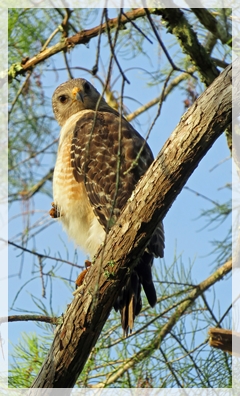 Seeing a red-shouldered hawk perched up in a nearby tree, I focused in on it only to see him suddenly duck his head to avoid being attacked by small bird and then drop again as another tiny bird swept down at him. Those two gnatcatchers boldly harassed the hawk as it kept bobbing and weaving to dodge them. Fiercely territorial, gnatcatchers are unafraid to confront predators and, apparently, the hawk was infringing on their territory. Eventually, the hawk admitted defeat and flew off to another tree. I later asked one of the Audubon docents why the large hawk didn’t fight back against the tiny birds and was told that the hawk knows it can’t win. Being so small, the fast and agile gnatcatcher easily can out maneuver the bigger bird. For the hawk, the energy spent trying to catch the gnatcatcher isn’t worth it; fleeing makes more sense than staying. After settling in another tree not far away, the hawk spotted a crayfish. After sweeping down to catch it, he returned to his new perch and enjoyed a peaceful breakfast (without any annoying gnatcatchers).
“Surely, there’s a devotion of some kind in this!” I thought. Seeing those tiny birds harass the hawk (who was more than 100 times their weight) seemed like a David versus Goliath moment. The more I thought about it, however, I thought the hawk was the innocent party. He hadn’t provoked the birds; he was just minding his own business and looking for breakfast when those birds started pestering him. What the gnatcatchers were doing is called “mobbing.” When birds mob, they make a distress call that attracts other birds (even different species) to join in the harassment. If the hawk hadn’t moved, chances are more birds soon would have joined in hounding and harassing him.
Since another word for harassing is “worrying,” I wondered if those gnatcatchers might be like the worries that seem to come at us from out of nowhere to vex, torment, and distress us. Like mobbing birds, worry calls its pals anxiety, fear, and apprehension to join in troubling us. The gnatcatchers kept the hawk from doing his work (finding breakfast) and worry keeps us from moving ahead, as well. Realizing those birds were not going to disappear, the hawk wisely moved away from them. Often, we’re not that smart; we remain smack dab in the middle of worry and allow it to continue attacking and pecking at us. While the hawk only needed to fly to a nearby tree, we need fly to God, thank Him for His goodness, ask Him for help, and leave our concerns with Him. “You can pick what you ponder,” says Max Lucado. We can perch ourselves in the midst of worry or we can perch ourselves in the promises of God.
Whether or not we worry, our problems will remain. Worry, however, accomplishes nothing. We may not have a lot of power over our problems, but we do have power over our thoughts. Like the hawk, we need to stop perching in the worry zone and get on with our lives, whether that involves catching crayfish in the swamp or giving our concerns to God and working at finding a solution to our problems!
Your problem is not your problem; it is the way you think about it. [Max Lucado]
And now, dear brothers and sisters, one final thing. Fix your thoughts on what is true, and honorable, and right, and pure, and lovely, and admirable. Think about things that are excellent and worthy of praise. Keep putting into practice all you learned and received from me—everything you heard from me and saw me doing. Then the God of peace will be with you. [Philippians 4:8-9 (NLT)]
Copyright ©2019 jsjdevotions. All rights reserved.
 By 1658 in England, it had become illegal to conduct a religious service differing from the Church of England’s official liturgy or for “one not in Episcopal orders” to address a congregation. A Puritan, John Bunyan, was arrested for preaching the gospel without a license. After three months in the Bedford jail, he was offered his freedom if he’d agree not to preach publicly. He refused saying, “If I was out of prison today, I would preach the gospel again tomorrow by the help of God.” Bunyan spent twelve years imprisoned. During that time, he wrote The Pilgrim’s Progress. No country cub prison, the Bedford jail was overcrowded, unsanitary, unheated, and the plague of 1665 claimed forty prisoners as victims. Years later, Bunyan wrote: “Satan can make a jail to look like hell itself.” Although all looked hopeless for the man, he found strength in prayer and in his writing.
 When we’re told to “Be still” in Psalm 46, we tend to think in terms of stopping movement—our busyness, frantic activity, or agitated actions. We associate it with a director yelling, “Cut!” the ref blowing his whistle, or a frustrated parent’s “Cut it out!” Being still can entail all of that, but it is much more. The root of the original Hebrew word used for “still” is the verb rapa which means to be faint, forsake, or sink down. When used as the imperative ra’pha’h, as it is in Psalm 46, it means to drop or release our concerns, to become weak, or surrender. While most Bible versions translate this as “Be still,” some translate as desist, stop fighting, cease striving, be quiet, or be at peace. In short, we’re being told to stop anxiously fighting a situation and leave the matter to God—to relax our grip on things, stop worrying and let it be.
 Sent by God to warn the people of Nineveh of God’s judgment, Jonah went in the opposite direction. After he survived three days in the belly of a fish, God gave Jonah another chance to deliver His message to the people of Nineveh. This time, Jonah delivered the news that God intended to destroy the city in forty days. When Nineveh’s king heard Jonah’s warning, he called for fasting, praying, and repenting their evil ways. People and animals were to cover themselves with sackcloth (a coarse fabric of goat’s hair) as a sign of grief, submission, and contrition. Seeing their repentance, God was merciful and gave them another chance.
 To explain her sisters’ bitterness and sour outlook on life, my mother-in-law would say, “Well, their lives didn’t turn out the way they’d hoped.” Those women had no reason to complain when comparing their lives to Naomi (the mother-in-law in the book of Ruth).
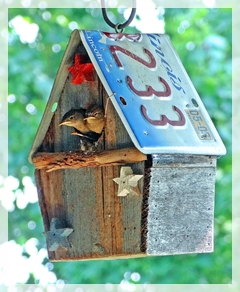 When writing yesterday’s devotion about what I called “concierge” parents, I couldn’t help but think about how birds parent their young. We once had a birdhouse hanging from the eaves and, every spring, a wren family would move in. Once their eggs hatched, I could hear the wren chicks chirping away, demanding food from the crack of dawn until dusk. Those who’ve had the patience to observe them estimate that wren parents make about 1,000 trips a day to provide room service for their hungry brood; my wrens were no exception. Mom or Dad would disappear inside and stay only long enough to drop off dinner before reappearing and flying off again. Back and forth, the pair flew as they delivered caterpillars, beetles, seeds, crickets, berries, snails and spiders to their youngsters.
