WHAT CHANGED THEM? (Easter – Part 2)

But beware! For you will be handed over to the courts and will be flogged with whips in the synagogues. You will stand trial before governors and kings because you are my followers. … Then Jesus said to his disciples, “If any of you wants to be my follower, you must give up your own way, take up your cross, and follow me.” [Matthew 10:17-18,16:24 (NLT)]

rabbitThe Federal Trade Commission is charged with enforcing truth-in-advertising laws so that all advertisements are truthful, not misleading, and backed by scientific evidence. Although drug companies abide by the FTC’s regulations by listing their products’ side effects, between the fine print and the announcer’s fast talk, most consumers don’t understand them. Jesus didn’t resort to fast talk, deceit, or ambiguity when he told His disciples the cost of following him. He was brutally honest and told the disciples they would arrested, persecuted and hated because of Him.

While the disciples may not have comprehended completely, they couldn’t say they weren’t warned and Jesus told them the possibility of losing their lives was very real. Nevertheless, I imagine they thought He was speaking figuratively when He spoke of them carrying a cross. Even though He’d predicted His own death, I suspect his followers really didn’t understand what lay ahead until that fateful night when Jesus was arrested. Once He’d been tried, sentenced, and crucified, I’m sure the Lord’s cautionary words echoed in their minds and they finally understood the reality of that cross they’d be expected to carry! No wonder they cowered together in a locked room. The next step after arresting a revolutionary was to arrest his followers.

It was only John and a few women followers at the foot of the cross and it was a stranger, not a follower, who carried the cross for Christ. Jesus’ disciples, the men with whom he’d lived for three years, weren’t there to carry his heavy load or share his final hours. Rather than His friends, it was a secret follower of Jesus, Joseph of Arimathea, who placed Him in a borrowed tomb. Rather than a day of rest, the disciples’ Sabbath probably was a day of mourning, disappointment, confusion, and fear. Sunday morning, with the Sabbath over, some followers returned home while the rest continued to cower together in fear.

What turned a veritable group of despondent deserters into men who bravely spread the good news of Christ the Savior? These are the same men who fled from Jesus when He was arrested and Peter publicly denied knowing Him three times that night. What caused the two disheartened men from Emmaus to return to Jerusalem and the disciples in that locked room? What turned Jesus’ followers into people who courageously faced persecution and martyrdom? Of the disciples, all but John are thought to have been martyred. They had nothing to gain from a lie but everything to lose with the truth. What turned a bunch of deserters into evangelists? They saw the risen Christ! They spoke with Him, touched his scars, and broke bread with Him. They knew it to be the truth!

We haven’t walked with Jesus, but we’ve read the words of those who have. We haven’t been in the same room with Him, but we’ve heard His voice. We’ve not touched Him, but He has touched us. We haven’t seen his wounds, but He’s healed ours. We didn’t see His ascent into heaven, but we’ve experienced his Holy Spirit. No—we haven’t actually seen the risen Christ but, as Jesus people, “We live by believing and not by seeing.” [2 Corinthians 5:7]

You can kill us. But you cannot hurt us. [Justin Martyr (c. AD 150)]

During the forty days after he suffered and died, he appeared to the apostles from time to time, and he proved to them in many ways that he was actually alive. And he talked to them about the Kingdom of God. [Acts 1:3 (NLT)]

Then Jesus told him, “You believe because you have seen me. Blessed are those who believe without seeing me.” [John 20:29 (NLT)]

WHEN GOD MOVES A STONE (Easter – part 1)

On the way they were asking each other, “Who will roll away the stone for us from the entrance to the tomb?” But as they arrived, they looked up and saw that the stone, which was very large, had already been rolled aside. [Mark 16:3-4 (NLT)]

Easter tombAlthough Jesus repeatedly predicted that He’d rise from the dead, the women didn’t bring clean clothes for a living man that Sunday morning when they went to the tomb. Instead, they brought burial spices of their own with which to anoint His dead body. Because of the Sabbath, Jesus’ burial was rushed and His body laid in a borrowed tomb. Although Joseph and Nicodemus had anointed Him, perhaps the women were concerned that, in the men’s haste to finish before sunset, they hadn’t done a proper job of preparing the body. The spices they brought would conceal the stench of decay and, out of love for Jesus, they wanted to complete the burial rites properly.

Not knowing about the guards Pilate had posted at the tomb, the women wondered how they would manage entry into it. Many Judean tombs were caves. The opening was covered by a large disc-shaped stone set into a groove cut in the bedrock. Getting the stone in place was fairly easy as it was rolled down a slight incline to cover the tomb’s opening. Several men, however, would be needed to roll it up the incline. “Who will roll the stone away?” they asked. Even though the women didn’t know how it would be done, they trusted that it could be done and proceeded in faith.

For a moment, consider that heavy stone at the cave’s opening. It was impossible to remove from within the tomb but it wasn’t removed so Jesus could exit the tomb. The Messiah who raised the dead, walked on water, and healed the sick certainly didn’t need anyone to move the stone for Him. Regardless of size, no boulder could block the way of the one whose resurrection meant that death had been conquered. That stone wasn’t moved so He could get out; it was moved so that His followers could get in, find the tomb empty, and share the good news!

The women didn’t let their reservations about moving the stone stop them from going to the burial site and serving their Lord. What about us? When we are called to serve Him, do we worry about the stones that might block our way and allow them to stop us? Let the Easter story remind us that, just as that stone was removed for the women so they could tell the good news, God will remove the barriers blocking our way from sharing the resurrected Christ!

Then the angel spoke to the women. “Don’t be afraid!” he said. “I know you are looking for Jesus, who was crucified. He isn’t here! He is risen from the dead, just as he said would happen. Come, see where his body was lying. And now, go quickly and tell his disciples that he has risen from the dead, and he is going ahead of you to Galilee. You will see him there. Remember what I have told you.” [Matthew 28:5-7 (NLT)]

Copyright ©2021 jsjdevotions. All rights reserved.

EROSION

Joyful are people of integrity, who follow the instructions of the Lord. Joyful are those who obey his laws and search for him with all their hearts. They do not compromise with evil, and they walk only in his paths. [Psalm 119:1-2 (NLT)]

Yellowstone RiverA few miles from our Illinois home, a giant ski jump towered over the treetops. Originally erected in 1905 by Carl Howelsen and a group of Norwegian skiers living in Chicago, it’s been rebuilt over the years and is still used today. In a curious coincidence, in 1913, the man who loved the mountains and deep snow found his way to the Colorado mountain town we once called our winter home. Although Howelsen returned to Norway in 1922, he left an indelible mark on the town by introducing it to recreational skiing and ski jumping. Not far from the hill named for him, stands a statue of the man known as Flying Norseman.
Howelsen never returned to Colorado, but I heard his son, Leif Hovelsen, speak at the dedication of that statue several years ago. It was then that I learned the legacy Howelsen left his son was even greater than the one he left our mountain town. When Leif was just a boy in 1930s Norway, Carl sent him on a delivery. Upon his return home, it was discovered that the boy had been short-changed. When his father insisted that he return and get the proper payment, the youngster balked. Not wanting to face the man who’d cheated him, the lad offered to make up the difference from his own savings. His father, however, insisted that he return to get the correct payment. It wasn’t about a few kroner, explained Carl. It was that every time we accept things like cheating, thievery, hate, depravity and deception, a little bit of our integrity erodes until none remains.

From Leif Hovelson’s life, it’s obvious that he took his father’s words to heart. Unable to accept the evils of Nazism during World War II, 19-year old Leif smuggled radio parts out of Oslo to members of the resistance fighting the Nazi occupation. Betrayed by a friend, he was captured by the Gestapo in 1943. As he was dragged from his home by soldiers, his mother’s parting words were, “Leif, never forget Jesus!” It seems that he never did!

Although he’d been placed in solitary confinement in a concentration camp, threatened with death, regularly interrogated, and tortured badly enough to lose much of his hearing, Hovelsen set his heart on reconciliation rather than revenge. After the war, he spent years in Germany working to help that country rebuild its moral and spiritual foundations. Choosing to love rather than hate, Hovelsen dedicated his life to Moral Re-Armament, an international movement with Christian roots and based around the “Four Absolutes:” absolute honesty, absolute unselfishness, absolute purity and absolute love. One of the core ideas of the movement was that changing the world begins with making changes in oneself. For Hovelsen, that change began when his father warned him of spiritual and moral erosion.

When I think of Carl Howelsen, I don’t think of the legacy he left to the sport of skiing and to the town that now boasts of 98 winter Olympic athletes. I remember the advice he gave his son and the impact it had on him.

Let us remember that, every time we accept that which is unacceptable, a little part of our soul wears away. While it takes water centuries to eat away at rock, it only takes one bad decision to start eroding our souls. We live in a world where immorality, prejudice, greed, selfishness, corruption, and dishonesty constantly assault us. If we are to be people of integrity, it is God’s standards, rather than the world’s, that must be our standards. Moreover, we can’t maintain the absolutes of honesty, unselfishness, purity, and love on our own; for that we need the power of the Holy Spirit.

Sow a thought, reap an act. Sow an act, reap a habit.
Sow a habit, reap a character. Sow a character, reap a destiny.
[Attributed to both Charles Reade and Ralph Waldo Emerson]

I will lead a life of integrity in my own home. I will refuse to look at anything vile and vulgar. I hate all who deal crookedly; I will have nothing to do with them. I will reject perverse ideas and stay away from every evil. [Psalm 101:2-4 (NLT)]

Copyright ©2021 jsjdevotions. All rights reserved.

CASTING CARES

Cast your cares on the Lord and he will sustain you; he will never let the righteous be shaken. [Psalm 55:22 (NIV)]

Cast all your anxiety on him because he cares for you. [1 Peter 5:7 (NIV)]

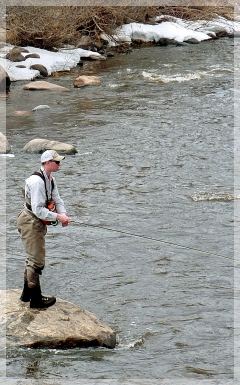
yampa river fishingEven though I’m not an angler, whenever I read about casting my cares, I picture using a fly rod and casting my concerns out into the river so the fast moving water can carry them away to God. When we lived in the mountains, one of our favorite walking trails ran alongside the Yampa River and we often paused to watch as the fishermen (and women) cast their lines into the water. Fly fishing is all about the art of casting and a bit like poetry in motion. It was fascinating to watch an angler flick the rod back and forth, gradually increasing the speed of the motion, before finally casting the line forward so the fly would land in the perfect spot. Masquerading as a water insect, the fly is made of things like fur, feathers, fabric and tinsel and secured to a hook. Rather than purchasing flies, many fishermen spend hours tying their own flies. Not wanting to lose either fly or fish in the river, anglers use at least five different knots to securely connect the reel to the backing, fly line, leader, and tippet before finally tying on the fly.
There is an art to fly casting and fly fishermen spend years perfecting their technique, especially since no one cast is ideal for every situation. Christians, however, aren’t casting flies—they’re casting things like fear, problems, anxiety, and worry—the cares every believer faces in this fallen world. While there’s no special technique to casting those cares, like fly fishing, it’s often easier said than done. Just as a fly fisherman may labor over tying his flies and fret about choosing the perfect ones for the day’s conditions, we often spend a great deal of time focusing on our worries rather than casting them into God’s river. Just as the fisherman ties those five knots to keep from losing his fly, we tie ourselves up in knots when we’re reluctant to give up our cares to God!

The anglers casting their lines in the river want to catch and land a fish but, when we cast our cares, we want to bring in an empty line. They catch, we release! Our cares are not for God to take away from us but for us to release to Him. Because the flies on the end of a fishing line are nearly weightless and our cares often seem as heavy as boulders, casting cares seems harder than casting a fly in the river. Nevertheless, it can be done and is far more rewarding than a trophy-sized trout.

Fishermen go to the river with an empty creel and hope to return home with a full one but we go to God with a creel full of cares so we’ll end up with an empty one. Our creels may be empty but we’ll be filled with the peace of God!

He that takes his cares on himself loads himself in vain with an uneasy burden. I will cast my cares on God; he has bidden me; they cannot burden him. [Joseph Hall]

Peace I leave with you; my peace I give you. I do not give to you as the world gives. Do not let your hearts be troubled and do not be afraid. [John 14:27 (NIV)]

Do not be anxious about anything, but in every situation, by prayer and petition, with thanksgiving, present your requests to God. And the peace of God, which transcends all understanding, will guard your hearts and your minds in Christ Jesus. [Philippians 4:6-7 (NIV)] 

Copyright ©2021 jsjdevotions. All rights reserved.

CONCEIT AND COMPARISON (Galatians 6:2-5 – Part 3)

Carry each other’s burdens; that’s the way to fulfill the Messiah’s law. If you think you’re something when you are not, you deceive yourself. Every one of you should test your own work, and then you will have a reason to boast of yourself, not of somebody else. Each of you, you see, will have to carry your own load. [Galatians 6:2-5 (NTE)]

sled dogs mushingThese last few days, I’ve been discussing Paul’s instructions both to carry one another’s burdens and to carry our own loads. In between those two directives, we find a warning about the things that can prevent us from doing that: conceit and comparison.
Conceit is thinking we’re better than we are. In carrying another person’s burden, we must never think ourselves too good to help nor should we think ourselves morally or spiritually superior to someone in their weakness and need. Comparison can lead to competition as we try to determine who is the better Christian by carrying his load better! The Lord has given each of us a task and equipped us with a specific set of skills and spiritual gifts to achieve it. The load given us is our responsibility just as the tasks and talents given to others are theirs. Moreover, we must never compare our virtues with other’s imperfections (leading to pride) or our flaws with others’ accomplishments (leading to jealousy). If we’re going to compare ourselves to anyone, it should be to Jesus!

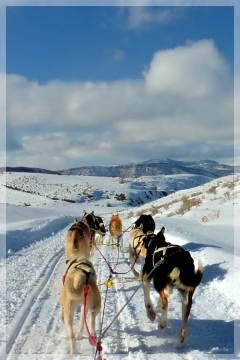
Oddly, this reminds me again of the Alaskan huskies I wrote about on Monday. Like us, each dog on the team has his own strengths (and weaknesses) and is assigned a position and a specific task that fit his attributes. Because they must follow the musher’s commands, set the pace, and keep the gangline taut, the lead dogs are the most intelligent on the team. No less important, however, are the swing dogs behind them. After the lead dogs make a turn, their critical task is to pull the sled in an arc that keeps the other dogs on the trail. They’re responsible for getting the musher and sled safely around curves and corners. Next are the team dogs—the brawn of the team who pull the sled and maintain the speed. Last, but hardly least, are the wheel dogs. Often the largest members of the team, as the first to take on the sled’s weight when starting out or going uphill, they play a crucial role in pulling and steering the sled.

Like us, each dog has a different skill set and position. Nevertheless, regardless of their position, no dog is more important than another and each is essential to the team. Just as the dogs’ responsibility is to the musher, ours is to God. The Apostle Paul tells us to examine ourselves (not others) to make sure we’re doing the work given to us by God. Like the sled dogs, we must be committed to doing our task well without conceit or comparison, Let us faithfully carry our own phortions and always be willing to carry one another’s baros.

Don’t think of yourselves more highly than you ought to think. Rather, think soberly, in line with faith, the true standard which God has marked out for each of you. As in one body we have many limbs and organs, you see, and all the parts have different functions, so we, many as we are, are one body in the Messiah, and individually we belong to one another. [Romans 12:3-5 (NTE)]

Copyright ©2021 jsjdevotions. All rights reserved.

BURDENS AND LOADS (Galatians 6:2-5 – Part 2)

Each of you, you see, will have to carry your own load. [Galatians 6:5 (NTE)]

he ain't heavyAfter saying we must carry each other’s burdens, the Apostle Paul seems to reverse himself three sentences later when he tells us we each must carry our own loads. It’s confusing; if we’re all supposed to carry our own loads, then nobody should need help carrying their burdens!

A few sentences previous to these verses, however, Paul encourages the Galatian church to follow the Spirit’s lead in their lives and now he’s explaining how walking in the Spirit actually looks—carrying one another’s burdens and carrying our own load. The Greek word Paul used for load was phortion, meaning load or cargo, and it was the word used for a marching soldier’s pack. Paul used the word figuratively to speak of the general responsibilities of life which we all have to bear. Like a soldier’s pack, this load is neither excessively heavy nor difficult to carry. In contrast to the oppressive burden of the Law demanded by the Pharisees, this load is the same phortion Jesus assigned to His followers. Things like discipleship, loving others, and forgiving one another are our load or phortion—obligations for which we alone are responsible.

When Paul wrote of carrying one another’s burdens a few sentences earlier, however, he used the Greek word baros, meaning something extremely heavy. Unlike a soldier’s pack, a baros is a crushing load too heavy for one person to bear alone. Baros was the word Paul used when describing the crushing weight that “was far too heavy for us; it got to the point where we gave up on life itself,” in 2 Corinthians 1:8. It is burdens like his that we are called to carry for one another.

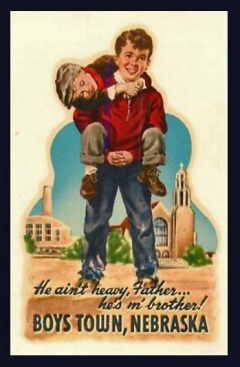
When I was a girl, Christmas seals were sent to us as a method of fundraising by Father Flanagan’s Boys Town. The story behind the picture on those stamps illustrates baros and phortion. A young boy named Howard was abandoned at Boys Town shortly after it opened in 1917. Having had polio, he wore heavy leg braces and couldn’t negotiate the staircases so the bigger boys carried him up and down the stairs. When Father Flanagan asked one of the boys if carrying Howard was hard, the answer was, “He ain’t heavy, Father, he’s my brother!” Years later, those words, accompanied by a photo of the two boys, became the organization’s logo. The burden of going up and down stairs was too great for Howard to bear alone. Because it was a baros, the other boys carried him. On the other hand, Howard was fully capable of doing his school work and helping the younger boys. Had he not done so, he would have failed to carry his own phortion.

While each of us is responsible for fulfilling our Christian duties by carrying our own phortions, one of those duties is to carry another person’s baros! It won’t seem heavy because we’ll be carrying our brother!

Pick up my yoke and put it on; take lessons from me! My heart is gentle, not arrogant. You’ll find the rest you deeply need. My yoke is easy to wear, my load (phortion) is easy to bear. [Matthew 11:29-30 (NTE)]

Copyright ©2021 jsjdevotions. All rights reserved.