
Do not be afraid or discouraged, for the Lord will personally go ahead of you. He will be with you; he will neither fail you nor abandon you. [Deuteronomy 31:8 (NLT)]
 With its declaration of one all-powerful infinite God, Jewish tradition holds that the Shema’s first verse “Hear, O Israel: The Lord our God, the Lord is one,” is the most important and, as such, demands greater concentration so the eyes are closed or covered by the right hand during its recitation. The Talmud traces this practice back to Rabbi Judah the Prince (135 – 219 AD) who often interrupted his lectures to recite the Shema. Whenever he did so, the rabbi placed his hands over his eyes as a way of disconnecting from his surroundings.
Reading about covering eyes during Shema caused me to ponder why we usually close our eyes during prayer. Closing our eyes certainly helps us avoid distractions but I came across additional Talmudic explanations for this practice. Rather than closing his eyes as a way to shut out the world, 13th century Rabbi Yonah Gerondi rotated his eyes so he could see God in all directions. He only covered them during the Shema to ensure his spiritual privacy while rolling his eyes. In his explanation for shutting the eyes, 17th century Rabbi Ezekiel Landau said, “it would be difficult to express complete faith in God while looking at the pain in the world around us.” Indeed, sometimes it is difficult to express our faith in the midst of the suffering and ugliness in the world.
Another Talmudic explanation for closing the eyes while reciting the Shema is that its meaning goes beyond stating there is only one God—the Shema also means there is no existence outside of God. By closing one’s eyes during its recitation, a person briefly steps outside the physical reality of the world and into a reality centered only on God.
While there are times I pray with my eyes open (when walking in the morning, inspired by God’s glorious creation, witnessing something troubling, or saying a quick prayer for a stranger or passerby), I usually pray with my eyes closed (as I suspect most people do). Why? After all, when Jesus taught us to pray, He didn’t tell us to close our eyes before starting!
Perhaps we close our eyes during prayer for all of the reasons found in the Talmud—to avoid distraction, to see past the pain, to see God in all directions, and to acknowledge that nothing exists outside of Him. It could simply be that when we close our eyes all we can see is darkness. Nevertheless, even though we can’t see our surroundings, we know they haven’t disappeared because we also know that not seeing something doesn’t mean it isn’t there. Our closed eyes remind us that even though we can’t see God, His purpose, or His plan, He’s right beside us. Perhaps, we close our eyes because, as follower of Christ, we live by faith, not sight!
 In its entirety, the Shema consists of three sections: Deuteronomy 6:4–9, Deuteronomy 11:13–2, and Numbers 15:37–41. The second paragraph of the Shema repeats the first one’s commands regarding the binding of God’s words to hands and forehead, writing them on the doorways and gates, teaching them to the children, and talking about them throughout the day. The primary theme of this paragraph, however, is that the promised land and the people’s enjoyment of it depended on their faithfulness to God. As long as they loved God and served Him with heart and soul, the people and land would be blessed but, if they turned aside to serve other gods, God’s wrath would result and things would not go well for the people or their land. In this warning, that is repeated again and again throughout the Old Testament, we see the fundamental Jewish belief that reward and punishment are based on the fulfillment of God’s commandments.
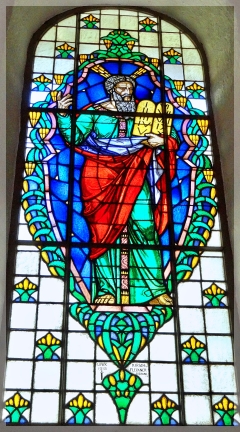 My morning’s reading took me to Deuteronomy 6 and the words that Jesus cited as the first, and most important commandment. Known as the Shema and found in verses 4 through 9, it is the essential declaration of the Jewish faith. Its name comes from the first Hebrew word of the verse, shema, which means “hear.” Observant Jews recite its words twice a day (morning and evening), on the Sabbath and religious holidays, and as the last words before death. The Shema is so entrenched in Judaism that a story is told about Rabbi Yitzhak Herzog who, in 1946, went searching for Jewish children who’d been hidden by Christians during the Holocaust. As he walked through European convents, monasteries, and orphanages, the rabbi would start to recite the Shema. He easily found the Jewish children because they immediately joined in saying the sacred words.
 Pontius Pilate was the Roman prefect (or governor) of Judea from 26 to 36 AD. He was responsible for the collection of taxes, managed construction projects, and had the sole authority to order a criminal’s execution. His most important duty, however, was to maintain law and order and, if he couldn’t do it through negotiation, he did it by any means necessary.
 The Great Sanhedrin was the Supreme council (high court) of the Jews. Formed around 200 BC and modeled after the 70 elders who helped Moses in governing the Israelites, its 71 members consisted of scribes, priests, and elders with the high priest acting as its presiding officer. Along with religious and ritualistic Temple matters, the Sanhedrin addressed secular criminal matters, proceedings in connection with the discovery of a corpse, trials of adulterous wives, tithes, the preparation of Torah Scrolls, and drew up the calendar. As long as the Sanhedrin maintained public order and the Jews kept paying their taxes to Rome, the Romans were content to leave most of the nation’s judicial matters to them. While the Sanhedrin were supposed to administer justice, in the case of Jesus, they were anything but just; in fact, they sought perjured testimony.
 Rather than a religious sect, the Herodians were a political group who favored Herodian rule over direct Roman rule. Unlike previous kings of Israel, the Herodian kings were appointed by the Roman emperors. It’s been said that “You can’t tell the players without a scorecard,” and it seems that way with the various Herods we meet in the New Testament. It was Herod the Great, ruler of Judea from 37 to 4 BC, who enlarged the Temple Mount and began rebuilding the second Temple around 20 BC. This Herod was the “king of the Jews” who questioned the Magi and sought to kill the Messiah by slaughtering boys under the age of two. [Jesus was born between 6 and 4 BC.] After Herod’s death, his kingdom was divided among his sons and Herod Antipas became tetrarch of Galilee and Perea. This is the Herod who ruled Galilee throughout Jesus’ ministry—the one who married the wife of his brother (Herod Philip II), beheaded John the Baptist, and sent Jesus back to Pilate.
