REACH OUT AND TOUCH SOMEONE

Just then a woman who had suffered for twelve years with constant bleeding came up behind him. She touched the fringe of his robe, for she thought, “If I can just touch his robe, I will be healed.” [Matthew 9:20-21 (NLT)]

Clam Pass BeachImagine the anguish of the woman with the blood disorder. Because Levitical law declared that anyone who touched her would be considered unclean, she’d been cut off from friends and family for twelve years. Sexual union would defile her husband so she couldn’t marry and, if she’d been married, her husband would have divorced her. Because her defilement would spread to anything she touched (be it food, cups or cushions), she was isolated in her own home. While the anemia, pain, stress, and public humiliation she endured because of her disorder must have been awful, perhaps the agony of being a pariah and unable to physically connect with people was even worse. It was her responsibility to make sure she didn’t defile others by touching them so she shouldn’t have been anywhere near a crowd. She certainly shouldn’t have touched a man (or his clothing) and could have been severely punished for her previously action. No wonder she tried to sneak unnoticed through the crowd to touch Jesus’ robe.

In the 1980s, AT&T urged us to “Reach Out and Touch Someone.” Granted, they meant with their phone service but now, when it is so easy to communicate with cell phones, email, texts, Facebook, Twitter, Skype, and Facetime, it is important to reach out and actually touch! Sunday mornings, there’s usually a lot of friendly touching with handshakes and hugs when we greet one another at our church in the park. Recently, after greeting Jimmy with a friendly handshake, my husband sat with him at a picnic table. (I previously wrote about Jimmy in “It Takes All Kinds.”) A man with what can be described as a colorful past, he’s been worshipping with us and joining in Bible study for the last several weeks. That morning, Merna walked over to greet the men at the table. Putting one hand on Jimmy’s back, she bent over to talk with him and casually patted his arm with her other hand. As she walked off to greet others, Jimmy broke out in a huge smile and confided to my husband that he couldn’t remember when last a lady had touched him.

As I pondered Jimmy’s words, I thought about the importance of touch; it is an essential human need. When we touch or are touched, our bodies release chemicals like oxytocin (the devotion, trust and bonding hormone) and serotonin (the happy hormone) while inhibiting other chemicals like cortisol (a stress hormone). Without a doubt, Jesus had a powerful touch and people brought their children to Him just so He could touch them. When Jesus touched Peter’s mother-in-law, she immediately recovered from her fever and, after touching Jairus’ daughter, the dead girl got up and walked. With a touch, Jesus gave sight to the blind, hearing to the deaf, speech to the mute, and made leprosy disappear. As for the woman with the blood disorder: even after the blood stopped, without waiting another seven days and undergoing a ritual bath, she was still considered unclean. I don’t think that bothered Jesus! Although the gospels don’t record it, there is no doubt in my mind that, as the trembling woman knelt at His feet, Jesus touched her when He told her to go in peace.

How many people go days, weeks, or longer without a gentle touch? Consider the many people who live alone or those, like Jimmy and the bleeding woman who feel tainted because of their past? When we touch one another, we communicate care and concern and experience oneness. Like Jesus’ touch, Merna’s touch told Jimmy that he wasn’t unclean—that he mattered both to God and to his family in Christ. The touch of Jesus has the power to heal and so does ours! Let’s reach out and touch someone today!

Each time we reach out and touch someone, we communicate the tangible truth of the gospel—that God in Christ reaches out to each of us, drawing us into intimate relationship with Him and those around us. [Rob Moll]

Then Jesus placed his hands on the man’s eyes again, and his eyes were opened. His sight was completely restored, and he could see everything clearly. Mark 8:25 (NLT)

Copyright ©2018 jsjdevotions. All rights reserved.

THE CORNERSTONE

You are God’s building. Because of God’s grace to me, I have laid the foundation like an expert builder. Now others are building on it. But whoever is building on this foundation must be very careful. For no one can lay any foundation other than the one we already have—Jesus Christ. [1 Corinthians 15: 9b-11 (NLT)]

oleanderTwo members of our small group attended Easter service at a Christian church in another town. Imagine their shock when the pastor began his sermon by saying he didn’t believe in the resurrection. Thinking his statement had been made for shock value, they patiently waited for him to make a case for Christ and defend the truth of Easter. Unfortunately, he only offered a feel good message about new beginnings. I was reminded of their story when another pastor mentioned his experience when a youth pastor. After one of the teens complained that he talked too much about Jesus, he was called into the senior pastor’s office and told that Jesus just should be a “side dish” in the church youth group!

As for the resurrection—can it be Christianity without the risen Christ? Without Easter, we just have a man who said some beautiful and wise things and was killed for his words. While He may have had a great message, he was either delusional or a liar. In the early church, an Apostle was someone who had personally known Jesus both before that dark Friday and after that glorious Sunday. Without the resurrection, Peter and the rest of the Apostles were equally delusional or liars who perpetrated a fraud with their claims of an empty tomb and their witness to the risen Christ. Without the resurrected Christ, everything that happened after the crucifixion and much of what happened before is suspect. When we read Acts, we find that the essence of every sermon preached is the resurrected Christ. Without the resurrection, how can we believe Jesus was God in flesh? Without the risen Christ how can we believe in the Holy Trinity, the resurrection of the dead, or the truth of the New Testament?

There are plenty of authors who make excellent cases for the resurrection and I’ll leave the Christian apologetics to them. Believing in the resurrection doesn’t mean we totally understand it, can explain how it happened, or know exactly what the body of the risen Christ was like but we don’t need those answers to believe in the risen Christ. Jesus is the cornerstone of Christianity and, if Jesus is still dead, so is our religion

As for a “side dish Jesus:” side dishes are optional and you can take as much or as little as you want or skip them altogether. They’re like the Brussels sprouts or green beans at Thanksgiving dinner. Jesus, however, is not a side dish; along with God the Father and the Holy Spirit, He’s the main (and only) course! Rather than a turkey, our Triune God is more like one of those Turduckens: three meats (turkey, duck, and chicken) rolled into one. When you slice through it, you get all three—each one equally delicious and equally essential. If we are going to call ourselves Christians, it seems that both the resurrection and Jesus are fundamental to our faith.

I don’t know about that doubting pastor from Easter but I do know a little about that teen who thought there was too much Jesus in her youth group. Her youth pastor refused to back down and, rather than put Jesus in a side dish, He kept the risen Christ front and center. The teen who objected to the main dish Jesus? Shortly after that meeting, she accepted Jesus—not as an optional add-on but as her Lord and Savior!

Scripture often referred to Jesus as the cornerstone: the foundation upon which the church is built. The cornerstone of a building gives it a reliable and firm foundation; it is indispensable and prominent. May the risen Christ remain indispensable and prominent in our witness as we build His church!

You are members of God’s family. Together, we are his house, built on the foundation of the apostles and the prophets. And the cornerstone is Christ Jesus himself. We are carefully joined together in him, becoming a holy temple for the Lord. [Ephesians 2:19b-21 (NLT)]

Copyright ©2018 jsjdevotions. All rights reserved.

PAYING THE PRICE

Don’t be misled—you cannot mock the justice of God. You will always harvest what you plant. [Galatians 6:7 (NLT)]

osprey“It wasn’t worth it!” I grumbled while applying cortisone over four painful red bumps on my foot. When walking around the lake at the botanic gardens, I’d spotted an osprey in a nearby tree. To get a good shot, I had to step off the paved trail into what I knew to be fire ant territory. Having had previous encounters with these stinging insects, I knew better than to stand there in sandals, but I did it anyway; the picture wasn’t worth the price I was paying for my poor decision.
It’s not just fire ants that cause us to regret our poor choices. Wanting to sow his wild oats, the prodigal son enjoyed himself while recklessly spending his inheritance but, when the hungry young man was slopping pigs, he knew his wild living hadn’t been worth it. Adam and Eve (and the rest of mankind) paid a hefty price for a bite of an apple: banishment from Eden, painful childbirth, marital discord, toil and death. I wonder if David thought adultery worth the price he paid: his first son by Bathsheba died, he was humiliated when Absalom publicly took his wives, and violence and rebellion plagued his family. King Manasseh knew better than to build pagan shrines, sacrifice his own children, and place a carved idol in the temple. The price he paid was being led away to Babylon in bronze chains with a ring in his nose. Fortunately for him, Manasseh was given a second chance by God; not everyone is so lucky. Lot’s wife had been warned; was that last look at Sodom worth the price she paid? Then again, as a pillar of salt, she could gaze at the city’s ruins forever.

After nearly 3000 prescription pills were found in her possession, a sheriff’s deputy in a northern community pled guilty to “attempted possession of a controlled substance.” Punishable by up to a year in prison, she was sentenced to seven days in jail and a year of “conditional discharge.” Less restrictive than probation, conditional discharge means the court retains jurisdiction over her with several provisions including drug and alcohol evaluations, no employment where she might have access to drugs, and no use or possession of a firearm. Since the original charge was negotiated down from felony possession (meaning four to fifteen years in prison), most of us would think she got off easy. Apparently expecting probation with no jail or restrictions, the defendant was shocked by what she considered a harsh sentence. As a deputy, she couldn’t plead ignorance of the law or its consequences; nevertheless, she thought the price she paid too high. My study Bible speculated that had David known the cost of his sin, he might not have bedded another man’s wife. I disagree. As a king, David knew the law given in Leviticus: the punishment for adultery was death for both he and Bathsheba! Like the deputy, he knew the consequences and like her, he got off easy.

Stepping onto an ant hill has painful consequences but so does sin. The penalty I paid for that photo was negligible compared to the cost of many of our poor decisions. When choosing between right and wrong, the price we pay can be far greater and longer lasting than a few insect bites. Although Jesus paid the price for our sins on the cross and God promises forgiveness when we repent, we still have to face the consequences of our sins here on earth. We, however, are not the ones who get to pick and choose what those consequences will be nor do we get to complain and say, “But God, it wasn’t worth it!”

Temptation can be tormenting, but remember: The torment of temptation to sin is nothing to compare with the torment of the consequences of sin. Remorse and regret cannot compensate for sin….though sins can be forgiven immediately – the consequences can last a lifetime. [Edwin Louis Cole]

No discipline is enjoyable while it is happening—it’s painful! But afterward there will be a peaceful harvest of right living for those who are trained in this way. So take a new grip with your tired hands and strengthen your weak knees. Mark out a straight path for your feet so that those who are weak and lame will not fall but become strong. [Hebrews 12:11-13 (NLT]

Copyright ©2018 jsjdevotions. All rights reserved.

THE EMPTY TOMB

You are looking for Jesus of Nazareth, who was crucified. He isn’t here! He is risen from the dead! [Mark 16:6 (NLT)]

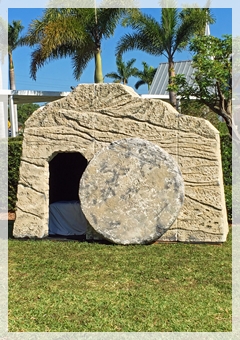
empty tomb - north naples churchYesterday I mentioned the wooden cross and rustic nail on my desk that serve as reminders of the terrible price Jesus paid for our salvation. Although early Christian symbols included a dove, ship, lyre, anchor, and fish, the cross has become the universal symbol for Christianity. While Coca-Cola’s logo, Nike’s swish and McDonald’s golden arches may come close, I doubt there is any so recognizable sign in the world. Nevertheless, a gruesome instrument of Roman torture seems an odd symbol for a faith that preaches such things as reconciliation, sacrifice, forgiveness, hope, love, and peace. While I’d never wear a miniature gallows, guillotine, or electric chair on a chain around my neck, I do wear a cross. Although it symbolizes everything that happened to Jesus on that dark Friday two thousand years ago, the cross would be meaningless if the tomb had not been empty Sunday morning.

As we walked out of worship service on Easter morning, we came upon a large replica of a stone tomb. The boulder that had covered its opening since Friday was rolled away and it was empty except for some linen cloth resting on a ledge. Like the women who came early that first Easter morning (and Peter and John who arrived later), a few curious children entered the tomb. No angel was there to reassure them, but they didn’t need one. They’d come from Sunday school and know the Easter story well. At worship services, they’ve joined their parents in saying: “Christ has died; Christ is risen; Christ will come again.” Rather than frighten them, that dark empty tomb reassured them of Jesus’s continual presence in their lives.

Jesus’s death upon the cross is important but it is His rising from the dead that demonstrates triumph over evil, sin, hate, and death. It is the empty tomb that allows us to say these words in the Apostle’s Creed: “I believe in Jesus Christ…[who] was crucified, died and was buried; he descended to the dead. On the third day he rose again… I believe in…the resurrection of the body and the life everlasting.”

Out of curiosity, I searched the stock of several Christian supply stores using the word “tomb.” There were plenty of books, choral collections, CDs, and songs with “tomb” in the title, some Easter stickers depicting an empty tomb, and even a “Raiders of the Empty Tomb” kit, but there were no empty tomb t-shirts, paper weights, jewelry, or wall décor. Apparently, there is no danger of an empty tomb replacing the cross as the universal symbol of Christianity. Nevertheless, when we see a cross, let us never forget that the story of God’s love for us did not end at Golgotha. It didn’t even end with the empty tomb three days later. The story of God’s presence, grace and love continues today.

Christians do not believe in the empty tomb, but in the living Christ. [Karl Barth]

So you see, just as death came into the world through a man, now the resurrection from the dead has begun through another man. Just as everyone dies because we all belong to Adam, everyone who belongs to Christ will be given new life. But there is an order to this resurrection: Christ was raised as the first of the harvest; then all who belong to Christ will be raised when he comes back. [1 Corinthians 15:21-23 (NLT)]

Copyright ©2018 jsjdevotions. All rights reserved.

HONOR THY FAMILY

mute swans and cygnetsThey [the Pharisees] asked him, “Why do your disciples disobey our age-old tradition? For they ignore our tradition of ceremonial hand washing before they eat.” Jesus replied, “And why do you, by your traditions, violate the direct commandments of God?” [Matthew 15:1b-3 (NLT)]

When the Pharisees asked Jesus why his disciples ignored tradition and didn’t wash their hands before eating, theirs was not a sanitation or health question. Rather than dirt, they were concerned about defilement. More interested in washing their hands than purifying their hearts, they believed hands could become ritually unclean even by touching someone as “unclean” as a Gentile or tax collector. Eating with unwashed hands meant that the sinner’s impurity was passed to the food which would defile the person eating it. Some Pharisees even considered eating with unwashed hands as sinful as sex with a prostitute. Although Salmonella and E. coli can be passed along on someone’s hands to their food, someone’s sins certainly can’t.

Jesus responded to their question with one of His own when He asked the Pharisees why they violated God’s commandments. After all, breaking a man-made tradition is hardly the same as breaking one of God’s direct commands. The Pharisees had a tradition called korban (meaning “a gift” or “offering”).  When a korban vow was made, the Pharisee transferred all of his assets to the temple but retained the use of them until his death (sort of a “life estate”). Those assets could not be transferred or used to benefit anyone else. As a result, while the Pharisee could live quite comfortably, he could not help the poor, disadvantaged or even his parents. The commandment they were neglecting was the fifth one—that of honoring one’s father and mother. A wealthy Pharisee’s parents could be in dire financial straits and yet he could self-righteously ignore their pleas for help. As so often happened with the Pharisees, they supplanted God’s command of honoring parents with a law that gave them prestige and honored only them!

Willing to neglect their family responsibilities in the name of religion, the Pharisees had misplaced priorities. I thought of them when one of our pastors proposed we ask ourselves what things we value the most, in what order we put them, and how we allot our resources to them. He then shared his experience of being called into a council meeting at another church several years ago. When questioned about the amount of time he gave the church, his response was that he lost one family when he put the church first and he was not about to lose his new one the same way. Family would always come before the church. Note—he didn’t say God but “the church” and there can be a big difference between the two.

In effect, the Pharisees put the church or religion before both God and family. If we look at those Ten Commandments, the first four have to do with our relationship with God; the rest have to do with our relationship to other people and parents are at the top of that list. It would seem that, after God, our next priority should be family; after all, once done with creation, God created the family unit (and not the church).

While we probably won’t pledge our entire estate to the church while watching our parents lose their homes or beg on the street, I wonder if, as our pastor once did, we occasionally misplace our priorities. Do we allow our church responsibilities to overshadow our family ones? There are lots of worthy causes and, sometimes, we’re torn as to where to put our resources. While we’re never too busy for God, God work and church work aren’t always the same; there is a fine line between the two. Although I don’t pretend to know where it is, I think the Holy Spirit will let us know when we’ve crossed it. The Pharisees turned a deaf ear to the needs of their families; we must never do the same.

If God cared only about religious activities, then the Pharisees would have been heroes of the faith. [Francis Chan]

But those who won’t care for their relatives, especially those in their own household, have denied the true faith. Such people are worse than unbelievers. [1 Timothy 5:8 (NLT)]

Copyright ©2018 jsjdevotions. All rights reserved.

GOD’S GOVERNMENT

Mt. RushmoreThe Lord does whatever pleases him throughout all heaven and earth, and on the seas and in their depths. [Psalm 135:6 (NLT)]

You will be secure under a government that is just and fair. Your enemies will stay far away. You will live in peace, and terror will not come near. [Isaiah 54:14 (NLT)]

Every nation has some system of government and I wonder what system is used in God’s Kingdom. Since He doesn’t govern by committee or with a privileged ruling class, it isn’t an oligarchy or an aristocracy. He is a King, has a Kingdom, and can exercise absolute power, yet His is not a monarchy. His power didn’t come from conquest or birthright, no one gave Him the crown, and no royal scion will follow Him; His reign always has been and forever will be. With all those Old Testament rules, perhaps His is a dictatorship, albeit a benevolent one, in which God exercises absolute power for the good of the population as a whole. That sort of rule, however, would be a one-size-fits-all government. A God who has numbered the hairs on our heads and written our names on his hand knows that one size can never fit all of his unique children.

God’s Kingdom isn’t like our nation, a government “of the people, by the people, and for the people,” with its three branches of government and the checks and balances that come with it. In God’s government, all three branches are rolled into one; He makes the rules, implements them, and decides how they are to be interpreted. There’s no need for checks and balances; God can’t step over the boundaries because He has none. His reign is not dependent upon re-election or approval rating, the majority does not rule, His word is law, and the only being God needs to please is Himself. He didn’t consult with Adam and Eve about the forbidden fruit rule nor with Sodom and Gomorrah about their destruction. The Ten Commandments were not created in committee, voted on by the Israelites, ratified by Moses or tested by an Israelite court. God doesn’t need our advice, consent, or support to make the sun rise or set. Clearly, He runs neither democracy nor republic.

With any sort of earthly government, the ruler’s power is limited to his life span and his nation’s border. God’s power, however, is unlimited. He is the eternal Sovereign God over the entire universe. His is a never-ending government of love, forgiveness, righteousness, peace and justice. Unlike other forms of government, His is truthful, dependable, and free of any corruption or bureaucracy. I don’t think there is a word that describes God’s reign except, perhaps, “perfect.” After all, God is God and we are not.

For the Lord is our judge, our lawgiver, and our king. He will care for us and save us. [Isaiah 33:22 (NL)]

May your Kingdom come soon. May your will be done on earth, as it is in heaven. [Matthew 6:9 NLT)]

Copyright ©2018 jsjdevotions. All rights reserved.