
 This is the message you have heard from the beginning: We should love one another. [1 John 3:11 (NLT)]
Last week, I delivered the eulogy for my 102-year-old mother-in-law at the celebration of her life. The word “mother-in-law” does not adequately describe our relationship. Although my mother died when I was fifteen, at the age of twenty God blessed me with another mother when I got married. Along with a husband, I gained his wonderful parents. My mother-in-law opened both her arms and heart to me and loved me well. It was from her that I learned how to be a woman, wife, mother, grandmother, mother-in-law, and friend. I never had a problem calling her Mom; indeed, I loved her as if she had been my very own birth mother.
Four years ago, I wrote a Mother’s Day devotion about Ruth and Naomi titled “Mothers-in-law.” While considering what an amazing woman Naomi must have been to inspire such love, I kept thinking of my mother-in-law and how I was a Ruth to her Naomi. Since my mother-in-law was approaching her 99th birthday that year, I suspected that I would probably use that comparison in a eulogy at her Celebration of Life in the not too distant future. When I delivered my father-in-law’s eulogy nearly fifteen years ago, I had glowing words to say about him; sadly, as happens with eulogies, he never heard them.
Although anyone who would be in attendance at my mother-in-law’s eventual funeral would certainly know from my words how much I loved this beautiful woman, I wondered if she knew it. People say actions speak louder than words and my actions were always kind, loving, respectful and considerate. Yet, in spite of my behavior, I wondered whether my mother-in-law knew that, even in difficult circumstances such as those encountered by Ruth and Naomi, I gladly would say, “Don’t ask me to leave you and turn back. Wherever you go, I will go; wherever you live, I will live. Your people will be my people, and your God will be my God. Wherever you die, I will die, and there I will be buried.” [Ruth 1:16-17 (NLT)] Sometimes, words need to be spoken and it occurred to me that I should share my thoughts with my mother-in-law while she was alive rather than wait to say them to those who mourned her when she’d passed. And so, along with Mother’s Day candy, flowers, and card, I gave her a letter comparing us to Ruth and Naomi and expressing my devotion, admiration and love for her.
When the Apostle Paul told us that eloquent words and generous actions without love were worthless, he wasn’t telling us not to express ourselves but rather to use our words and actions authentically. We often assume that the people we love know it, but do they? The time to express our love is now, when our words and actions can be appreciated, rather than later, when they can’t!
I would rather have a single rose
From the garden of a friend,
Than to have the choicest flowers
When my stay on earth must end.
I would rather have the kindest words
Which may now be said to me
Than flattered when my heart is still
And this life has ceased to be.
I would rather have a loving smile
From the friends I know are true,
Than tears shed ’round my casket
When this world I’ve bade adieu.
Bring me all your flowers,
Whether pink, or white, or red,
I’d rather have one blossom now
Than a truckload when I’m dead. R.D. Richards
 Yesterday, I wrote about archeological support for the story of Balaam; his is but one of many Old Testament stories with evidence provided by archeology. When reading about King Belshazzar giving a feast for 1,000 in his Babylonian palace, it’s easy to think there must have been exaggeration as to the size of his party. Archaeologists, however, have excavated a large hall in Babylon that was 55 feet wide and 165 feet long, a room sufficient to host a gathering of that size. The Bible mentions writing that appeared on the room’s plaster walls and archeologists found that this ancient room had plaster walls!
 We were window shopping and celebrating our anniversary. Wanting to get me a gift, my husband spotted a dress he liked in the window of a little boutique and insisted we go inside. The owner greeted us, said the dress in the window wouldn’t fit and showed me a different dress. It was so unlike anything I’d ever worn that I immediately said it wouldn’t look right on me—wrong color, wrong style, wrong material, and wrong fit. ”Don’t you tell me what it will look like,” she said indignantly. “I created this dress and know exactly who it will fit. It will be beautiful on you.” Chastened, but still sure it would look terrible, I reluctantly tried it on. The designer, however, was right. As the creator of the dress, she knew what she had in mind when making it and that it would be right for me.
 When the Israelites sent scouts out to Canaan, they were doing due diligence and getting the lay of the land. Let’s remember, Moses had only asked them to scout out the land, not to determine how or whether they should proceed. But, when they returned, ten of the twelve reported the Promised Land was the land of giants who were undefeatable. In spite of Moses’s leadership, the reassurances of Joshua and Caleb, and God’s promises and power, the Israelites pridefully decided they knew more than God and chose fear instead of stepping out in faith.
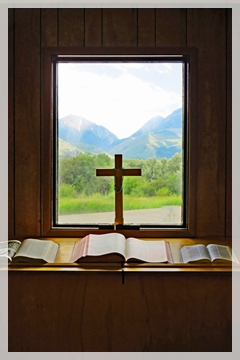 Before the incarnation of Christ, God dwelt first in the tabernacle and then in the temple. The innermost room of the temple was called the “Most Holy Place” and it was in this inner room that God’s glory was said to dwell. This was where the Ark of the Covenant was kept and where the high priest came with a sacrifice to atone for his and the nation’s sins every year. With the incarnation of Jesus, God no longer dwelt in the temple but in the flesh of His son and, for a brief time, God actually walked among His people. Yet, when Jesus lived as a man, only a few people at a time could be in His presence. With His death, there is no yearly atonement ritual because Jesus atoned for our sins once and for all. Moreover, because of His resurrection, ascension, and the presence of the Holy Spirit, it is possible for countless people, everywhere, to be in His presence at the same time. Once we become believers, the Holy Spirit moves into our hearts and each one of us, as members of Christ’s church, become part of His body and the temple of God.
 Some prophets weren’t bothered by the truth and were available for hire. Ahab, for example, had 400 prophets on his payroll acting as his “yes men.” When he asked Jehoshaphat to join him in a campaign against Aram, Jehoshaphat requested the advice of prophets so Ahab summoned his seers. Jehoshaphat, however, recognized them as pagans; when he asked for a true “prophet of the Lord,” Micaiah was summoned.
 Devotions of the Heart