
If possible, so far as it depends on you, live peaceably with all. [Romans 12:18 (ESV)]
 There was a bit of a kerfuffle behind us during church last week; it started during the Old Testament reading and continued to the Gospel. As best as I can figure, a bottle of water had leaked onto the pew. The women behind me sat on the damp cushion and made quite a production of detecting, discussing, and complaining about it first to her husband and then to her neighbor (whose water it had been). There was room enough to move down in that pew and plenty of other pews (with dry cushions) available, but the couple never moved. Nevertheless, throughout the rest of the service, I felt the woman’s breath on my neck every time she exhaled another loud sigh of misery.
Upon returning to our pews after receiving Communion, I realized she’d left church rather than go forward for the bread and wine. When her husband returned to the pew, I heard the woman whose water had spilled whisper her heartfelt apology once again. She asked what she could do to make it right. He casually said, “Nothing. Life happens; it was an accident and she has to get over it.” He then confided, “I’m sorry; she doesn’t handle things well.”
I thought of the story of David, Nabal, and Abigail in 1 Samuel 25. David and his men were hiding from King Saul in the wilderness of Maon when they came across Nabal’s shepherds tending his 3,000 sheep and 1,000 goats. Rather than stealing any animals for themselves, David’s men formed a line of protection around the shepherds and animals so that no harm came to them. At sheep shearing time, a time of celebration when the shepherds would get paid, David sent wishes of peace and prosperity to the wealthy Nabal. Explaining that he and his men had warded off both Bedouin raiders and predators, David asked Nabal to share some provisions with his men as payment for their protection. While their services had been unsolicited, David’s request was not unreasonable.
Nabal’s name meant “fool,” and the man lived up to his name; he not only refused but did so by insulting the slayer of Goliath. Upon hearing Nabal’s rude response, the angry David and his army headed out with the intention of killing every man in Nabal’s household. Fortunately, a servant told Nabal’s wife, Abigail, of David’s service and Nabal’s rashness in offending him. The wise woman quickly packed a large quantity of food and wine and went to David. Humbly apologizing for Nabal’s bad manners and offering the provisions to David and his men, she assuaged David’s anger and defused a dangerous situation.
I imagine Abigail frequently had to make amends for her husband’s churlish and stingy behavior and, from the way that husband handled the situation at church, I suspect that he is no stranger to apologizing for his wife’s peevish conduct. Living with someone who makes mountains from molehills, overreacts to minor annoyances, or takes every slight as a personal insult can’t be easy and I immediately prayed for him.
It was not until later that I thought to pray for his wife. It’s easy to pray for the Abigails and Abners—the long-suffering spouses—in situations like that. They have both our admiration and sympathy as they regularly repair any damage left behind by their spouse. After giving it more thought, however, I also prayed for his wife and others like her—the Nabals and Mabels of life. How sad it must be to go through life choosing misery over joy, tightfistedness over generosity, resentment over forgiveness, turmoil over peace, and complaint over praise. May we all be wary of behaving as a Nabal; it didn’t end well for him. When he discovered what his wife had done, Nabal had a stroke and died!
If you don’t like something, change it. If you can’t change it, change your attitude. [Maya Angelou]
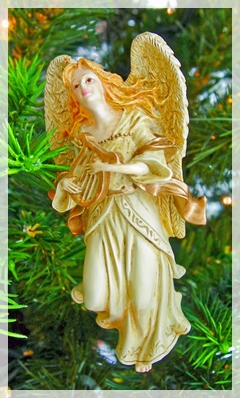 It’s no wonder that the angel Gabriel told Mary not to be afraid. Angels were not an everyday occurrence and, when they arrived, lives were changed. As God’s messengers, angels sometimes brought good news, offered protection, or comforted people, but they also brought warnings and executed God’s judgment. Although angels rescued Lot, they also warned of Sodom’s destruction! Balaam received a stern warning from a sword-bearing angel, David wrote of destroying angels, and 2 Samuel tells of an angel nearly destroying Jerusalem. Mary’s initial confusion and concern at seeing an angel is understandable. When reassuring the girl, Gabriel tells her she is “highly favored” by God; he’s not brought bad news, but good. Nevertheless, she knows her life is going to change; she just doesn’t know how!
 The National Retail Federation estimates that Americans will spend between 727.9 and 730.7 billion dollars on Christmas gifts and merchandise between November 1 and the end of the year. If they’re correct, we’ll have spent nearly $95 for every one of the 7.7 billion people on earth (most of whom won’t get any of those purchases). It’s ironic that a day set aside to honor the birth of Jesus, the Savior who sacrificed His life for us, has become a frenzied season of obtaining and consuming.
 Since 2014, we’ve awaited the opening of a new grocery store. Having missed all three of its previous launch dates, it is supposed to open today. Promising to be a “local destination,” this store isn’t just another Publix or Kroger’s. This “culinary mecca” and “foodie paradise” promises to be the Disneyland of grocery stores. In its 77,000 square-feet, there will be a food court and restaurant along with a book corner, five-level children’s play area, cooking demonstration kitchen, and coffee, smoothie, juice, wine and cocktail bars. They’ll churn fresh butter, roast fresh coffee, make their own ice cream and candy, pull fresh mozzarella cheese, and bake wood-fired pizzas. There will be tanks of live tilapia and shrimp along with six-hundred gallons of live lobster. Like any grocery, they’ll have fresh produce and bakery, dairy case (with artisan cheeses), wine department, butcher shop, bulk food, flowers, and whatever else you could possibly find in a grocery store. The store claims it will be “the kind of place where you’ll want to hang out.”
 But Jesus said, “You feed them.” “With what?” they asked. [Luke 9:13a (NLT)]
 Seeing the rise of secularization, communism, fascism, and atheism following World War I, Pope Pius XI instituted the Feast of Christ the King in 1925. He wanted to remind Christians who their only King was and that it was Christ (and Christ alone) who should reign in our hearts! Originally celebrated the last Sunday in October, the feast day was moved to the last Sunday of the liturgical year in 1969. In spite of being created by the Roman Catholic Church, many Protestants including Episcopalians, Methodists, Lutherans, and Presbyterians celebrate the day.
 Devotions of the Heart