IMITATING CHRIST

Instead, clothe yourself with the presence of the Lord Jesus Christ. And don’t let yourself think about ways to indulge your evil desires. [Romans 13:14 (NLT)]

rue anemoneBecause of the Jewish prohibitions about images, I understand why no pictures of Jesus were drawn by His followers. Nevertheless, any decent author gives a minimal word picture of his characters but the gospels’ writers give us nothing. With Melville’s description of Captain Ahab’s gray hair, scarred face, and whale-bone peg-leg, we know more about the fictional whale hunter’s looks than we do about the real Jesus! The most we know about His exterior is found in Isaiah’s prophecy: “There was nothing beautiful or majestic about his appearance, nothing to attract us to him,” [53:2] which describes most of us! Adjectives are few and far between in Scripture but the Bible isn’t a novel and its words were God-breathed not writer created. If God wanted us to know about Jesus’s appearance, He would have told us. After all, if we knew what Jesus looked like, wouldn’t we focus more on His looks rather than His words? Rather than wanting to emulate His character, we’d probably want to match His features—after all, He was God!

When Paul told the Romans to “put on” or clothe themselves with Christ, he wasn’t speaking of robes, sandals, beard or haircut. He was speaking of spiritual clothing—to take off our “dark deeds like dirty clothes, and put on the shining armor of right living.“ [13:12] While we know nothing of Jesus’ physical appearance, the New Testament writers gave us more than enough description of Jesus’ words and behavior to clearly picture the “shining armor of right living.” When we put on Christ, our minds and behavior transform so that our lives imitate His—so that, when people see us, they should see Him.

Below is an excerpt from the Epistle to Diognetus. While not part of the Christian canon, it is a valuable document. Written around 130 AD, the author calls himself Mathetes (meaning “disciple” in Greek) and claims to be a student of the apostles. Yesterday, I wrote of the misconceptions surrounding the early followers of Jesus. In Mathetes’ letter, he defends the doctrines of Christianity and describes Christian behavior to the “most excellent Diognetus.” In one chapter, Mathetes explains that, while Christians follow the ordinary customs of clothing, food and conduct, “they display to us their wonderful and confessedly striking method of life.” The lifestyle to which Jesus calls us has not changed since Mathetes’ time and yet, when reading his words, I wonder if anyone would describe today’s followers of Christ in the same way.

They dwell in their own countries, but simply as sojourners. As citizens, they share in all things with others, and yet endure all things as if foreigners. Every foreign land is to them as their native country, and every land of their birth as a land of strangers. They marry, as do all [others]; they beget children; but they do not destroy their offspring. They have a common table, but not a common bed. They are in the flesh, but they do not live after the flesh. They pass their days on earth, but they are citizens of heaven. They obey the prescribed laws, and at the same time surpass the laws by their lives. They love all men, and are persecuted by all. They are unknown and condemned; they are put to death, and restored to life. They are poor, yet make many rich; they are in lack of all things, and yet abound in all; they are dishonoured, and yet in their very dishonour are glorified. They are evil spoken of, and yet are justified; they are reviled, and bless; they are insulted, and repay the insult with honour; they do good, yet are punished as evil-doers. When punished, they rejoice as if quickened into life; they are assailed by the Jews as foreigners, and are persecuted by the Greeks; yet those who hate them are unable to assign any reason for their hatred.

To sum up all in one word—what the soul is in the body, that are Christians in the world. The soul is dispersed through all the members of the body, and Christians are scattered through all the cities of the world. The soul dwells in the body, yet is not of the body; and Christians dwell in the world, yet are not of the world.  [Epistle to Diognetus – translated by Alexander Roberts and James Donaldson]

Put on your new nature, and be renewed as you learn to know your Creator and become like him. [Colossians 3:10 (NLT)]

Put on your new nature, created to be like God—truly righteous and holy. [Ephesians 4:24 (NLT)]

Copyright ©2021 jsjdevotions. All rights reserved.

IN ALL CIRCUMSTANCES

Be thankful in all circumstances, for this is God’s will for you who belong to Christ Jesus. [1 Thessalonians 5: 18 (NLT)]

With his words, the Apostle Paul doesn’t give us any exceptions—we are to give thanks in all circumstance (rather than some or most and certainly not just in the ones we like)! Right now, however, I’m not feeling particularly thankful. In the span of a week’s time, two dear friends died—men that were like brothers to us. Distance and COVID meant that we couldn’t even grieve in person with their families. As I sit here tearfully, I realize that in the past eighteen months a dozen people who were important parts of our lives are no longer with us. Grief weighs heavy on my heart. When I consider my prayer list and the people on it who are struggling with the devastating aftereffects of a stroke or suffering from cancer, Parkinson’s, chronic pain, dementia, and heart failure, I realize that number will soon grow. I want to stomp my feet and shout at God that it’s not fair and ask Him how He expects me to give thanks!

As a Christian, I know I should be in a permanent state of thanksgiving for God’s grace in my salvation and I am thankful for that. It’s things like the suffering and loss in life that pose the problem for me. I should be reassured by the words of Romans 8:28 that, “We know that God causes everything to work together for the good of those who love God and are called according to his purpose for them.” In theory, I know that even in the worst of circumstances, God can take a bad thing and make it work for a good purpose. I know He is in full control of all of life’s happenings and that He can put all of those horrible events together to achieve a beautiful God-designed purpose. Nevertheless, that knowledge is of little comfort to those who mourn. Finding comfort in Paul’s words is a great deal harder than repeating them.

That David could say he was “worn out from sobbing” and his vision was “blurred from grief,” [Psalm 6:7-6] tells me that neither grief nor calling out to God in sorrow means a loss of faith; sorrow is an unavoidable part of life. One thing that frequently keeps us from giving thanks in our grief is that pesky question of “why?” I’ve written enough about Job to know that I have no business asking why and that I’ll never know the answer. Yet, even knowing God’s reasons wouldn’t take away the sense of loss or make the grief disappear.

Where do we find the ability to give thanks? Perhaps by looking more closely at the Apostle’s words. Paul tells us to be thankful in everything not for everything. While there’s a fine line between the two, we don’t have to be thankful for things like heart attacks, strokes, car accidents, COVID, or cancer but we do need to have a grateful heart in the midst of those afflictions.

Giving thanks in all circumstances requires a change of heart. Without that change, we might stop crying, start smiling, and even laugh at times but something sour will begin growing in our hearts—bitterness, anger, resentment, or self-pity. Giving thanks is the only way out of the pit of grief; yet it seems impossible until I remember the simple truth that God is good. Regardless of the circumstances, He remains the same loving, wise, and good God that He always has been.

Pauls’ admonition to give thanks in all circumstances follows two other directives—to rejoice always and to pray continually. In prayer, I asked the Spirit for guidance, strength and peace and then listed the names of those for whom I mourn. Thinking of each one by name, I rejoiced in the privilege of having those beautiful people in my life—to have talked, worked, agreed, and disagreed with them—to have touched and been touched by them—to have both taught and learned from them—to have shared good times and bad, gain and loss, secrets, sorrow, and laughter with them—to have loved and been loved by them. As I thanked God for the blessing of bringing each and every one them into my life, I found that I am, indeed, thankful in even this circumstance!

Give thanks to the Lord, for he is good! His faithful love endures forever.… You are my God, and I will praise you! You are my God, and I will exalt you! Give thanks to the Lord, for he is good! His faithful love endures forever.  [Psalm 118:1, 28-29 (NLT)]

And let the peace that comes from Christ rule in your hearts. For as members of one body you are called to live in peace. And always be thankful. [Colossians 3:15 (NLT)]

Copyright ©2021 jsjdevotions. All rights reserved.

KEYSTONES – EARTH DAY (April 22)

God spoke: “Earth, generate life! Every sort and kind: cattle and reptiles and wild animals—all kinds.” And there it was: wild animals of every kind, cattle of all kinds, every sort of reptile and bug. God saw that it was good. [Genesis 1:24-25 (MSG)]

When the grands visit, we usually take them to a nearby preserve where we walk the boardwalk and hope to catch sight of one of the more than 150 gopher tortoises living there. We watch them lumber through the sand, munch on prickly pear cactus, or sun on the apron of their burrows.

The gopher tortoise is what’s called a “keystone species,” meaning it plays a unique and crucial role in holding together a habitat. A keystone species can be a plant, animal, fungi, or even bacteria. It isn’t necessarily the largest or most plentiful species in an ecosystem but, if it were to disappear, the ecosystem would be dramatically different or cease to exist altogether.

Gopher tortoises are considered keystones because they are ecosystem engineers capable of digging tunnels forty feet long and ten feet deep. Their burrows provide refuge for some 350 to 400 other species, including snakes, rodents, armadillos, rabbits, lizards, worms, spiders and bugs. Some animals use the burrows as homes and others hide there from predators. In the case of fire, animals can escape the blaze in the deep tunnels.

Although these prehistoric looking creatures have lived on the earth millions of years, their survival is now endangered by predators, herbicides, and habitat destruction (better known as “progress”). Their population has declined by 80% in the last century and the gopher tortoise’s extinction is a real possibility. Sadly, its disappearance would lead to the disappearance of those other species that share its habitat. The gopher tortoise carries more than a carapace on his back—he carries the future of his ecosystem!

Other keystone species include sea otters, mangroves, prairie dogs, wolves, salmon, saguaro cactus, and bees. Not all are ecosystem engineers like the gopher tortoise but each is essential to its specific habitat and fulfills a critical ecological role that no other species can accomplish. It’s amazing how intricate God’s creation is and how interdependent various species are. Every living thing seems to uniquely mesh with others, much like the pieces of a jigsaw puzzle. When a piece goes missing, however, the puzzle ceases to come together as it should.

Although mankind clearly has a huge impact on the environment, we’re not a keystone species. In fact, some scientists argue that, if we were to disappear, the environment would improve! With the cessation of so many human activities because of COVID lockdowns, greenhouse gas emissions reduced, water quality improved, noise pollution lessened, air quality improved, and nature began healing. The break, however, was short-lived and now that many restrictions have been lifted, pollution has returned to pre-pandemic levels in most areas.

After God created the world and everything in it, He found it all to be good. He then gave mankind the responsibility for His beautiful creation. I wonder if He is as pleased with the state of our world today as he was when He turned its care over to us. Let us remember that each one of God’s creatures (whether bee, gopher tortoise, or mangrove) is His handiwork and precious to Him. Today (and everyday), let us consider what we can do to keep His creation functioning as He meant it to do!

Father of all, Creator and ruler of the universe, You entrusted your world to us as a gift. Help us to care for it and all people, that we may live in right relationship—with You, with ourselves, with one another, and with creation. [From the United States Conference of Catholic Bishops]

God spoke: “Let us make human beings in our image, make them reflecting our nature So they can be responsible for the fish in the sea, the birds in the air, the cattle, And, yes, Earth itself, and every animal that moves on the face of Earth.” God created human beings; he created them godlike, Reflecting God’s nature. He created them male and female. God blessed them: “Prosper! Reproduce! Fill Earth! Take charge! Be responsible for fish in the sea and birds in the air, for every living thing that moves on the face of Earth.” [Genesis 1:26-28 (MSG)]

Copyright ©2021 jsjdevotions. All rights reserved.

JUST DO IT (Part 3)

“Teacher, which command in God’s Law is the most important?” Jesus said, “‘Love the Lord your God with all your passion and prayer and intelligence.’ This is the most important, the first on any list. But there is a second to set alongside it: ‘Love others as well as you love yourself.’ These two commands are pegs; everything in God’s Law and the Prophets hangs from them.” [Matthew 22:36-40 (MSG)]

IMG_2710awDecades ago, I found an interesting article in a parenting magazine having to do with negative and positive commands. Because our brains tend to best process the end of a sentence rather than its beginning, when a mother says, “Don’t tease your sister,” the child tends to hear “Tease your sister!” Moreover, telling children not to do something requires them to double process. First, they have to figure out what it is they’re not supposed to do and then they have to figure out what it is they’re supposed to do instead! While there are an infinite number of alternatives to not doing something, there is only one alternative when told what to do! Since vague instructions like “Behave!” leave a lot of gray area, a clear course of action should be given.

I recalled that advice when writing about the 615 Old Testament mitzvoth. 365 of those laws were negative commands, one for every day of the year, and that’s a whole lot of “don’ts” and “shalt nots” to remember. Any reading of the Old Testament tells us the Israelites weren’t any more successful in obeying them than were my children when I told them not to do something.

Perhaps those psychologists were familiar with the Bible and the way Jesus put a positive spin on things when he summed up the law in the one word—love—and the two commands—love God and love your neighbor. Two direct laws, stated in a positive way, with no need to split hairs because there are no exceptions. Love—it’s what we do and the power of the Holy Spirit is how we do it

For years, I misunderstood Jesus’ words in Matthew 11 about taking on his yoke. Always anxious to unload my burdens and get some rest, I was happy to dump my problems on Him. This verse, however, isn’t about the burdens of our troubles and fears; it is about the burden of the law laid upon the Jews by the scribes and Pharisees. When following a set of laws is considered the path to salvation, it does, indeed, become a heavy burden. In contrast, Jesus’ yoke is easy because his teaching equips us to live our lives in God’s will. The yoke of discipleship is a light one; it is simply walking with Jesus and allowing him to teach us moment by moment how to live His way. Even though my initial interpretation was incorrect, that verse continues to give me comfort. If love leads my actions, I don’t have to worry about doing the wrong thing. Instead, when led by love, I become the right person—the person God wants me to be.

Don’t run up debts, except for the huge debt of love you owe each other. When you love others, you complete what the law has been after all along. The law code—don’t sleep with another person’s spouse, don’t take someone’s life, don’t take what isn’t yours, don’t always be wanting what you don’t have, and any other “don’t” you can think of—finally adds up to this: Love other people as well as you do yourself. You can’t go wrong when you love others. When you add up everything in the law code, the sum total is love. [Romans 13:8-10 (MSG)]

Copyright ©2021 jsjdevotions. All rights reserved.


COMPLICATING IT (Part 2)

For I am not ashamed of this Good News about Christ. It is the power of God at work, saving everyone who believes—the Jew first and also the Gentile. This Good News tells us how God makes us right in his sight. This is accomplished from start to finish by faith. As the Scriptures say, “It is through faith that a righteous person has life.” [Romans 1:16-17 (NLT)]

tri-colored heronAmong the 613 mitzvot were laws about not adding to or detracting from the commandments. Unfortunately, man’s need for rules and regulations must be ingrained. Finding the original 613 laws an insufficient guide to Jewish life, the religious leaders stayed busy for the next several centuries clarifying the law by creating even more laws about how to keep the initial ones and then determining the proper way to atone for every infraction.
For example, finding the simple prohibition of work on the Sabbath too general, thirty-nine categories of work were created which led to sub-categories and then more laws about handling any of the implements used in such work. Among the work subcategories were sewing two stitches and hammering which meant handling needles or hammers on the Sabbath also was prohibited. There were, however, exceptions to the rules. If necessary, you could move a needle to open your prayer book and, if you had nothing else, a hammer could be used to crack nuts!

The laws in Leviticus said a priest with a physical defect could not serve in the sanctuary but, since a “defect” was not explicitly defined, 140 disqualifying physical blemishes were categorized that covered everything from head to toe (and even body odor). Even the size of a disqualifying mole was specified (but, if a mole had any hair, it was prohibited regardless of  size).

True to form, when an expert in religious law spoke with Jesus about the law of loving his neighbor, he wanted to define who his neighbor might be. While a fellow Jew surely would be a neighbor, what about a convert, an Edomite or an Egyptian? Would Moabites and Ammonites (who were barred from citizenship) be considered neighbors? And what about those hated Samaritans?

Interpreting those 615 laws became as difficult as understanding today’s complicated tax code. Eventually, it became more about doing a deed than following a creed—more about works than worship—rules than relationship—laws than love—penalties rather than penitence—and thinking it possible to save oneself rather than be saved.  Jesus brought a covenant that fulfilled the true intent and purpose of the law—one in which our salvation rests solely with God by grace through faith. There’s a lot we can do for ourselves but one thing we can’t do is to save ourselves by following rules. Salvation is God’s business; ours is getting saved, not by laws but by faith.

For Christ has already accomplished the purpose for which the law was given. As a result, all who believe in him are made right with God. [Romans 10:4 (NLT)]

Copyright ©2021 jsjdevotions. All rights reserved.

WHAT REASON? (Part 1)

If you obey my decrees and my regulations, you will find life through them. I am the Lord. [Leviticus 18:5 (NLT)]

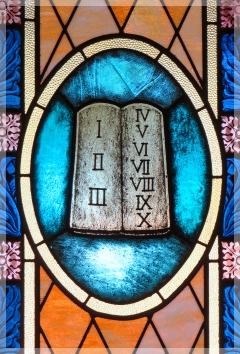
Ten COmmandments windowThe Ten Commandments are the foundation of both Jewish and Christian principles, conduct, and accountability, but they are just ten of the 613 mitzvot or commandments given to the Jewish people. In light of the big ten, many of those commands, such as using accurate scales and weights and fulfilling our promises make perfect sense as do prohibitions about speaking derogatorily of others or standing idly by if another person’s life is in danger. Moreover, laws regarding boundary markers, evidence, assessing property damages, and not perverting justice or accepting bribes certainly were necessary in a new nation. Some laws, like the ones regarding latrine placement, covering excrement, and making a guard rail around a flat roof seem reasonable from a health and safety viewpoint. Other laws may have served as a way to separate the Jews from their pagan neighbors. Perhaps it was because the Hittites, Elamites, and Sumerians were clean-shaven and the Egyptians often were clean shaven or had shaped goatees that Jewish men were not to trim the hair on their temples or shape their beards. Many laws, such as the intricate laws of sacrifice, the blue tassels on hems, reciting the Shema twice a day, and saying a blessing after meals, were related to worship and God.

Many of those laws, however, seem inexplicable. What, for example, makes land animals that don’t chew the cud and have completely split hooves (like the pig) unacceptable food? Why eat only fish with fins and scales but no shellfish or mollusks? If locusts can be eaten, why not ants? Why can’t linen be woven with wool? Why can’t a Nazarite eat grapes or raisins or cut his hair and why did every sacrifice require salt?

As I looked through these ancient laws and tried to understand God’s reasoning behind them, I missed the point. The first rule God made was the simple one he gave to Adam and Eve: don’t eat from that tree. Although He warned that death would be the result of disobedience, God didn’t explain His reasons for the prohibition because obedience to God isn’t supposed depend upon human reasoning. If we have to understand before we obey, rather than obedience, it becomes agreement and dependent on us! God, however, doesn’t require our understanding or agreement; He requires our obedience.

Abraham didn’t know where he was going when he packed up his family nor did he question God’s reasoning when he placed his son on a sacrificial altar. Building an enormous ark on dry land probably made no sense to Noah, wearing out his troops by marching around Jericho for a week seemed a questionable battle plan to Joshua, and Mary didn’t understand God’s reasoning behind her pregnancy; nevertheless, they all obeyed without understanding.

Obedience shows reliance and trust—an acceptance that God knows more than we can ever know or understand—that God is God and we are not! I don’t know God’s reasoning behind those mitzvot nor do I need to. It’s enough that God made them and expected the Israelites to abide by them. The only thing we must understand about God’s commands is that they are divinely decreed and, as such, are to be unquestionably obeyed. Rather than leading us away from God’s blessings, obedience will lead us to them.

Loving God means keeping his commandments, and his commandments are not burdensome. [1 John 5:3 (NLT)]

Trust in the Lord with all your heart; do not depend on your own understanding.  Seek his will in all you do, and he will show you which path to take. [Proverbs 3:5-6 (NLT)]

Copyright ©2021 jsjdevotions. All rights reserved.