
Be strong and courageous! … Do not be afraid or discouraged, for the Lord will personally go ahead of you. He will be with you; he will neither fail you nor abandon you. [Deuteronomy 31:6a,8 (NLT)]
Let all who fear the Lord repeat: “His faithful love endures forever.” … The Lord is for me, so I will have no fear. What can mere people do to me? [Psalm 118:4,6 (NLT)]
Judge Guido Calabresi regularly asks his Yale law students to imagine receiving an offer of an amazing invention that could improve people’s lives in every imaginable way. In exchange for this invention, however, the lives of at least 1,000 randomly selected young people would be taken every year. When asked if they’d accept the deal, his students inevitably conclude they wouldn’t. Calabresi then asks them the difference between that offer and the automobile. The very thing that allows us to travel, see loved ones, easily move products across the country, and do things that couldn’t be done otherwise, kills even more than that! Over 2,600 teens (16-20) accounted for auto accident fatalities in 2019 and, with over 46,000 car fatalities last year, more than 150 people of every age die each day because of a car. Be that as it may, we’re not about to give up driving!
Calebresi uses his example to illustrate how selective we are in our fears. We underestimate and accept chronic risks like riding in a car while overestimating prominent ones like a terrorist attack or plane crash. In actuality, rather than dying from either of those things, we’re more likely to die by choking on food or slipping in the shower or tub but, preferring bathing, eating, and even driving to the alternatives, we decide they’re worth the risk. On the other hand, after assessing the perils involved in things like free solo climbing, running with the bulls, or base jumping, most of us probably decide they’re not worth the risk.
In contrast, any risk we take in obedience to God always is worth it. Regardless of the danger, we must obediently accept the risks in the challenges and tasks He gives us. Think of what Abraham risked by packing up his family and leaving Haran for an unknown destination. Think of the risks taken by the midwives Shiphrah and Puah when they defied Pharaoh by letting boy babies live or the risk Moses took when he returned to Egypt and confronted Pharaoh. It was a huge risk when Gideon and his 300 men took on an army 400 times their size and when David faced Goliath with just a sling and stones. In spite of the risk, Esther approached the king, Daniel defied the law by praying, and the bleeding woman touched Jesus’ robe. Joseph of Arimathea took a risk when he asked Pilate for Jesus’ body and Peter and John risked imprisonment and worse when they defied the Council by continuing to share the gospel. When we search Scripture, we don’t find people who assessed the risks and played it safe. We find God’s version of bungee jumpers and wing-suit flyers—faith-filled and obedient risk takers.
Every God-sent risk comes with a God-sent promise. He will remain faithful to us and be present in the risk. He will protect and empower us and we’ll never need more than what He supplies. As followers of Jesus, we don’t walk by sight. In spite of the risks, we walk by faith because faith means we’re willing to risk anything for God!
Trust is faith that has become absolute, approved, and accomplished. When all is said and done, there is a sort of risk in faith and its exercise. But trust is firm belief; it is faith in full bloom. Trust is a conscious act, a fact of which we are aware. [E.M. Bounds]


 It’s easy to assume the Pharisees were irate just because Jesus had worked on the Sabbath but, for these sticklers for the law, it was as much about how He healed the man! Spitting on the ground on the Sabbath was forbidden because plowing was one of the 39 types of work prohibited on the Sabbath! Using their convoluted logic, that meant that digging any hole was prohibited and, when spittle landed on soil, it might cause a small dent in the ground (which would be digging a hole) and dislocate a small amount of dirt (which would be plowing)! Compounding Jesus’ violation of the law by both healing and plowing, He made mud. Kneading, defined as joining small particles into a mass using any liquid, was another of the 39 kinds work prohibited on the Sabbath. Jesus broke this law the moment his spittle wet the dust; the mixing of his spittle and the dirt together to make mud was an additional offense! To them, the restoration of sight meant nothing when compared to His many transgressions of the law!
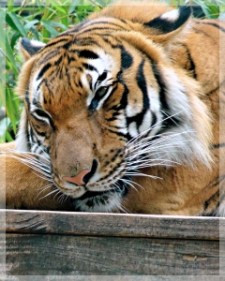 Last December, after breaching the barrier surrounding the tiger enclosure at our local zoo, a man stuck his hand into the tiger’s cage. A similar incident occurred a few months later at a nearby airboat attraction when a man improperly went through the first enclosure and put his arms into the tiger’s cage. Although both men survived, they suffered serious injuries to their hands and arms. Fences are placed to protect us and keep us from getting too close to danger but you can’t protect people from their own stupidity.
