UNREALISTIC EXPECTATIONS

So brothers and sisters, since God has shown us great mercy, I beg you to offer your lives as a living sacrifice to him. Your offering must be only for God and pleasing to him, which is the spiritual way for you to worship. Do not be shaped by this world; instead be changed within by a new way of thinking. Then you will be able to decide what God wants for you; you will know what is good and pleasing to him and what is perfect. [Romans 12:1-2 (NCV)]

queen butterflyWhile in my early thirties, in an attempt to straighten my teeth and correct an overbite, I wore braces for four years—and even had to wear the dreaded head-gear at night! For some reason, as the years dragged on, I seemed to think that everything I didn’t like about myself and my body would be miraculously corrected once the braces were removed. I imagined that, with straight teeth, I could possibly bear some resemblance to Cheryl Tiegs, a super-model of the era. Needless to say, I was disappointed when the braces were finally removed and I still looked just like me—only with nicer teeth. Not that looking like me was so bad, but I certainly wasn’t going to be asked to appear on the cover of the Sports Illustrated swimsuit issue! The fact that I didn’t want to do so made no difference; I just wanted everything I didn’t like about myself to miraculously change. It took some much needed maturing, both spiritually and emotionally, to understand that my discontent had nothing to do with my appearance and that real change doesn’t come from the outside; it comes from within.

Too often prayer expectations are a bit like my unrealistic expectations about the braces. We pray to change the world around us so that we (and those we love) will be happier. We ask God to make the teacher more understanding or the judge more lenient. We ask God to make the stock market improve, the house to sell, the spouse more loving, the job more fulfilling, and the boss to give us a raise. We ask God for prosperity, the healing of our loved one’s disease, successful children and the removal of our pain. We ask God to give us the life we want. Perhaps we’d be less disappointed in His answers if we asked God (with praise and thanksgiving) to make us accept and love the life we already have.

Rather than pray for God to change our little corner of the world to suit our wants, we need to ask God to make internal changes in us so that we can live well in His world and the life He has given us. If we ask God to use us in some way, He surely will. If we ask God to get us through our pain, rather than remove it, He will. If we ask God for peace, forgiveness, courage, wisdom or strength, He will supply it abundantly. If we ask God to guide us or give us a task, He surely will. What He isn’t likely to do is to change the world to fit our hopes and desires…or make us look like super models!

And shall I pray Thee change Thy will, my Father,
Until it be according unto mine?
But, no, Lord, no, that never shall be, rather
I pray Thee blend my human will with Thine. [Amy Carmichael]

 Prayer is not a battle, but a response; its power consists in lifting our wills to God, not in trying to bring his will down to us. [Stephen S. Smalley]
 With God’s power working in us, God can do much, much more than anything we can ask or imagine. [Ephesians 3:20 (NCV)]

Copyright ©2017 jsjdevotions. All rights reserved.

LAY ON THE LOVE

Give freely and spontaneously. Don’t have a stingy heart. The way you handle matters like this triggers God, your God’s, blessing in everything you do, all your work and ventures. There are always going to be poor and needy people among you. So I command you: Always be generous, open purse and hands, give to your neighbors in trouble, your poor and hurting neighbors. [Deuteronomy 15:10-11 (MSG)]

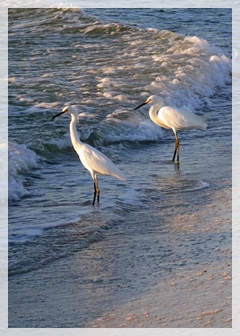
snowy egretsWe’d purchased a gift card at a grocery store for someone in serious financial straits and started talking about her, wondering how she got so deep in debt. A lot of unwise decisions combined with the loss of employment and topped off by major health issues was the answer. We then reminded ourselves that our task is not to analyze the hows, whys, could haves and shouldn’t haves of her or anyone else’s life—our task is simply to lay some love on our neighbors.

I recalled a discussion we had in Bible study about this very thing. Someone asked about giving money to street people—wouldn’t they just use it for drugs or drink? Our pastor reminded us that we’re not to be the judges; that’s God’s job. We’re simply to be the conduits of God’s grace. He also suggested doing what he does—rather than offering money, he gives $5 McDonald’s gift cards to panhandlers. They’re not valuable enough to be traded for drugs and can only be used for food. Another person shared that she gives street people a baggie filled with things like socks or mittens, hotel-sized toiletries, a religious tract and a card with information about local shelters and food pantries. Those kinds of gifts neither enable nor judge but they do spread God’s love. Money, gift cards and socks are just temporary solutions, however, and connecting someone with the right resources is ideal. Nevertheless, immediate needs must be met immediately, social services are rarely immediate, and some situations fall through the cracks.

When I see street people or panhandlers, I think of my nephew who, because of a combination of incredibly poor decisions, mental illness, drugs and alcohol, is one of them. They are the modern day version of the Bible’s lepers who had to sit outside the city gate—outcasts. Society has no use for them and they no longer fit into society. To a great extent, they must depend on social services and handouts to get through the day. Some are lost souls and some are scam artists, but how am I to know and who am I to judge? Rather than getting self-righteous, I remind myself, “There, but for the grace of God, go I or my children or grands.”

Jesus didn’t ask people how they got in their predicaments before healing them or ridding them of demons and the prodigal’s father didn’t ask his lost son for an accounting of his wastrel ways—they simply laid on God’s grace. Whether or not someone is worthy of our assistance is not a question that we, as Christians, should be asking. Rather, we should be asking what we can do to remedy the situation both in the short and run long. Remember, none of us are worthy of God’s grace but we all happily accepted it!

I tell you, love your enemies. Help and give without expecting a return. You’ll never—I promise—regret it. Live out this God-created identity the way our Father lives toward us, generously and graciously, even when we’re at our worst. Our Father is kind; you be kind. Don’t pick on people, jump on their failures, criticize their faults—unless, of course, you want the same treatment. Don’t condemn those who are down; that hardness can boomerang. Be easy on people; you’ll find life a lot easier. Give away your life; you’ll find life given back, but not merely given back—given back with bonus and blessing. Giving, not getting, is the way. Generosity begets generosity. [Luke 6:35-38 (MSG)]

Copyright ©2017 jsjdevotions. All rights reserved.

SAFETY NETS

bald python and florida cottomouth snakes
If you think you are standing strong, be careful not to fall. [1 Corinthians 10:12 (NLT)]

Our local zoo does a fascinating presentation called “Snakes Alive.” Two snake handlers stand in a walled area while the spectators stand on the other side of the waist-high wall. Using snake hooks and tongs, the keepers bring out their reptilian charges—including venomous snakes such as rattlers and cottonmouths. As the snakes roam freely around the enclosure, the keepers talk about each species. There may be as many as three snakes loose at once. Even though the keepers are speaking to the audience, they keep their eyes on the snakes at all times. Since they wear low-cut hiking boots, I wondered about their footwear and asked why they didn’t wear high boots. The keeper responded that they’ve found wearing high boots gives them a false sense of security. When trusting boots to keep them from harm (which they won’t), the keepers tend to become complacent and less vigilant, adding that lack of caution can have disastrous results.

I thought of that response when five of the famed Flying Wallendas fell over 30-feet while practicing an eight-man high-wire pyramid stunt earlier this month. Known for performing without a net, the Wallendas weren’t using a safety net that day. “We don’t train with a net. It’s been taught for generations a net can be a false sense of security,” said spokesman Nik Wallenda. “It’s all about training and preparing,” he added. Like high boots for zoo keepers, even a net cannot fully protect someone. In the 1930s, one of the troupe died when he fell into the net and bounced out of it.

While I don’t advocate performing on a high-wire without a net or sharing an enclosure with venomous snakes at any time, I think both the Wallendas and the zoo’s reptile handlers make a good point. High boots can’t prevent snake bites, nets can’t prevent falls, and being a Christian doesn’t mean the enemy won’t get his fangs in us or make us lose our balance.

Satan wants us to get so comfortable and relaxed in our lives that we start going through the motions rather than truly keeping the faith. We are so sure of heaven that we forget about hell. Being Christians it isn’t enough to protect us from the enemy—we must live as Christians. When life is going smoothly, we tend to get lax in Bible reading, prayer and even church attendance. Although we have the armor of God, we get too self-confident to put it on. We become self-reliant rather than God-dependent. When we stop bubbling over with heartfelt enthusiasm for God, we become tepid and lackadaisical and the enemy is ready to strike while we’re looking the other way. When our worship becomes perfunctory, our prayers are half-hearted and our good intentions regarding Bible study and service remain just intentions, Satan distracts us and we start wobbling! When we become spiritually apathetic and stop paying attention to God, Satan is right there waiting to attack. As well trained and prepared as both the snake handlers and the Wallendas are, they can’t allow themselves to let down their guard or become complacent and overly confident in their abilities; neither can we! A lack of caution can have disastrous results!

Not everyone who calls out to me, “Lord! Lord!” will enter the Kingdom of Heaven. Only those who actually do the will of my Father in heaven will enter. On judgment day many will say to me, “Lord! Lord! We prophesied in your name and cast out demons in your name and performed many miracles in your name.” But I will reply, “I never knew you. Get away from me, you who break God’s laws.” [Matthew 7:21-23 (NLT)]

Copyright ©2017 jsjdevotions. All rights reserved.


GOOD INTENTIONS

This is why I remind you to fan into flames the spiritual gift God gave you when I laid my hands on you. For God has not given us a spirit of fear and timidity, but of power, love, and self-discipline. [2 Timothy 1:6-7 (NLT)]

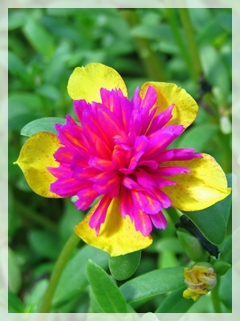
flowerFor two years, I was part of a women’s ministry. One of its purposes was to host a web site for twelve Christian writers. We were a diverse multi-generational group and the site offered hyperlinks to our individual blogs. All were women who felt they’d been called by God to expand His kingdom through their writing. We regularly shared our prayer concerns with one another and a month rarely passed without one or more women requesting prayers for their writing or asking for divine inspiration. Sadly, the ministry disbanded this past year, in great part due to the lack of writing by most of the authors.

When God calls us to a task, He will provide us with the talent, tools, situation, time, assistance and spiritual gifts necessary for that task. The one thing He won’t provide is the finished product. He expects us to do the labor and, as powerful as prayer is, it is no substitute for work. When speaking about the value of hard work, retired NBA star Ray Allen said, “God will give you a lot of things in life, but he’s not going to give you a jump shot.” When writer Jodi Picoult can’t write a good page, she revises a bad one, pointing out that “You can’t edit a blank page.” If we want a good jump shot, we’ve got to practice; if we want a page filled with words, we’ve got to sit down and write them; and if we want to do God’s work, we need more than good intentions or even prayers.

God gave man the gift of work, a sense of purpose, in the Garden. After the fall, however, thistles and thorns appeared and man’s work became difficult. Work was still good; it just wasn’t easy. When faced with a garden full of weeds, we can wait for divine intervention and pray they’ll disappear or, while praying, we can put on our work gloves and start pulling them out!

Opportunity is missed by most people because it is dressed in overalls and looks like work. [Thomas Alva Edison]

Pay careful attention to your own work, for then you will get the satisfaction of a job well done, and you won’t need to compare yourself to anyone else. For we are each responsible for our own conduct. [Galatians 6:4-5 (NLT)]

Copyright ©2017 jsjdevotions. All rights reserved.


FLYING

Then he said to the crowd, “If any of you wants to be my follower, you must give up your own way, take up your cross daily, and follow me. If you try to hang on to your life, you will lose it. But if you give up your life for my sake, you will save it. [Luke 9:23-24 (NLT)]

trapeze high
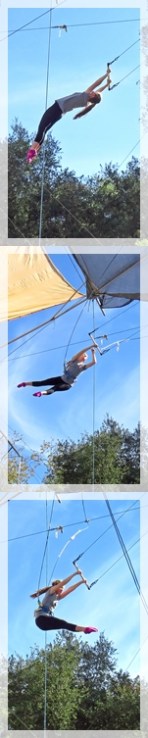
While watching my 16-year old granddaughter fly on the trapeze, I thought about trust. She clearly trusted the rigging, ropes, safety harness, net and her coach. I, however, was not so confident as she climbed up to a platform more than 25 feet above the ground. Her coach, acting as the line-puller, held the lines to her safety harness. She listened carefully as he called out various instructions in trapeze lingo: “listo..ready…hep!” and off she flew.

No longer a novice, my grand was working on a couple of tricks that required her to let go of the fly bar (and not just to drop onto the net.) In one, she reversed her position, requiring her to let go with one hand, swing around and then readjust her grip with the other hand. She had to trust her coach to call directions correctly and to have a good hold on the lines if she missed her grab. In the second trick, she had to trust both the coach and the catcher as she went from her fly bar into his hands. One novice flyer, however, was not so willing to trust anyone. In spite of the safety harness and net below, she refused to let go of the fly bar when told to dismount. Eventually, she came to a dead stop. Even though the coach assured her that he’d lower her safely to the net using the harness ropes, she stubbornly refused to release her grip. She just hung there until, exhausted, she could no longer hold her weight.

Trapeze is all about timing and trust and the line puller knows where the flyer is in her arc far better than the flyer. He calls out when to kick, get legs up, hang from the knees, and let go to dismount safely. My grand ceded control of her flying to him, trusting that his directions were correct, that he was reliable and attentive, and that both he and the catcher had the ability and strength to do what was required of them. When my grand relinquished control to her coach, she flew! Because the novice refused to relinquish control, she went nowhere and ended up hanging miserably in the air.

Hanging on until we can hang no longer—we all do it at some time or another. How much easier for her if she just trusted the coach and, for us, if we’d just trust God and give control of our lives to Him! Like the coach, God sees the big picture and knows where we are far better than we do ourselves. His timing is impeccable. He knows when we should hang on and when we need to let go and, just as the coach did, he’ll tell us! Unfortunately, we often don’t listen or obey and, like the novice flyer, end up in trouble. While trapeze school offers a safety harness and net, real life is nowhere near as accommodating. When we fail to listen to God and fall, our landing will not be so gentle.

Trust is essential when flying on a trapeze and it is essential in our relationship with God. Knowing that we’re in good hands, we have to let go of trying to run things ourselves and cede control to Him. Almighty, all-powerful and invincible, He will keep his every promise and never err in His guidance. Indeed, when we trust in God, we will soar!

But those who trust in the Lord will find new strength. They will soar high on wings like eagles. They will run and not grow weary. They will walk and not faint. [Isaiah 40:31 (NLT)]

Don’t let your hearts be troubled. Trust in God, and trust also in me. [John 14:1 (NLT)]

Copyright ©2017 jsjdevotions. All rights reserved.

STORMS

Colorado River storm
Save me, O God, for the floodwaters are up to my neck.  Deeper and deeper I sink into the mire; I can’t find a foothold. I am in deep water, and the floods overwhelm me. I am exhausted from crying for help; my throat is parched. My eyes are swollen with weeping, waiting for my God to help me. [Psalm 69:1-3 (NLT)]

Every few minutes, Sunday’s service in the park was interrupted by the sound of planes leaving the local airport. A severe storm with gale winds or tornadoes was predicted and the planes (and people in them) were escaping the storm. Perhaps they remembered the storm just a year ago that brought wind gusts of 85 mph when both planes and hangars at the airport were damaged. How fitting that our pastor’s message was about the storms of life. As I listened to those private jets overhead, I thought, “You can run, but you can’t hide!”

Given enough warning, we can escape stormy weather, especially if we’re rich and/or famous as many of those flying away were. Nevertheless, no matter who we are or how much we have, none of us are immune to the storms of life. More often than not, those storms will be like last January’s—somewhat unexpected. Granted, there was a tornado warning issued in the wee hours of the morning but most people slept through it. While they slumbered, a storm battered the city and left them with downed power lines, severe wind damage, scattered debris, and a flooded downtown. As with tornado alerts, we often fail to heed life’s storm warnings when heath is fading, mental ability is lessening, a marriage is crumbling, a child is using, a business is going under, or our nest egg is disappearing. We‘re caught off guard when we wake to the storm’s presence.

While we may lessen a storm’s damage by heeding warnings or preparing for its arrival, ready or not, storms will arrive. At some point in time, we’ll be battered by circumstances beyond our control and left feeling powerless. When the storm hits, life as we once knew it will wash away in the flood. We’ll look at the wreckage that remains and be tempted to give up. After last year’s wind storm, however, people didn’t give up. They  coped with lack of power and water, removed the trees in the roads, kept what could be salvaged, discarded what couldn’t, and rebuilt what was destroyed. When the storms of life arrive, we can’t give up either. No matter how extensive the storm, we must remember that our God is bigger and far more powerful than even a category 5 hurricane!

We know God can stop storms; with just a word, Jesus stopped the wind and calmed the sea for the disciples. Not every storm, however, will be quelled. Some must be endured as they run their course. They may be so severe that we’re shipwrecked, as was the Apostle Paul. He encountered such severe storms that he was shipwrecked three times and even spent a day and night adrift at sea. God can calm the storm as He did for the disciples or He can calm us, as He did for Paul. The Apostle knew that when we no longer can hold on to the debris of our lives, we can hold on to God! No matter how faithful, we will never have a life that is free from storms but, with the power of God, we can have a life that no storm can defeat.

Sometimes the Lord rides out the storm with us and other times He calms the restless sea around us. Most of all, He calms the storm inside us in our deepest inner soul. [Lloyd John Ogilvie]

“Lord, help!” they cried in their trouble, and he saved them from their distress. He calmed the storm to a whisper and stilled the waves. What a blessing was that stillness as he brought them safely into harbor! Let them praise the Lord for his great love and for the wonderful things he has done for them. [Psalm 107:28-31 (NLT)]