DORMANCY

God, make a fresh start in me, shape a Genesis week from the chaos of my life. Don’t throw me out with the trash, or fail to breathe holiness in me. Bring me back from gray exile, put a fresh wind in my sails! [Psalm 51:10-12 (MSG)]
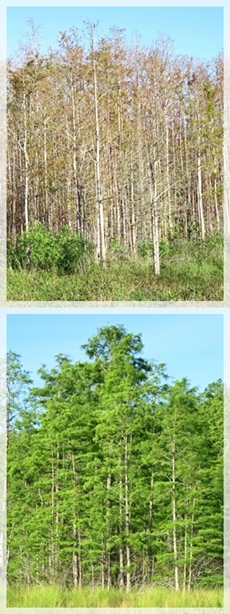
Corkscrew swamp - cypress - dormantEarlier this year, upon seeing the browning and nearly naked cypress trees at the bird sanctuary, the visitor asked if Hurricane Irma had killed them. I explained that the bald and pond cypress weren’t dead, just dormant. Being deciduous, they shed their leaves annually and were just enjoying a much needed rest during the shorter days and dryer conditions of winter. I reassured her that, in a month or so, their bright green needles would return and new growth would sprout from their branches. Today, the forest is verdant throughout the swamp.

While it is possible to force trees to evade dormancy by keeping them inside and controlling the light, temperature and water conditions, it would greatly shorten the plant’s lifespan; they’re not meant to leaf and branch continually. Dormancy is vital for the survival of deciduous trees and the way they withstand unfavorable growing conditions. When better conditions return, the trees wake up and start to bud and blossom again.

While dormancy is good for trees, dormancy is not usually considered a good thing when applied to Christians. A study in Great Britain found that 55 percent of those who identify themselves as Christian never read the Bible, 29 percent never pray, and a third of them don’t even attend church; it called these people “dormant Christians.” When God’s word isn’t growing in our hearts or we fail to bear the Fruit of the Spirit, some people say we’re in “spiritual dormancy.” Superficial, uncommitted, wilting or dying faith like this seems more a case of failure to thrive than dormancy. Just because growth isn’t obvious when a tree is dormant doesn’t mean nothing is happening. Dormancy is when the tree gathers strength, prepares for leafing and branching, and is the best time for pruning in preparation for new growth!

I’ve seen too many people lose their zeal for Christ because they haven’t taken a rest from their busyness for Him to spend time abiding in Him. It’s often when they’ve forgotten to spend time in His rest that their spiritual lives go dead. Sometimes, like trees, we need to retreat into dormancy to rest, do some pruning, and prepare ourselves to take our next steps in God’s ministry. Even Jesus took time away from His ministry for prayer and guidance.

During these next few months, my husband and I will be travelling a great deal. While I remain committed to prayer, worship, study, and journaling, there will be times when writing and posting will be difficult, if not impossible. Last year, I solved this problem with some “summer re-runs.” Knowing how refreshed and enthusiastic I felt upon my return to writing, I think dormancy is a far better term. So, like the cypress trees that go dormant in adverse conditions, I will take a break when circumstances are not conducive to writing. Unlike the trees, however, I won’t change color or shed my needles in preparation for dormancy. Instead, I’ve selected a few old devotions to repost and, with over 1,500 devotions from the last four years, I have plenty from which to choose. Throughout the next few months, they will be scattered in among new ones. So, if you see a devotion you’ve read before, don’t worry; I’m not dead, I’ve just gone dormant!

God, my shepherd! I don’t need a thing. You have bedded me down in lush meadows, you find me quiet pools to drink from. True to your word, you let me catch my breath and send me in the right direction. [Psalm 23:1-3 (MSG)]

I’ll refresh tired bodies; I’ll restore tired souls. [Jeremiah 31:25 (MSG)]

Copyright ©2018 jsjdevotions. All rights reserved.

GOOD SOIL GONE BAD

And the seeds that fell on the good soil represent honest, good-hearted people who hear God’s word, cling to it, and patiently produce a huge harvest. [Luke 8:15 (NLT)]

thistleWhen Hurricane Irma uprooted trees here last September, the underground irrigation pipes throughout our 1,800 home community were wrenched out of the soil and the lines ruptured. Trees and stumps had to be removed before the process of finding and fixing the leaks could begin and we went more than seven months without irrigation. What with winter and spring’s hotter than average temperatures, receiving about half of our average rainfall since November, and no working irrigation system in our community, the once lush green grass became dry and brown, the flowers wilted, and the parched soil got hard. The only things that seemed to thrive were the weeds! Fortunately, the repairs were completed last week, the summer rain eventually will arrive, and our grass, shrubbery and trees will recover.

Seeing how our once good soil became so hard and dry made me think about Jesus’ parable of the four soils in which the soils represent the sort of people who receive the seed of God’s word. One was the hard dry soil of a footpath where the birds quickly snatched away the seed. Because the second soil was rocky, the plants’ roots were shallow and they withered and died in the hot sun. The third seed was sown among the weeds that crowded out the new growth. It was only in the fertile fourth soil that the seeds produced a good crop. Although this parable tells us that not everyone will be receptive to God’s message, perhaps, there’s more to it.

When looking at our parched ground, I realize that unless it is cultivated, watered, and fertilized, good soil will not remain that way. Like the fourth soil, we can receive God’s word with enthusiasm but, unless it is well tended, our faith will suffer. Worry, busyness, or discontent can crowd out our enthusiasm and commitment the way thorny weeds do in an untended garden. If we don’t keep feeding our soil with God’s word, like the plants sown on the rocky soil, our roots can wither and die because of things like regret, troubles, doubt or unforgiveness. When we let failure, complaint, anger, or temptation give the enemy a foothold, he can snatch away our faith faster than a sparrow can a sunflower seed on a footpath. We may have been good soil when we accepted Jesus but, at various times in our lives, we can become any one of those other soils. I’m not a gardener, but even I know that it takes work to keep a garden productive. We must continue to fertilize with prayer, cultivate with a community of faith, and water with God’s word if we want to bear fruit in God’s garden.

Although Jesus was explaining to His disciples why people responded as they did to Him, His parable is more than a lesson about evangelism or gardening. It’s a reminder that good soil can go bad. We must continue to tend the soil in our spiritual garden lest Satan steals the word, we stop believing when troubles arise, or the cares of the day leave no room for His word to grow.

Remain in me, and I will remain in you. For a branch cannot produce fruit if it is severed from the vine, and you cannot be fruitful unless you remain in me. Yes, I am the vine; you are the branches. Those who remain in me, and I in them, will produce much fruit. For apart from me you can do nothing. [John 15:4-5 (NLT)]

When the ground soaks up the falling rain and bears a good crop for the farmer, it has God’s blessing. But if a field bears thorns and thistles, it is useless. The farmer will soon condemn that field and burn it. [Hebrews 6:7-8 (NLT)]

Copyright ©2018 jsjdevotions. All rights reserved.

NOT JUST HALF

From then on Jesus began to tell his disciples plainly that it was necessary for him to go to Jerusalem, and that he would suffer many terrible things at the hands of the elders, the leading priests, and the teachers of religious law. He would be killed, but on the third day he would be raised from the dead. But Peter took him aside and began to reprimand him for saying such things. “Heaven forbid, Lord,” he said. “This will never happen to you!” [Matthew 16:21-22 (NLT)]

tri-colored heronWhile talking with a friend, I mentioned how many people of our generation seem unprepared for the challenges of widowhood. Having relinquished certain responsibilities to their spouses during the decades of marriage, they’re ill-equipped when they lose that spouse. There are men who have no idea how to do laundry, grocery shop, clean the bathroom or use the microwave. On the other hand, many of my women friends have never done minor repairs, paid bills, made an investment or purchased a car. “That was me!” replied my friend whose husband died of cancer. His death, while unwelcome, was not unexpected so I asked why they hadn’t prepared her for widowhood. “He tried to,” she said, “but I wouldn’t listen.” As long as they didn’t talk about his imminent passing and her future life without him, she still could deny its reality.

While thinking of her experience, I thought of the disciples’ behavior when Jesus spoke of his death. At first, He spoke metaphorically: “Destroy this temple and in three days I will raise it up.” At least three times, however, He spoke quite plainly about what the future held: he would be killed and raised from the dead. He didn’t mince any words when he described his death but the disciples didn’t understand. Jesus forewarned them but they were confused and frightened when He died, hid in a room instead of waiting expectantly at the tomb, and didn’t believe the women who said the tomb was empty.

Jesus spoke of fulfilling the prophecies and the disciples knew those prophecies. They preferred the ones about the messiah’s glory, however, to those of the suffering servant. Still thinking about an earthly king, Jesus’s words were contrary to their expectations and the disciples couldn’t reconcile what Jesus said to what they wanted. How could suffering and death accomplish anything? Like my widowed friend, they didn’t want to face the truth of what the future held. Perhaps, like her, they thought their denial would keep the horror from happening.

We aren’t all that different when it comes to seeing and hearing only what we want. In his Bible commentary, Matthew Henry cautions that we’re like the disciples when we read the Bible “by halves” – only the half we like. Consistently, the top three searched-for Bible verses are John 3:16, Jeremiah 29:11, and Philippians 4:13; the rest of the top twenty are other reassuring verses of comfort. If the Bible was a buffet, we’d find those feel-good verses on the dessert table. Dessert is great and so are those verses; nevertheless, they only tell part of the story. The other half of the Bible, while just as nourishing, isn’t quite as sweet; it’s the meaty stuff on the main dish table that tells us we’re going to have trials, temptation, affliction, and persecution. It tells us of mankind’s failures, God’s warnings, and why He had to redeem the world He created. It speaks of sin and God’s wrath and uses words like sacrifice, suffering, judgment and tribulation.

Let us never turn away from God’s word because we don’t like what it says. Ignoring the prophecies didn’t keep Jesus from being crucified and ignoring the still unfulfilled ones will not keep them from coming true! As for me, I want to be prepared for what the future brings (both in this world and the next).

Anyone with ears to hear should listen and understand. … Pay close attention to what you hear. The closer you listen, the more understanding you will be given—and you will receive even more. To those who listen to my teaching, more understanding will be given. But for those who are not listening, even what little understanding they have will be taken away from them. [Mark 4:23,24-25 (NLT)]

Copyright ©2018 jsjdevotions. All rights reserved.

SACRED TRUST

He said to them, “The Scriptures declare, ‘My Temple will be called a house of prayer for all nations,’ but you have turned it into a den of thieves.” [Mark 11:17 (NLT)]

great egret - corkscrew swampSeasoned travelers know the worst place to exchange their money is at the airport. With no easy option to get local currency, the unsuspecting tourist gets the worst exchange rates at the highest fees. Seasoned travelers also don’t buy suntan lotion or Dramamine onboard the cruise ship or a face mask and goggles at the ski shop on top of the mountain. Knowing their customers are desperate for their products, those shops tend to gouge them with inflated prices.

That’s what was happening in the Temple when Jesus cleared it of money changers and merchants. Jerusalem was filled with pilgrims who’d traveled long distances to worship, offer sacrifices, and pay their annual temple tax. With the Tyrian half-shekel the only coin acceptable for the tax, people had to exchange their foreign currency. Because traveling with animals was problematic for the pilgrims, they had to buy their sacrificial offerings in Jerusalem. The priests solved the problem, not out of the goodness of their hearts but as a way to fatten their wallets.

They rented out spaces in the Court of the Gentiles to money changers who charged excessive fees for their services and to merchants who sold sheep, lambs, goats, doves, pigeons, grain, and anything else necessary for a sacrifice at exorbitant prices. Since sacrificial animals were to be unblemished, the priests had to approve them. They charged an additional fee for the inspection and, if an animal wasn’t purchased at the Temple, chances are that it wouldn’t be approved. What should have been a service to the pilgrims had become a scheme to swindle them. The priests who looked for flaws in offerings were blind to the flaws in their own behavior.

With the commotion of the animals and vendors competing for business, the courtyard was no longer a place of worship. The inevitable animal odor and excrement was considered defilement of a sacred place; people weren’t even supposed to pray, recite blessings or study the Torah if urine or feces were visible within a range of six feet. That the sanctity of the Temple was profaned by this filth and exploitation or that the worship of Gentiles was disturbed in the mayhem of this stockyard and marketplace didn’t seem to bother the priests. It bothered Jesus enough so that He chased the offenders out of the Temple.

Today’s equivalent of that first century corruption can be found in those churches that don’t operate with financial oversight or fiscal responsibility. Whether out of ignorance, irresponsibility, or dishonesty, they use smoke and mirrors with vague budgets and no accountability or audits. The church has been given a sacred trust both to raise and spend money with integrity. Let us never forget that people’s tithes and offerings come at a cost to them. By the time the money exchanger took his cut, the half shekel Temple tax represented four days wages and the widow who put her two small coins in the Temple treasury gave all that she had. The church must recognize the sacrifice that comes with every dollar and take their duty to be good stewards seriously. As congregations, we must demand fiscal responsibility and transparency; we have an obligation to keep God’s house from becoming a den of thieves.

So guard yourselves and God’s people. Feed and shepherd God’s flock—his church, purchased with his own blood—over which the Holy Spirit has appointed you as leaders. [Acts 20:28 NLT

No one can serve two masters. For you will hate one and love the other; you will be devoted to one and despise the other. You cannot serve God and be enslaved to money. [Matthew 6:24 (NLT)]

Copyright ©2018 jsjdevotions. All rights reserved.

REACH OUT AND TOUCH SOMEONE

Just then a woman who had suffered for twelve years with constant bleeding came up behind him. She touched the fringe of his robe, for she thought, “If I can just touch his robe, I will be healed.” [Matthew 9:20-21 (NLT)]

Clam Pass BeachImagine the anguish of the woman with the blood disorder. Because Levitical law declared that anyone who touched her would be considered unclean, she’d been cut off from friends and family for twelve years. Sexual union would defile her husband so she couldn’t marry and, if she’d been married, her husband would have divorced her. Because her defilement would spread to anything she touched (be it food, cups or cushions), she was isolated in her own home. While the anemia, pain, stress, and public humiliation she endured because of her disorder must have been awful, perhaps the agony of being a pariah and unable to physically connect with people was even worse. It was her responsibility to make sure she didn’t defile others by touching them so she shouldn’t have been anywhere near a crowd. She certainly shouldn’t have touched a man (or his clothing) and could have been severely punished for her previously action. No wonder she tried to sneak unnoticed through the crowd to touch Jesus’ robe.

In the 1980s, AT&T urged us to “Reach Out and Touch Someone.” Granted, they meant with their phone service but now, when it is so easy to communicate with cell phones, email, texts, Facebook, Twitter, Skype, and Facetime, it is important to reach out and actually touch! Sunday mornings, there’s usually a lot of friendly touching with handshakes and hugs when we greet one another at our church in the park. Recently, after greeting Jimmy with a friendly handshake, my husband sat with him at a picnic table. (I previously wrote about Jimmy in “It Takes All Kinds.”) A man with what can be described as a colorful past, he’s been worshipping with us and joining in Bible study for the last several weeks. That morning, Merna walked over to greet the men at the table. Putting one hand on Jimmy’s back, she bent over to talk with him and casually patted his arm with her other hand. As she walked off to greet others, Jimmy broke out in a huge smile and confided to my husband that he couldn’t remember when last a lady had touched him.

As I pondered Jimmy’s words, I thought about the importance of touch; it is an essential human need. When we touch or are touched, our bodies release chemicals like oxytocin (the devotion, trust and bonding hormone) and serotonin (the happy hormone) while inhibiting other chemicals like cortisol (a stress hormone). Without a doubt, Jesus had a powerful touch and people brought their children to Him just so He could touch them. When Jesus touched Peter’s mother-in-law, she immediately recovered from her fever and, after touching Jairus’ daughter, the dead girl got up and walked. With a touch, Jesus gave sight to the blind, hearing to the deaf, speech to the mute, and made leprosy disappear. As for the woman with the blood disorder: even after the blood stopped, without waiting another seven days and undergoing a ritual bath, she was still considered unclean. I don’t think that bothered Jesus! Although the gospels don’t record it, there is no doubt in my mind that, as the trembling woman knelt at His feet, Jesus touched her when He told her to go in peace.

How many people go days, weeks, or longer without a gentle touch? Consider the many people who live alone or those, like Jimmy and the bleeding woman who feel tainted because of their past? When we touch one another, we communicate care and concern and experience oneness. Like Jesus’ touch, Merna’s touch told Jimmy that he wasn’t unclean—that he mattered both to God and to his family in Christ. The touch of Jesus has the power to heal and so does ours! Let’s reach out and touch someone today!

Each time we reach out and touch someone, we communicate the tangible truth of the gospel—that God in Christ reaches out to each of us, drawing us into intimate relationship with Him and those around us. [Rob Moll]

Then Jesus placed his hands on the man’s eyes again, and his eyes were opened. His sight was completely restored, and he could see everything clearly. Mark 8:25 (NLT)

Copyright ©2018 jsjdevotions. All rights reserved.

LOWERING THE BAR

He died for everyone so that those who receive his new life will no longer live for themselves. Instead, they will live for Christ, who died and was raised for them. … This means that anyone who belongs to Christ has become a new person. The old life is gone; a new life has begun! [2 Corinthians 5:15,17 (NLT)]

Never did God so manifest His hatred of sin as in the death and suffering of His only begotten Son. Hereby He showed Himself unappeasable to sin, and that it was impossible for Him to be at peace with it. [Jonathan Edwards]

blue flag irisIn a recent Doonesbury comic (written by Garry Trudeau), a pastor is explaining to the congregation what constitutes sin in the eyes of their church. The elders now will condone conduct such as, “lewdness, vulgarity, profanity, adultery, and sexual assault,” and exemptions from Christian values include, “greed, bullying, conspiring, boasting, lying, cheating, sloth, envy, wrath, gluttony and pride.” In addition, the church will overlook such things as, ”Biblical illiteracy, church non-attendance, and no credible sign of faith.” After the service, one church member says, “Lovin’ the lower bar, Pastor!” while another adds, “I feel like a freakin’ saint now!” Trudeau’s comic may be satire but it is closer to the truth than I care to admit.

The church of the 18th and 19th centuries often preached a fire and brimstone message that emphasized a wrathful and vengeful God. During the 20th century, the pendulum moved toward God’s love and mercy. In the 21st century, perhaps in an effort to fill empty pews, we see the pendulum moving to the other extreme where there are feel-good messages that come more from self-help books than the Bible, an emphasis on self-esteem rather than self-denial or self-control, an “anything goes” God who would never allow anyone to go to hell, and the absence of words like sin, guilt and repentance. The concepts of right and wrong, good and evil, appear to have gone out of style along with madras shorts, poodle skirts, and velour track suits. Rather than list acceptable sins as did Trudeau’s pastor, the church simply avoids mentioning sin or hell at all. This new age feel-good doctrine is correct that Jesus loves us and accepts us just as we are but it is woefully wrong when it neglects to mention that He doesn’t want us to stay that way! Since Jesus came to earth, suffered and died on the cross to pay for our sins, sin is an important part of any Christian conversation; without sin or hell, there was no need for a Savior.

Some people find this new version of Christianity an ideal arrangement: mankind loves to sin and God loves to forgive so it’s a win-win situation! Let us remember that a profession of faith that doesn’t result in a changed life and good works is not a true profession of faith. For the true Christian, deliberate sin is not an option; he should hate sin, not accept it! As St. Augustine wisely said: “It is human to err; it is devilish to remain willfully in error.”

It was said that when listening to the 18th century Puritan pastor Jonathon Edwards, one could almost smell the sulfur burning when he spoke about hell! That wasn’t all bad. Unlike Trudeau’s comic strip pastor (and many popular pastors in real churches), at least Edwards cared enough about his flock to warn them of hell’s reality and the dangers of sin.

Some people have no sense of the vileness of sin, and no sense of God’s infinite and holy opposition to it. They think God has no higher standards than they have! So they get on well with him and feel a sort of love for him, but they are loving an imaginary God, not the real God. [Jonathan Edwards]

You can enter God’s Kingdom only through the narrow gate. The highway to hell is broad, and its gate is wide for the many who choose that way. But the gateway to life is very narrow and the road is difficult, and only a few ever find it. [Matthew 7:13-14 (NLT)]

Copyright ©2018 jsjdevotions. All rights reserved.