
The earth and everything in it, the world and its inhabitants, belong to the Lord. [Psalm 24:1 (CSB)]
The heavens are yours; the earth also is yours. The world and everything in it—you founded them. [Psalm 89:11 (CSB)]
 The two were seated next to us on the patio; the frail elderly woman was the mother and the younger woman her daughter. After pondering the menu, the mother had all sorts of questions about it. In no rush to order, she dithered over her entrée choice and, once food was served, she lingered over it. As I observed the two women, I could see and hear the daughter’s growing frustration and impatience with her mother. They reminded me of the times I took my mother-in-law out to lunch. Having “been there and done that,” I wanted to tell the daughter to be patient. One day, mom would be gone and she’d wish they had more days together.
Because they are our possessions and we have control over them, we say we own things like our money, house, car, lawnmower, and toothbrush. I suspect we also think we own our time but, when you think about it, we don’t. Like everything else, it’s a gift from God. While we have clocks and calendars to help us keep track of it, God is the one who owns our time and has ultimate control over it! Nevertheless, because we think our time is ours alone, we often dole it our sparingly or not at all. Moreover, just as a toddler feels put upon when his mother makes him share his toys, we tend to resent the imposition when called upon to share our time in a way we hadn’t planned.
In her later years, we took my mother-in-law to her numerous appointments and a day with Gert was a little like the children’s story If You Give a Mouse a Cookie. In Laura Numeroff’s circular tale, the mouse’s simple request for a cookie leads to a series of escalating demands of things like milk, a straw, a napkin, a mirror, nail scissors, a broom, a nap, a story, paper, crayons, a pen, and scotch tape before ending up with the mouse wanting another cookie!
Whether we took Gert to doctor, hairdresser, seamstress, or shopping, the undertaking was guaranteed to take all day. Once done with the first task, Gert would add more errands to run and more places to visit. By then she’d be hungry and insist it was time for lunch. Once in a restaurant, she’d scrutinize the entire menu forever and discuss the various items before finally requesting the burger she always ordered. She was even slower to finish her meal and, once done, she’d order coffee before deciding about dessert. Once Gert was home, she’d insist we come in and “sit awhile” which often led to our staying for dinner at her senior residence! Just as the act of giving one cookie to a mouse led to a whole series of unexpected events for the little boy, a ride to a one appointment with my mother-in-law led to a full day’s outing for us.
It wasn’t just her advanced age that made my mother-in-law seem so needy, slow, and indecisive. I suspect she wanted to spend more time with us and the numerous errands and lengthy meals were a way to do that! As pleasant at those days with Gert were, they were time-consuming. I admit there were times we felt she infringed on time that was rightfully ours! As much as we loved her, it was easy for us to resent the hours she took from our day. That feeling of being imposed upon didn’t come from God—it came from the enemy. Our selfishness came from the mistaken assumption that we owned the 24-hours of each day and could spend them as we wished rather than as God desired.
If Jesus appeared and asked us to spend the day with a widowed elderly woman, we gladly would say yes (and be thankful it wasn’t a bigger ask). What if He asked us to spend time packing groceries at the food bank, helping at Vacation Bible school, volunteering at the charity thrift shop, visiting a house-bound neighbor, bringing communion to a shut-in, or tutoring youngsters at the Boys and Girls club? Because He asked, we’d happily do it without resenting Him or those we served. The thing is—Jesus asked us to do those things when He was here so He shouldn’t have to ask us again now! He calls on us to use His time as He would have it used! Never rushed, if God Himself found time to feed the hungry and heal the sick, we have the time to serve both loved ones and strangers alike!
In truth, nothing—not our time, talents, or even bodies—are truly ours; they all belong to God. Rather than the owner, we are merely stewards of God’s gifts. The time God gives us is to be used for His glory. When given the opportunity to serve Him by helping others, let’s respond with joy, enthusiasm, and a large dose of patience on the side—always remembering that what we do for others, we are doing for Him! As the Psalmist said, let us “Serve the Lord with gladness, come before him with joyful songs.” [100:2]
How could we enjoy heaven if during our lifetime we had used most of our time, treasure, and talents for ourselves and our select group? [Daniel Fuller]
 As much as I enjoy reading the works of authors like C.S. Lewis, A.W. Tozer, Dietrich Bonhoeffer, and N.T. Wright, I admit to not always understanding exactly what they’re saying. Nevertheless, thinking me an expert, a friend sent me an article written by a well-known Christian theologian and asked for my thoughts. Unfortunately, I had none because I couldn’t make sense of it. When I reluctantly admitted my bewilderment, my friend admitted the same. Although we both tried to understand the author, neither of us could discern his point. He appeared to have used a great many fancy words to say very little. While another scholar might make sense of his words, we two reasonably intelligent believers couldn’t. Unfortunately, some pastors, theologians, Christian writers, and fellow believers unnecessarily complicate faith and our relationship with God.
 The next day would have been Sally’s wedding anniversary but, because it marked the six-month anniversary of her husband’s death, there would be no celebration. Instead of flowers, dinner, and romance, there would be tears. That morning, Sally called her step-mother, Sue, to share her dread of the following day. When telling us this, Sue admitted to being at a loss for words of consolation. A woman of faith and an ordained pastor, Sue’s difficulty in finding comforting words was because her step-daughter is Jewish. When Sue married Sally’s Jewish father, she respected her new family’s faith just as they respected hers. They knew her beliefs and what she did for a living and Sue gladly answers their questions. Nevertheless, she chooses her words carefully when speaking of the Lord and neither evangelizes nor condemns. Although her words that morning were as reassuring as they could be without speaking of Jesus, Sue knew they were nowhere near as comforting as they could have been.
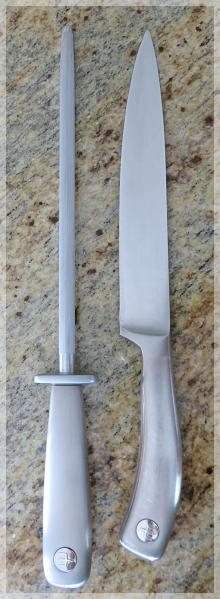 This proverb about iron sharpening iron reminds me of Sunday dinners when I was a girl. After the roast beef was placed in front of my father, he picked up the carving knife and a steel rod. With dramatic flair, he would run the knife back and forth against the steel before carving the meat. For the perfect slice of beef, he used iron to “sharpen” iron.
 Today is Labor Day—the unofficial last day of summer. On a day originally intended to celebrate the accomplishments of workers, it’s somewhat ironic that most of us are doing as little work as possible. Nevertheless, whether it’s just making the bed, grilling the burgers, washing the car, or being called in for an emergency surgery, we’ll all do some work today. We appreciate the day off but we’d much prefer a full-blown vacation—with no chores, deadlines, schedules, or business calls, texts, and emails. On the ideal vacation, all we have to do is relax and enjoy ourselves.
 Back in 1957 (long before PETA existed), Curt Richter, a professor at Johns Hopkins, conducted a series of cruel and inhumane experiments to demonstrate the power of hope and resilience in overcoming difficult situations. In this case, the difficult situation was rats being put in a bucket of water with no means of escape and timing how long it took them to drown. After two preliminary experiments, Richter hypothesized that introducing hope to the rats would increase their survival times.
