OUR VOWS

For your Creator will be your husband; the Lord of Heaven’s Armies is his name! He is your Redeemer, the Holy One of Israel, the God of all the earth. [Isaiah 54:5 (NLT)]

But you have been unfaithful to me, you people of Israel! You have been like a faithless wife who leaves her husband. I, the Lord, have spoken. [Jeremiah 3:20 (NLT)]


Throughout the Bible, marriage is often used as a metaphor for man’s relationship with God. His covenant with Israel is seen as a form of marriage, their unfaithfulness as adultery, and their alienation from God as divorce. The book of Hosea is a story of a prophet with an unfaithful wife that parallels God’s relationship with his unfaithful people. Some scholars say the entire Song of Songs is an allegory of God’s love for Israel or the church. In the New Testament, John the Baptist describes the Messiah as a bridegroom and Jesus refers to himself as the groom in wedding parables. Marriage was ordained by God and the marital bond illustrates God’s relationship with His people.

55 years ago, I promised to love, comfort, and honor my husband and to forsake all others, keeping myself only for him as long as I lived. I took him for better or worse, for richer or poorer, in sickness and health, and to love and cherish until we were parted by death. In light of the many Biblical references to our spiritual marriage, I started to evaluate how I’ve done keeping those same vows with God.

Although I’ve done a pretty good job of doing all that I promised to my husband, I’ve not done as well with God. In times of health, wealth and contentment, I often forgot who made those good times possible. Moreover, I often was doubtful, distant, or angry with God in the times of sickness, scarcity, and sorrow. Since I frequently followed my peers, took the easy rather than right route, and listened to the enemy when I should have listened to Him, I’m not sure I even forsook all others for the Lord. Like a mistress or prostitute, I seemed to love Him for his gifts and often came to Him only because I wanted something more. While I can’t comfort our Almighty God, I’ve probably caused Him a fair amount of discomfort and grief. Fortunately, there was nothing about obedience in my wedding vows because obedience certainly hasn’t been my strong suit with the Lord. While I haven’t failed completely as a spiritual wife, I certainly haven’t kept our covenant relationship as well as I should have done.

On God’s part, like the perfect husband, He has been faithful and loved me in all circumstances. In spite of seeing me at my worst and knowing my every fault, God continued to love me. When I stopped believing in Him, He never stopped believing in me and, when I rejected him, He never rejected me. No matter how unfaithful I have been, God has remained faithful to me. He’s been loving and true to me at my sickest, poorest, and most contemptible. He gave me unconditional love when my love for Him seemed to depend on circumstances. Just as God told Hosea to redeem and love his adulterous wife, God has redeemed and loved me! The gift of His only Son to save my sorry soul is evidence of that.

At landmark anniversaries, people often remake their wedding vows. Our vows to God need to be retaken not just every ten years but every day. Merciful God, thank you for your unconditional and lavish love. Forgive us for being less than you deserve and thank you for giving us more than we could ever desire. In all circumstances, may we love, honor, cherish, and obey you, now and forever.


Never again will you be called “The Forsaken City” or “The Desolate Land.” Your new name will be “The City of God’s Delight” and “The Bride of God,” for the Lord delights in you and will claim you as his bride. Your children will commit themselves to you, O Jerusalem, just as a young man commits himself to his bride. Then God will rejoice over you as a bridegroom rejoices over his bride. [Isaiah 62:4-5 (NLT)]

Copyright ©2022 jsjdevotions. All rights reserved.

SOWING

Here is another story Jesus told: “The Kingdom of heaven is alike a farmer who planted good seed in his field. But that night as the workers slept, his enemy came and planted weeds among the wheat, then slipped away. When the crop began to grow and produce grain, the weeds also grew.” [Matthew 13:14-16 (NLT)]

p0rairie rose - rose hip
Our brief return north last June meant we again enjoyed walking among the Midwest’s summer wildflowers. I only stepped a few feet off the path for a photo and yet my pants were covered with sticky seedpods from the Tick-Trefoil. Sometimes called sticktights or beggar’s lice, their seed pods are covered with fine hooked hair that catches on anything it contacts—whether clothing or a passing squirrel. I spent the rest of the walk picking off the pods and scattering them along the trail. After carefully stepping over a pile of seed-studded raccoon poop, I was reminded that a flower’s purpose isn’t merely to look pretty; it’s to spread its seeds any way it can.

Like the Tick-Trefoil, some flowers have pods that attach to clothes and animals and ride through the forest on pants’ legs and fur until they find a good home. Flowers like the False Solomon’s Seal and Pokeweed, however, produce fruit that is eaten by animals and, like that raccoon, leave the seeds behind in their waste. Other wildflowers, like the Asters and Milkweed, have seeds attached to a feathery sort of “parachute” that is blown away by the wind to (hopefully) land on fertile soil. That the flowers are rooted into the ground doesn’t seem to keep them from spreading their seeds every which way to make more of their kind.

Looking at the colorful blossoms throughout the park, I saw that the native wildflowers have done their seed-spreading job well. Unfortunately, undesirable invasive species like Canadian Thistle and Purple Loosestrife also have been expanding their territory. The seeds of these invasive weeds are trying to defeat the native wildflowers in the same way Satan is trying to defeat us by planting his seeds of evil. So far, the flowers are ahead of the game; are we?

Jesus also told a parable about a farmer who planted seeds and the various kinds of soil on which his seeds fell. Types of soil, however, make no difference if the farmer fails to sow any seeds! Unsown seeds will never germinate! Would that we Christians were as determined to spread God’s word as the flowers are to scatter their seeds. As pretty as it is, the Prairie Rose knows that its job isn’t finished when it blooms into a beautiful flower. Its real purpose is to bear fruit (the rose hip) and spread its seeds far and wide. Unlike the rose, however, many Christians are quite content just looking good and give little thought to bearing fruit, let alone enlarging God’s garden by sowing His word.

It’s what you sow that multiplies, not what you keep in the barn! [Adrian Rogers]

He said to his disciples, “The harvest is great, but the workers are few. So pray to the Lord who is in charge of the harvest; ask him to send more workers into his fields.” [Matthew 9:37-38 (NLT)]

And then he told them, “Go into all the world and preach the Good News to everyone.” [Mark 16:15 (NLT)]

Copyright ©2022 jsjdevotions. All rights reserved.

BUTTERFLY KISSES – Part 2

Give thanks to the Lord, for he is good! His faithful love endures forever. [Psalm 107:1 (NLT)]

For I know the plans I have for you,” says the Lord. “They are plans for good and not for disaster, to give you a future and a hope.” [Jeremiah 29:11 (NLT)]

red-spotted purple admiral butterflyAs I began looking for, listing, and thanking God for the little blessings hidden in each day (His “butterfly kisses”), I couldn’t help but wonder about the rest of the day. In a fallen world that all but guarantees loss, pain, misery, and trouble, does God just scatter these special moments of grace willy-nilly? Does He randomly send things like encouraging emails, the perfect worship song at just the right time, the aroma of gardenias wafting through the air, a hummingbird flitting through the garden, a shooting star, or doves nesting outside the window? What about the rest of our moments—the ones when we’re struggling with colicky babies, chronic pain, a severely disabled child, stage-4 cancer, betrayal, or abuse? As I look at my prayer list, I see prodigal children, financial woes, severe depression, food insecurity, parents who’ve lost two infants in less than two years, families dealing with Alzheimer’s, and a newly-wed who, less than an hour after sending her husband off to work with a kiss, learned that he died of an aortic aneurysm while on the train. Hearing children’s laughter while frolicking in the pool, a popsicle on a hot summer day, a rainbow, or seeing the elusive green flash at sunset only go so far in alleviating their anguish or sorrow. Where is God’s grace the rest of the time?


But wait! What do we know of God? Throughout Scripture, we are told that He is good and that He loves us as a parent loves a child. We know we have a loving God who gives us good gifts because, in Matthew 7, Jesus compared God’s provision to that of a loving father who wouldn’t deceive his children by giving them an inedible stone or a poisonous snake instead of bread or fish. Scripture also tells us that this good and loving God has a plan for us. So, if we believe that we are loved by a good God and that this good and loving God has set our lives in motion according to His plan, does it not follow that His entire plan is for our good (even when it includes sleepless nights, loss, hurt, pain, and tears)?

While we grab with gusto all that seems good to us, we’d prefer escaping the rest. While we find joy in the gifts we like, we feel cheated when it’s not the gift we wanted or expected. Nevertheless, every moment, even the ones that seem to break our hearts, are as much a part of God’s grace as are the little blessings of the day. Perhaps, God’s butterfly kisses are simply His way of reminding us of His loving presence in everything and serve as a way for us to see His hand in all things. It is in thanking Him for the little insignificant gifts of our day that we eventually find the ability to gives thanks in all circumstances!

Be filled with the Holy Spirit, singing psalms and hymns and spiritual songs among yourselves, and making music to the Lord in your hearts. And give thanks for everything to God the Father in the name of our Lord Jesus Christ. [Ephesians 5:18b-20 (NLT)]

Copyright ©2022 jsjdevotions. All rights reserved.


BUTTERFLY KISSES

What is the price of two sparrows—one copper coin? But not a single sparrow can fall to the ground without your Father knowing it. And the very hairs on your head are all numbered. So don’t be afraid; you are more valuable to God than a whole flock of sparrows. [Matthew 10:29-31 (NLT)]

dove squabs

In her book One Thousand Gifts, Ann Voskamp writes of being challenged by a friend to write a list of 1,000 things she loved. Interpreting the challenge as making a list of the day’s blessings or gifts, she began recording the seemingly insignificant things that brought bits of joy into her ordinary day. Like a gratitude journal, it included the more obvious things like a child’s escape from serious injury or an unexpected visit from a friend. There was, however, more as Voskamp deliberately set out to find the little gifts hidden in the day—things like jam piled high on toast, toothless smiles, moonlight on pillows, warm cookies, the whistle of the tea kettle on a winter’s day, and the earthy aroma of the woods. As she thanked God for the trivial inconsequential little blessings of the day, she discovered the joy hidden within them. While Ann Voskamp refers to them as gifts, I think of them as God’s “butterfly kisses.” Even though God doesn’t flutter His eyelids on my cheek, these blessings are like the nearly imperceptible kisses mothers have given their children for generations. In the midst of the busyness, trouble, and worries of the day, they are the subtle and easily missed reminders of our Father’s love.

Recognizing my need for an attitude adjustment after spending much of the past year fighting health issues and the glums and gloomies accompanying them, I’ve been reading Voskamp’s book. When what was to be more than a month-long road trip was cut short by half because of my medical issues, I knew I needed to start my own list if I ever hoped to get out of my funk. The first morning home, I looked out and saw that a pair of Mourning Doves had nested in the nearby bougainvillea. The hope that came with the nest’s promise of new life made it the first gift I listed. Several days later, upon finding the nest empty, I thought the chicks had fledged until I looked down at the ground to see their mangled remains. “Oh God, how could you?” I cried. After all, if He sees every sparrow that falls, He certainly saw the doves that brought me such joy. I took it as a personal affront that He allowed the first “gift” I listed to be taken by some predator.

Throughout the morning, I watched as Mr. and Mrs. Dove walked around the bougainvillea and among the shrubbery. By the end of the day, however, they were gone and, most likely, busy building another nest and laying two more eggs. The mortality rate for dove squabs is 69% so I suspect they are accustomed to loss and knew enough to get on with their lives.

Of course, I know that the birds’ unfortunate demise wasn’t directed at me; loss and death have been a part of life since the time Adam and Eve were evicted from Eden. Then again, their loss may have been a lesson for me—to accept that uncertainties, pain, disappointment, and death are an inevitable part of life. Just as the doves moved on with their lives, so should I! While life is gain, it also is loss. As mere players, we don’t get to write the script, rewrite the scenes we don’t like, direct the show, or know how or when the play will end.

Granted, sometimes it feels as if God is nowhere to be found, but maybe it’s simply because we haven’t slowed down and really looked for Him. On that Sunday morning after the crucifixion, two of Jesus’ followers were returning to Emmaus when Jesus joined them. It may have been because of their sadness, disappointment, fear, or even doubt, but they failed to recognize the Lord. It was only when they stopped, invited Jesus into their home, and shared the bread He blessed, that they finally recognized Him. Perhaps, when we do the same—when we are mindful of the moment and thankful for the blessings or bread we have before us (whether focaccia, Wonder Bread, saltines, or a few crumbs)—we will recognize God’s presence. Thankfulness is the soil from which joy sprouts and it is when we are thankful for His gifts (whether large or small) that we will find His joy.

God is the great I AM which means He is present not just in the past or in the future but in the here and now! It’s not always easy to see Him but, when we slow down, open our eyes, and deliberately seek Him, we will find Him in the little seemingly insignificant gifts of each day and feel his butterfly kisses on our cheeks. As Elijah discovered, God is present in the whisper as well as the shout!

Always be joyful. Never stop praying. Be thankful in all circumstances, for this is God’s will for you who belong to Christ Jesus. [1 Thessalonians 5:16-18 (NLT)]

This is the day the Lord has made. We will rejoice and be glad in it. [Psalm 118:24 (NLT)]

Copyright ©2022 jsjdevotions. All rights reserved.

WHICH CAME FIRST?

Then God said, “Let there be light,” and there was light. … Then the Lord God formed the man from the dust of the ground. He breathed the breath of life into the man’s nostrils, and the man became a living person. [Genesis 1:3. 2:7 (NLT)]

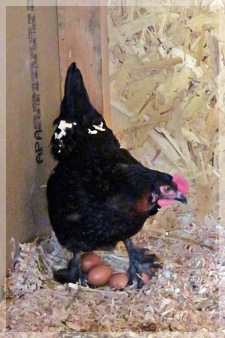
hen and eggs

Years ago, The Jerusalem Post published a joke about human arrogance. After considering all of humanity’s scientific progress, a group of scientists decided that God no longer was necessary. The chief scientist explained to God that man’s ability to clone people, manipulate atoms, build molecules, fly through space, create body parts with 3-D printers, and perform other miraculous feats meant God was unneeded and could be replaced by man. After patiently listening to the scientist, God suggested a human-making contest with only one rule: “We have to do it just like I did in the Bible.” Saying that was easy, the arrogant scientist bent over to pick up a handful of dust. “Put that down!” said God, while adding, “To do it my way, you have to make your own dust!”

Our vacation home in Idaho came complete with chickens and hen house. Every morning, the littlest grands would trek out to the hen house, check for eggs, and return with the makings of an omelet. I was relieved they never asked the age-old unanswerable question of “Which came first, the chicken or the egg?” We need a chicken (actually two) to have a fertilized egg but we need a fertilized egg to make a chicken. This seemingly futile question has been discussed for thousands of years. The Greek philosopher Aristotle considered it but evaded the answer by saying that both egg and chicken went infinitely backwards and always existed. The oldest fossilized eggs are 190 million years old and the oldest fossilized birds are only 150 million years old so paleontologists might say the egg came first. A strict reading of Genesis, however, would lead us to conclude that the chicken came first because animals appeared on the 5th day of creation. It’s a silly question but people ask it because they want to understand how something can come from nothing.

When making the children’s omelets, we still needed the raw ingredients. Along with the eggs that came from chickens (that came from eggs), we needed butter and cheese from cows, salt from the sea, pepper from the drupe of a pepper plant (Piper nigrum}, and green peppers and onions that came from seeds sown by a farmer, as well as a frying pan, whisk, spatula, and gas stove. Although my seamstress friend creates stunning clothing, she needs the silk from the silkworm (that came from an egg) or the cotton from the cotton bush (that came from a seed) to do so. My wood-working friend creates beautiful furniture but he can’t do it without the wood that comes from an oak tree that comes from an acorn that originally came from the oak! This begs the question, “Which came first, the oak or the acorn?” As the arrogant scientist learned, mankind can’t create something from nothing!

God, however, created everything from nothing. He had no eggs for the chickens, acorns for the oaks, seeds for the apple trees, or pollen for the flowers. He had no hydrogen or oxygen for water and no sodium or chloride to add to the water for the sea! Simply put, God spoke all creation into existence. That’s a rather unsatisfactory answer for those who want a technical explanation but the Bible is a book of theology that tells us the who and not a book of science that tells us how. We’re not about to get any more details as to how chaos turned to order, a void came to be filled, and nothing became something. Whether it was the chicken or its egg that came first will always be a conundrum.

The Lord merely spoke, and the heavens were created. He breathed the word, and all the stars were born. He assigned the sea its boundaries and locked the oceans in vast reservoirs. Let the whole world fear the Lord, and let everyone stand in awe of him. For when he spoke, the world began! It appeared at his command. [Psalm 33:6-9 (NLT)]

Copyright ©2022 jsjdevotions. All rights reserved.

MRS. JOB

He comforts us in all our troubles so that we can comfort others. When they are troubled, we will be able to give them the same comfort God has given us. [2 Corinthians 1:4 (NLT)]


When God gave Satan permission to test Job, He told the fallen angel that he could do anything he wanted to Job except take the man’s life. As a result, Job lost his wealth, possessions, children, and health. The only things left were his home and wife. Some might say that one of Job’s trials was that his wife didn’t die when the rest of his family did. After all, it was his wife who told him, “Curse God and die.”

Let’s not be too harsh with Mrs. Job; don’t forget that, when Satan stole Job’s normal, he also took life as she once knew it from his wife. She may have kept her health, but everything else she held near and dear was taken and she suffered the same emotional, economic, and social devastation as her husband. The ten children to whom she’d given birth, nursed and tended, were gone as were any grandchildren. Her mama’s heart had to be breaking. The family wealth (and status) had vanished in an instant; soon the bill collectors would arrive and, in all probability, the roof over their heads would vanish as well. Her strong and healthy husband, the man who loved and protected her, became an invalid overnight! He was covered with boils from head to toe and itched so badly that he scratched his skin with broken pottery. He had scabs all over his body and maggots and worms in his pus-filled sores. In deep depression, he was an insomniac who had nightmares when he managed to sleep. He was feverish, losing weight, in constant pain, had halitosis, his skin had turned dark, and he was in constant pain. Today’s doctors might diagnose a necrotizing skin fasciitis—think “flesh eating bacteria.” Job’s future was doubtful and his wife had to watch as he suffered. Witnessing her husband’s anguish and being unable to alleviate his pain couldn’t have been easy!

Moreover, there wasn’t much hope for Mrs. Job’s future; a better tomorrow was not on the horizon As far as she knew, she was facing imminent widowhood. A penniless widow with no children, she’d be the poorest of the poor, powerless, and vulnerable. Frightened and distraught, she was understandably angry at a God who allowed this to happen. Unfortunately, the only words of hers recorded are ones in which she took out that anger on her husband. Giving Mrs. Job the benefit of the doubt, those words may have been a combination of anguish and compassion— anguish about a seemingly hopeless situation and a compassionate hope that her husband’s suffering would end with his quick death.

As I thought about Mrs. Job, I thought of other people whose spouses are slowly being stolen by things like strokes, cancer, Parkinson’s, MS, and dementia. It seems that some of them have become rather cold to their afflicted partner and I’ve judged them unfairly (as I originally did Job’s wife). I forgot that they, too, are suffering. Their old normal is gone, their new normal is challenging, and their future is not the one they expected or hoped to have. Their lives have become a struggle as they try to cope with increasing responsibilities, mounting financial burdens, and a spouse who is deteriorating daily. Perhaps, what seems to be a lack of sympathy and understanding for their spouse is their way of preparing themselves for the loss they eventually will face. It’s not easy to summon compassion for people who seem to lack compassion themselves but, if I can muster sympathy for Mrs. Job, I should be able to muster far more sympathy for people I know who are caught in similar situations.

If ever presented with challenges like those of Job’s wife, I pray that I’ll be strong, brave, supportive, hopeful, loving, and trusting of God. As for now, I’ll no longer judge Mrs. Job or her brothers and sisters in similar situations. Whether or not I like their attitude or behavior is not my business. My job is simple—prayers, compassion, and support, not just for the afflicted, but also for their caregivers. The job of caregiver is not an easy one. Father, give them strength, wisdom and compassion in the face of their tremendous challenges.

Since God chose you to be the holy people he loves, you must clothe yourselves with tenderhearted mercy, kindness, humility, gentleness, and patience. Make allowance for each other’s faults, and forgive anyone who offends you. Remember, the Lord forgave you, so you must forgive others. Above all, clothe yourselves with love, which binds us all together in perfect harmony. [Colossians 3:12-14 (NLT)]

Copyright ©2022 jsjdevotions. All rights reserved.