MAKING A DEAL

God is not a man, so he does not lie. He is not human, so he does not change his mind. Has he ever spoken and failed to act? Has he ever promised and not carried it through? [Numbers 23:19 (NLT)]

halloween pennant dragonfly
While my college mantra was, “Study like you don’t pray and pray like you don’t study,” I tended to wait until the end of the semester to do either one. While cramming for finals, my prayers always included a promise that, if God would help me pass my exams, I’d never again cut class or wait until the last minute to do the required reading.

It certainly is tempting to make promises to God in return for answered prayers. In the 1940s, when Danny Thomas was down and out, the young entertainer did just that. Turning to St. Jude, the patron saint of lost causes, he prayed, “Show me my way in life, and I will build you a shrine.”  When his career took an almost immediate upswing, he envisioned a children’s hospital and started raising money to build and maintain it. In November of 1958, Thomas dug up the first spadeful of dirt at the groundbreaking for St. Jude Hospital! I’m not maligning Danny Thomas, condoning praying to saints, or disparaging the wonderful research hospital that resulted from Thomas’ promise. Nevertheless, in spite of the good that resulted, I don’t think prayers promising something to God if He fulfills our prayers are ones we should make.

When we pray “I’ll do this, if you’ll do that,” it seems like we’re asking God for something we don’t think we’ll get unless we “sweeten the pot” with a promise. It’s as if we don’t truly trust His intentions. The promise to do something for God seems like we’re asking Him to see it our way instead of us desiring His way. Yet, if we’re praying within God’s will, He promises we will receive.

Sometimes, sin is what causes us to make a promise to God. At finals’ time in college, forgetting that both repentance and facing consequences are an essential part of confession and forgiveness, I glibly promised a change in my behavior if I didn’t have to meet the consequences for my foolishness. Others, thinking their sins are just too great for absolution, make a promise to serve God in some way to merit His forgiveness, which seems a lot like bribing a judge for an innocent verdict. Such deal making is refusing God’s grace. Since Jesus already paid for our sins on the cross, paying God for forgiveness and absolution is an offense to Him!

Sometimes we make promises to God out of gratitude. Preferring to rely on ourselves rather than Him, we’re uncomfortable with feeling beholden or indebted to God. Rather than offering Him praise and thanksgiving, we make a pledge to do something as a way of thanking God for blessings received. Then, after fulfilling our promise, we’re the ones who feel praiseworthy for our good works! Trying to pay God for blessings received is another insult to Him; our good works should come from our love for Him rather than as a payment to Him.

Although God always keeps His promises, we humans aren’t so reliable and, more often than not, we break our promises to God. Granted, Danny Thomas kept his promise but perhaps he’s the exception that proves the rule. When the next semester rolled around in college, because I’d failed to keep the previous semester’s promise, I again made the same conditional prayer while cramming for exams. Although I always ended up with decent grades, it had nothing to do with my promises. Those grades, like Danny Thomas’ success and every other good thing that comes our way, have nothing to do with our promises—they are received only by God’s grace!

Praying with conditional promises of any kind turns our prayers into a transaction. Moreover, because we think it was our promise that caused the prayer’s fulfillment, it robs God of his deserved glory and praise. May we always remember that following Christ isn’t about making promises to God, it is about depending on the promises of God!

Believers do not pray, with the view of informing God about things unknown to him, or of exciting him to do his duty, or of urging him as though he were reluctant. On the contrary, they pray, in order that they may arouse themselves to seek him, that they may exercise their faith in meditating on his promises, that they may relieve themselves from their anxieties by pouring them into his bosom; in a word, that they may declare that from him alone they hope and expect, both for themselves and for others, all good things. [John Calvin]

God saved you by his grace when you believed. And you can’t take credit for this; it is a gift from God. Salvation is not a reward for the good things we have done, so none of us can boast about it. [Ephesians 2:8-9 (NLT)]

Copyright ©2022 jsjdevotions. All rights reserved.

RELIGIOUS PRIVILEGES

But it is no shame to suffer for being a Christian. Praise God for the privilege of being called by his name! [1 Peter 4:16 (NLT)]


Before my evening prayers, I often reflect on a prayer from The Valley of Vision, a collection of Puritan prayers edited by Arthur Bennett. In a recent selection, the prayer’s author asked the Lord to let him know his “need of renovation as well as of forgiveness,” and confessed, “I am often straying, often knowingly opposing thy authority, often abusing thy goodness….” He went on to admit, “Much of my guilt arises from my religious privileges, my low estimation of them, and my failure to use them to my advantage.” His words gave me pause.

Since a privilege is a special right, advantage, benefit, exemption, or legal immunity granted only to a particular person or group, I pondered the “religious privileges” we enjoy as Christians. The obvious is that even though we remain sinners, our belief in Jesus gives us God’s forgiveness; because Jesus paid the price for our sins, we are exempt from an eternity in Hell. That, however, was God who willingly gave up His absolute power and privilege to take on mankind’s limitations and die a criminal’s torturous death for us! Do we truly appreciate what He did or do we take that privilege for granted and fail to do the spiritual renovation necessary to show our appreciation for His sacrifice and blood? Do we thank the Lord each and every day for what He did on the cross?

Aside from a Christian’s destiny of having a home in heaven and sharing in the glory of God, what other religious benefits do we have? As Christ’s followers, we have the advantages of the peace that surpasses all understanding and the ability to find joy in all circumstances. We have the blessings of His continual presence, guidance, and protection from the enemy. We have the privilege of sharing the Gospel message and even that of suffering in His name!

Do we value the privilege of direct access to God and the advantage of two intercessors: the Holy Spirit who intercedes within us and puts our concerns into words along with Jesus Christ who intercedes for us in heaven? The Holy Spirit, however, is more than an intercessor. He corrects, teaches, sanctifies, strengthens, comforts, protects, and enables us to recognize the truth and obey God. He gives us one or more spiritual gifts and produces His fruit in us. Do we fully appreciate and use the many privileges and benefits that only Christ followers can enjoy or do we ignore and possibly abuse them?

A Christian’s “religious privileges” are offered to all but accepted by few. May we never be unappreciative, neglectful, or careless with God’s gifts or favor by disregarding the privilege of being one of His adopted children.

It is our privilege to know that we are saved. [ D.L. Moody]

Because of our faith, Christ has brought us into this place of undeserved privilege where we now stand, and we confidently and joyfully look forward to sharing God’s glory.[Romans 5:2 (NLT)]

Copyright ©2022 jsjdevotions. All rights reserved.

SELFIES

Finally, all of you, be like-minded, be sympathetic, love one another, be compassionate and humble. [1 Peter 3:8 (NIV)]

Rejoice with those who rejoice; mourn with those who mourn. [Romans 12:15 (NIV)]


I watched as the couple extended their selfie stick and posed. Focusing only on themselves, they were oblivious to others on the beach and the beautiful sunset behind them. In love and on vacation, for the moment the world revolved around them and nothing else mattered.

It’s not just when we’re in love that we think the world revolves around us. When encountering difficulties, we frequently get out an emotional selfie stick. Focusing on ourselves and our particular situation, we often end up throwing ourselves a pity party while whining things like, “Poor me…my life is so difficult…I hurt…it’s unfair…no one understands my situation…I’m miserable…nobody cares!” Fixated on what we’re feeling, we can’t see God let alone anyone else!

On the other hand, if we put aside the selfie stick and turn the camera around, we can move beyond our limited self-awareness and interest. By zooming out or using the panoramic setting, we get an entirely different perspective. When our view widens, we begin to see people with problems of their own, and, in many cases, those problems are far worse than ours. With better perspective, we cease being the center of the universe and our difficulties cease being the center of our lives.

According to NASA astronauts, seeing the earth from space causes a profound change in their awareness. When astronaut Ron Garan viewed his home planet from space, he was in awe of its overwhelming beauty. By viewing the earth without borders, he also was struck both by the oneness of the world and by the inequity existing on it. He felt a deep sense of sadness as he thought of the billions of people on earth who suffer from things like hunger, lack of clean water, social injustice, conflicts, and poverty.

We don’t need to be astronauts to step back far enough to realize how many people suffer and suffer far more than do we on even our worst days. The pain and problems in our lives are just a small part of the interconnected and continually evolving drama of life in this world. We are but one of more than 7.8 billion people on earth and only one of the nearly 335 million people in our nation. Those numbers are humbling—and a gentle reminder that life does not revolve around us!

Oddly, when we recognize the pain of others, our pain is lessened, not because they might hurt more than we do but because we become united with them in our anguish. Rather than wallowing in self-pity, widening our perspective allows empathy and compassion to emerge. No longer alone in our suffering, we become connected with others in this flawed and troubled world of ours. No longer isolated in our distress, we move from focusing on the “me” to caring about the “we.”

Father, open our eyes to you and to the world around us. Broaden our view so that we see the purpose in pain, the lesson in loss, and the meaning in misery. Give us compassionate hearts and peace filled souls. If we are to cry, let our tears be for others and, if we are to mourn, let our mourning be for all who grieve. Please strengthen and comfort us so that we can strengthen and comfort others.

Between stimulus and response there is a space. In that space is our power to choose our response. In our response lies our growth and our freedom. [Viktor Frankl]

Praise be to the God and Father of our Lord Jesus Christ, the Father of compassion and the God of all comfort, who comforts us in all our troubles, so that we can comfort those in any trouble with the comfort we ourselves receive from God. For just as we share abundantly in the sufferings of Christ, so also our comfort abounds through Christ. [2 Corinthians 1:3-5 (NIV)]

Copyright ©2022 jsjdevotions. All rights reserved.

NO GUILT

For he gives his sunlight to both the evil and the good, and he sends rain on the just and the unjust alike. [Matthew 5:45 (NLT)]

peony
50 years ago, mothers spent several days in the hospital before going home with their newborns. While sharing my hospital room with a young woman who’d given birth to her first child, I overheard the pediatrician explain that her baby had Down’s syndrome, was being examined by a pediatric cardiologist, and likely needed immediate surgery. Although my heart broke for that mother, I also felt a sense of relief his news wasn’t for me. Statistically, as the older woman with three children, I was the mother more likely to hear that diagnosis. Knowing I was no more deserving of a healthy child than was she, I felt a tinge of guilt for the healthy infant nursing at my breast.

Have you ever felt guilty for receiving blessings when others weren’t so blessed, for reaping a harvest of blessings that you didn’t sow, for catching “lucky breaks” that come from God’s hand, or for having the equivalent of manna from heaven when others go hungry? We’re no more deserving than anyone else and yet our fertility treatment worked, we beat the odds with the chemo, we survived the crash, a loved one got sober, or our prodigal child returned. While others are not so blessed, we have healthy babies, loving parents, successful children, a financially secure retirement, a booming business, or simply were in the right place at exactly the right time. Yes, we may have prepared well and worked hard, but so have others who never enjoyed those blessings! When hearing the horrific stories told by Ian’s survivors and witnessing the destruction this hurricane left in its wake, I felt guilty admitting that the worst we suffered was lack of cell service, 24-hours without TV, and a few hours of yard and lanai clean-up.

With so many others suffering or in need, I’m probably not alone in feeling some sort of guilt or shame for God’s blessings like better circumstances, answered prayers, and what seems like “dumb luck.” Job asked “Why me?” about his suffering and I can’t help but wonder “Why me, Lord?” about the incredible blessings He’s bestowed on me. But, just as Job never discovered God’s reasoning, neither will I! As the one who controls the universe, God knows exactly what He’s doing even though we don’t. Rather than understand Him, God asks us to trust in His infinite wisdom and love.

God is not sadistic, cruel, neglectful, incompetent, or capricious. He doesn’t scatter blessings and trials impulsively, haphazardly, or accidentally. Knowing the past, present, and future of the entire cosmos, His perspective is far wider than ours ever will be. Although He orchestrates events that frequently seem questionable, needless, tragic, or unjust, we must accept that God is God and we, most definitely are not. We will never know the reasons behind our blessings or tragedies.

As Christ followers, what we do know is that we are recipients of the most undeserved and greatest gift of all—Jesus! As sinful and undeserving as we are, I suspect none of us feel guilty about receiving God’s only son and the salvation and eternal life that He purchased for us! Why then should we feel any guilt for His other blessings (all of which are equally undeserved)?

Let us remember that guilt is a gift from the enemy. If he can’t make us envious of the blessings received by others, he’ll try to make us ashamed of the blessings God gives to us. Rather than questioning God’s reasoning, let us recognize His amazing grace and appreciate his lavish generosity. It’s an insult to the Giver of All Gifts to discount, disregard, squander, or fail to appreciate, enjoy, and use all that we’ve been given. While we should be humble when accepting God’s blessings, we must never be ashamed or embarrassed about them.

If God has bestowed a blessing upon us, it’s because others are in need and we are the means by which He fills those needs. The only reason for guilt or shame is when we’re not good and faithful servants who steward and share His gifts wisely and generously while giving God the glory!

All the blessings we enjoy are Divine deposits, committed to our trust on this condition, that they should be dispensed for the benefit of our neighbors. [John Calvin]

God saved you by his grace when you believed. And you can’t take credit for this; it is a gift from God. Salvation is not a reward for the good things we have done, so none of us can boast about it. For we are God’s masterpiece. He has created us anew in Christ Jesus, so we can do the good things he planned for us long ago. [Ephesians 2:8-10 (NLT)]

Copyright ©2022 jsjdevotions. All rights reserved.

A FEARLESS INVENTORY

If we claim we have no sin, we are only fooling ourselves and not living in the truth. But if we confess our sins to him, he is faithful and just to forgive us our sins and to cleanse us from all wickedness. [1 John 1:8-9 (NLT)]

Made a searching and fearless moral inventory of ourselves. [Step 4 of the 12 steps of Alcoholics Anonymous]

great blue heron

Step four in most twelve-step recovery programs requires “a searching and fearless inventory of ourselves.” However, it’s not just addicts or alcoholics who should take an honest inventory of themselves—we all should. Blindness to our faults can keep us from far more than recovery; it keeps us from a relationship with Jesus. Sin keeps us from being the people God wants us to be because it weighs us down with guilt and shame.

While most of us probably have no problem saying, “Forgive us our trespasses,” and admitting we’ve trespassed, the problem occurs when we’re asked to catalog those trespasses! We’d much rather gloss over our faults than face the unpleasant task of honest self-examination. Real confession, however, requires more than just admitting we’re sinners; it requires taking a good hard look at ourselves to determine how we sinned. Since self-examination can be unpleasant, we tend to generalize or even avoid confession altogether in our prayers; but, we can’t grow spiritually if we’re discounting or ignoring our sins.

It’s easy to spot what’s wrong in the world or in the lives of others but much harder with ourselves. If we’re innocent of the obvious sins—murder, bribery, fraud, assault, worshiping graven images, stealing, and blasphemy—we feel pretty good about our behavior. But even the best Christian, when making a searching and fearless inventory, is likely to find some hypocrisy, bitterness, jealousy, pride, selfishness, greed, prejudice, worry, and/or materialism. Upon further examination, we’ll probably find a list of failures, as well—failure to forgive, show patience, love God with our whole being, love our neighbor as ourselves, have a grateful heart, pray for our enemies, read God’s word, further His kingdom, bear the Fruit of the Spirit, do what we know is right, or give the glory to God.

We don’t need to confess our sins to receive forgiveness. Our sins—past, present, and future—were cancelled when Jesus was nailed to the cross. He paid the debt with His life and anyone who believes in Him receives that forgiveness. The assurance of our forgiveness, however, doesn’t give us carte blanche to keep on sinning.

As Jesus’ followers, we are expected to make war on our sins—to “put to death the sinful, earthly things lurking within” us. How can we go to war if we don’t know what it is we’re battling? Our omniscient God doesn’t need our confession to know our sins—He knows them all. Confession is for us! Simply saying, “forgive us our trespasses” is little more than lip service; admitting lack of forgiveness regarding the ex, surfing for porn, deceit on your resume, or gossiping about your neighbor is taking up arms and engaging in combat against that sin!

Confession makes us open up the junk drawer of our lives, scrutinize it carefully, and toss out the trash that we’ve accumulated. That searching and fearless inventory makes no excuses—it focuses on the truth and accepts full responsibility for the actions. Recognizing that our sins are offensive to God, we repent and forsake our sins, admit our need of God’s saving grace, and commit to walking in Jesus’ footsteps.

Children of God should not make a general confession by acknowledging their innumerable sins in a vague manner, because such confession does not provide conscience opportunity to do its perfect work. They ought to allow the Holy Spirit through their conscience to point out their sins one by one. Christians must accept its reproach and be willing, according to the mind of the Spirit, to eliminate everything which is contrary to God. [Watchman Nee]

So put to death the sinful, earthly things lurking within you. Have nothing to do with sexual immorality, impurity, lust, and evil desires. Don’t be greedy, for a greedy person is an idolater, worshiping the things of this world. [Colossians 3:5 (NLT)]

Copyright ©2022 jsjdevotions. All rights reserved

IN ENEMY TERRITORY

Be alert and of sober mind. Your enemy the devil prowls around like a roaring lion looking for someone to devour. Resist him, standing firm in the faith, because you know that the family of believers throughout the world is undergoing the same kind of sufferings. [1 Peter 5:8-9 (NIV)]

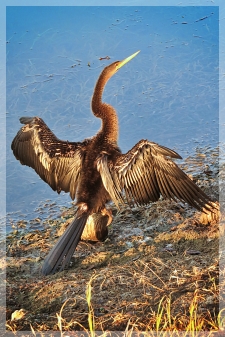
anhingaAnhingas are among my favorites of our lake’s birds. Unlike most birds, their bones are heavy and dense and, rather than waders like the herons and egrets or paddlers like the ducks, they are deep-diving swimmers. Lacking the oil glands that waterproof the feathers of other water birds, anhingas (and their cormorant cousins) become water-logged in the water. While making it difficult to remain afloat, that allows them to dive up to sixty feet deep, swim underwater for several hundred feet, and stay underwater for more than a minute. Eventually, however, the birds become so heavy they will sink unless they return to land to dry their feathers.

Every morning I find anhingas resting along the lake’s shoreline and spreading their wings to dry. The wettest ones get barely out of the water but, as they dry, they waddle further back until dry enough to get up onto a rock, bench, or low hanging branch. As their feathers continue to dry, they move higher up in the trees until they are dry and light enough to take flight.

Unlike the lake’s ducks who nest and sleep in the vegetation along the shoreline, anhingas remain on land only out of necessity. Vulnerable to predators, a soaking wet anhinga is like a “sitting duck.” With its stubby legs and large webbed feet, it can’t run; water-logged, the water isn’t a good option and yet it’s too wet to fly up to safety. While hissing, grunting, and trying to look intimidating by ruffling its feathers, raising its tail, lengthening and waving its long neck, and pointing its spear-like beak may deter some birds of prey, that behavior probably won’t dissuade hungry alligators or crocodiles.

Just as being vulnerable to a predator’s attack is part and parcel of being an anhinga, being vulnerable to our enemy’s attack is an inevitable part of being human in our fallen world. Rather than gators and crocs, that enemy is Satan and he can sneak up on us even more adeptly than the wiliest reptile in the Everglades. Rather than the weight of soaking wet feathers, it is the weight of things like pain, illness, betrayal, weariness, conflict, loneliness, loss, disappointment (and even hurricanes) that make us especially vulnerable to attack. The enemy will use every weapon in his armory including lies, half-truths, fear, despair, hopelessness, and (his favorite) doubt to assault our belief in the goodness of God. Fortunately, in His wisdom, God armed us for battle with more than the saber-sharp beak and intimidating appearance of the anhinga. We wage war with the weapons of our faith: God’s Word and the power of the Holy Spirit.

An anhinga, aware of its vulnerability when wet, only enters the water to hunt or bathe. With neck extended and eyes wide open, it remains watchful when drying along the shoreline and never dawdles there once dry. Like the anhinga, we must be alert to our vulnerability in our fallen world. Unlike the anhinga, however, we often act as if we’re not sitting smack dab in the middle of the enemy’s territory! A. W. Tozer warns us about thinking of the world as a “playground instead of a battleground.” May we never forget that we live in the enemy’s territory and he is as dangerous as a prowling lion or a hungry alligator!

Anyone who serves the Lord is going to be the target of Satan’s attacks. [Zac Poonen]

Finally, be strong in the Lord and in his mighty power. Put on the full armor of God, so that you can take your stand against the devil’s schemes. For our struggle is not against flesh and blood, but against the rulers, against the authorities, against the powers of this dark world and against the spiritual forces of evil in the heavenly realms. [Ephesians 6:10-12 (NIV)]

Copyright ©2022 jsjdevotions. All rights reserved.