
Don’t you realize that I could ask my Father for thousands of angels to protect us, and he would send them instantly? But if I did, how would the Scriptures be fulfilled that describe what must happen now? [Matthew 26:52-54 (NLT)]
 There is a fancy term for how God the Son, Jesus, took on human form and yet remained God: hypostatic union. Sounding like why my socks cling to my t-shirts in the dryer, knowing the term doesn’t help us understand it. I’m not sure anyone can wholly comprehend how Jesus always existed and yet was conceived by the Holy Spirit, born of Mary, and became man. When pondering Christ’s incarnation, I can’t help but think of an old ad for Certs Mints. Since they were both a breath mint and a candy mint, their commercials ended with the catch phrase: “Certs is two, two, two mints in one!” Fully man and fully God at the same time, Jesus, like Certs, had two distinct natures in one.
When Jesus walked the earth, He was not a human who once had been God; He was God in a human body. When He put on skin and became a living breathing man, Jesus didn’t cease being God or lose His godly attributes. For the most part, however, He voluntarily limited himself to the restrictions of humanity. As God, He could be everywhere at once but, as a man, Jesus only could be one place at a time. God is eternal and transcends time but the man Jesus had both a beginning and an end and was confined to a twenty-four-hour day. Nevertheless, there were moments when Jesus exercised His omniscience, omnipotence, and authority. For example, He knew the scandalous history of the woman at the well, the thoughts of the Pharisees, and who would betray Him. He used His divine power and authority to cast out demons, walk on water, give sight to the blind, and forgive sins.
Jesus, however, never resorted to His godly attributes to make life easier for Himself. As God, He never experienced weariness, hunger, or thirst but, when living in a man’s body, He grew tired, hungry, and thirsty. When fasting in the wilderness, the man who fed thousands with a few fish easily could have turned stones into loaves of bread, but He deliberately chose not to do so. God doesn’t feel pain, bruise, bleed, or die but, as a man, Jesus chose to do just that. The man who could still storms, change water into wine, and cast demons into swine could have stopped the flogging, mockery, and beating he endured that dark Friday. The man who cured lepers, healed a bleeding woman, and raised the dead certainly had the power to endure crucifixion without agony or to survive it unscathed. But, He didn’t!
After tempting Jesus in the wilderness, Luke tells us Satan left Him “until the next opportunity came.” Without a doubt, an opportunity came at Golgotha when the enemy made a last-ditch effort to stop God’s plan of redemption. He may have tempted Jesus with words like these: “Smite them; they dared to spit on you!” or “They’re beating you cruelly—show no mercy, strike the mortals down!” As Jesus suffered on that cross, Satan may have whispered, “You’re God, you don’t have to suffer like this. Break free and step down!” Being divine, Jesus easily could have come down from the cross unmarked by His ordeal. Instead, our all-powerful God deliberately chose to limit Himself to the indignities, pain, and weaknesses of a mortal human body. Submitting Himself to God the Father, He chose to endure torture, suffer, and die a miserable death as a man. Why? Because He loved us.

 As one of three pilgrimage feasts requiring every Jewish man’s attendance in Jerusalem, Jesus and the disciples joined other pilgrims on their journey toward the city for the Passover celebration. By the time they passed through Jericho (where He healed the blind Bartimaeus and ate dinner with Zacchaeus), a large crowd was following Jesus. It was on a Sunday that He and His disciples left Bethany for the two-mile walk into Jerusalem. The roads would have been crowded as pilgrims streamed into the city in preparation for the festival. Having heard of Jesus’ miracles and the way He brought Lazarus out of the grave, many of those in the streets were anxious to see Him. ”Could this be the long-awaited Messiah?” they wondered.
 Our sons recently visited to celebrate their father’s birthday. As I watched them work their culinary magic in the kitchen, I marveled at how the boys who once thought Kraft mac n’ cheese to be haute cuisine became gourmet cooks. For that matter, when did they get so tall or those wrinkles appear around their eyes? At what point did the tow-headed boy’s hair darken and start receding or his brother’s turn grey? The changes I observed weren’t just physical. As we talked, I wondered when my once irresponsible boys became so sensible and wise. None of it happened overnight and yet each little change was so subtle it barely was noticed. But, when I thought back to the children and young adults they once were, the change was enormous.
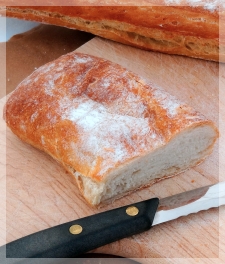 If “daily bread” refers to our necessities and nothing more, then what are the necessities of life? The most obvious answer is food enough to maintain us, water enough to sustain us, along with clothing and shelter enough to protect us. Chances are you are among the fortunate who have all that’s needed to support life (plus a great deal more.) I know I am. Should we then cease asking the Lord for our daily bread? Martin Luther would say, “No.”
 A pastor friend told me about returning from a service project with some of his SK8 church youth including Brian, a young man new to the faith. When they stopped for lunch at a taco stand, a street person asked Brian for money. Trying to do what Jesus would want done, the new Christian offered to buy the hard-up man a burrito. It was when Brian ordered two bean burritos that his dining guest loudly complained, “I ain’t eatin’ no $%2#!* bean burrito—I want a steak one!” Brian had little money to spare but, since the man was getting vociferous, he ordered the steak burrito for his guest and a bean one for himself. Apparently, the vagrant wasn’t familiar with the proverbs about beggars not being choosers, half a loaf being better than none, and not looking a gift horse in the mouth!
