WITHOUT ERROR

All scripture is breathed by God, and it is useful for teaching, for rebuke, for improvement, for training in righteousness, so that people who belong to God may be complete, fitted out and ready for every good work. [2 Timothy 3:16-17 (NTE)]

Since God can’t err and the Bible is His word, we’re left with the conclusion that the Bible is without error. While we’re not Christian apologists, there will be times when we are called on to defend its integrity. Scripture is God-breathed but, for the most part, the writers did not serve as stenographers recording His exact words. They were human beings, with distinctive personalities, writing in their own style, from their perspective, and using the language of their day. Nevertheless, even though God used men to do the writing, He inspired the words they wrote. The truth in Scripture comes from God, not from the men who penned the words.

In stories like the healing of the Roman centurion’s servant or the women at the tomb on Easter morning, we find different versions of the same event but it’s a mistake to assume different means incompatible or false. An article published by the CrossExamined ministry comparing five actual press reports of the same Chicago accident demonstrates how different accounts of the same event can appear contradictory when they aren’t. The first one, by AP, reported an airplane plane sliding off the runway, crashing through a boundary fence onto Central Ave., hitting a car, killing a child in that car, and pinning another car underneath it. Never mentioning crashing through a fence, the second account referred only to the car in which the passenger died, identified the fatality as a 6-year old boy, placed the accident at 55th and Central, and noted that no passengers on the plane were seriously injured. Rather than a fence, the third account referred to a security wall, said the plane hit two cars, didn’t name either street, and, while reporting a child’s death, never mentioned he was a passenger in one of the cars. In the fourth account, Reuters reported the airplane’s destination, made no mention of hitting cars or a child’s death, and called it a security barrier rather than a fence or wall. The fifth account simply reported that a plane skidded off the runway and ended up at 55th and Central.

Which account, if any, is true? In spite of their differences, they’re all correct! As for what the plane went through—there was a wall that served as a security/noise barrier along with a fence and the plane crashed through them both. Whether the second car was hit or pinned was merely a matter of semantics. The reports of either one or two cars are both correct because where there are two, there always is one! No account ever said “only” one car was involved and none reported “only” one barrier/wall/fence. The absence of details in some accounts doesn’t invalidate their report and, while later accounts of the same incident gave more details (including that four others in another vehicle also were injured), the additional information doesn’t negate the validity of the first reports. A partial report is not a false one!

Deviations in a story do not necessarily mean errors or deceit. In fact, identical statements by multiple witnesses are more suspect than ones with slight variations. Because each witness has a unique viewpoint, multiple witnesses always mean slightly different accounts. A report of the crash from a passenger on the plane would differ from the pilot’s account or that of someone standing at 55th and Central; all of those would differ greatly from statements by the parents of the boy who died.

Just because the Bible is without error doesn’t mean it is without difficulties. While all of those original accident accounts are correct, if they were hand-copied several times, translated into another language, and copied again, chances are we’d eventually find a few unexplainable inconsistencies or minor errors. Although the Bible is God’s word, He only uttered the original text. Any mistakes we find today are man’s, not His!

If we are perplexed by any apparent contradiction in Scripture, it is not allowable to say, The author of this book is mistaken; but either the manuscript is faulty, or the translation is wrong, or you have not understood. … The pious inquirer will find all perplexity removed by a careful examination. [Augustine]


You must know this first of all, that no scriptural prophecy is a matter of one’s own interpretation. No prophecy, you see, ever came by human will. Rather, people were moved by the holy spirit, and spoke from God. [2 Peter 1:20-21 (NTE)]

Copyright ©2021 jsjdevotions. All rights reserved.

WITH JUST A WORD

I tell you the truth, I haven’t seen faith like this in all Israel! [Matthew 8:10]

Coming from a career in the military where, as the commanding officer, his word was law, my brother-in-law had a rude awakening when he retired from the Navy and returned to civilian life. If, at his word, a squadron of planes could be on the runway and ready for flight at 0700 sharp, he didn’t understand why the cable man or plumber couldn’t be counted on to arrive on time (let alone, at all)! Unfortunately, the power and authority he had as a commanding officer didn’t transfer to his new role as a private citizen.

Like my brother-in-law, the Roman centurion who asked Jesus to heal his servant was used to the power of his words. When the centurion spoke, he spoke with the emperor’s authority and he knew he didn’t need to be present to have his orders carried out by the 100 men he commanded. Recognizing Jesus as more than an itinerant rabbi, the centurion knew that, when Jesus spoke, He spoke with God’s authority. Like the centurion, Jesus didn’t need to be present to exercise His power—all that was needed was His command!

Typically, people were amazed by Jesus but, that time, Jesus was amazed by the centurion. Turning to the crowd around him, He commended the Gentile’s faith—saying he’d not seen so great a faith in the land. Reminding his listeners that the Kingdom of Heaven was open to everyone, both Gentile and Jew, He warned them that faith, rather than heritage, would determine attendance at the Messianic banquet and cautioned that some Israelites would not be there!

The only other time Scripture records Jesus’ amazement is when, after being scoffed and scorned in Nazareth, Jesus expressed amazement at his fellow Jews’ lack of faith. Mark tells us that was why Jesus could perform only a few healings (but no miracles) in his home town. The lack of miracles, however, doesn’t mean that Jesus didn’t have the power to perform them; it means that He chose not to do so in an atmosphere of unbelief. Rather than being subject to our faith, God acts in response to it! God’s power is unlimited but He will not force His blessings on those who don’t believe. Let us remember that the One who spoke the universe into existence is capable of far more than we can ask! The centurion had great faith in Jesus; we should follow his example!

And it is impossible to please God without faith. Anyone who wants to come to him must believe that God exists and that he rewards those who sincerely seek him. [Hebrews 11:6 (NLT)]

Jesus looked at them intently and said, “Humanly speaking, it is impossible. But not with God. Everything is possible with God.” [Mark 10:27 (NLT)]

Copyright ©2021 jsjdevotions. All rights reserved.

LOOK DEEPER

But the Lord said to Samuel, “Do not look on his appearance or on the height of his stature, because I have rejected him. For the Lord sees not as man sees: man looks on the outward appearance, but the Lord looks on the heart.” [1 Samuel 16:7 (ESV)]

carolina wrenYesterday, when writing about the lack of physical descriptions of Jesus, I realized how rarely Scripture describes anyone. Granted, we know that Goliath was huge, Saul was tall, Ehud was left-handed, Samson had long hair, Esau was hairy, Zacchaeus was short, that Sarah, Esther, and Rachel were beautiful, and that Leah was not. Those brief descriptions, however, were necessary to explain the narrative. Other than their ages, for example, we know nothing about the appearance of Noah, Abraham, or Moses and we don’t even know the ages of any of the disciples! Appearance, however, isn’t important to God.

1 Samuel 9:2 describes Saul as “the most handsome man in Israel—head and shoulders taller than anyone else in the land.” Looking kingly, however, isn’t qualification enough to be a king. After removing Saul’s kingship because of his disloyalty and disobedience, God sent Samuel to Jesse’s house to find and anoint Israel’s new king. Once there, the prophet took one look at Jesse’s impressive-looking eldest son Eliab and was sure he found the new monarch. When God rejected Eliab, Jesse lined up the rest of his sons and Samuel continued on down the line. Going about this selection process as would a casting director—by choosing someone who looked regal—Samuel seemed to have forgotten that Israel already had a king who looked the part. What they needed was someone worthy of the role.

When God rejected all seven of Jesse’s boys, Samuel asked if there were any more. He learned of the young David out herding animals in the fields. This youngest son was so far down the family’s pecking order that his father hadn’t even summoned him to the feast but Samuel insisted on sending for him. Although David is described as being pleasant looking, with beautiful eyes and a ruddy complexion, a young shepherd boy (no matter how handsome) doesn’t sound much like king material, but God told Samuel, “This is the one.”

God explained to Samuel that He doesn’t look at a man’s appearance; He looks at a man’s heart. With his pink-cheeks and beautiful eyes David may not have looked the part, but he had the makings of a king because he was what God wanted: a man after God’s heart. [13:14] While people see what a person appears to be, God sees who that person actually is!

In spite of our best efforts not to do so, like Samuel, we tend to categorize people by their looks and often allow age, physique, beauty, ethnicity, clothing, wealth, grooming, or style to outweigh substance. If God doesn’t judge people by appearance, I wonder why we so often do. Unlike God, we can’t immediately see what’s in a person’s heart but, when we estimate a person’s worth by his exterior, we often miss the opportunity to ever see into his interior! God calls us to live by faith rather than sight; perhaps we should apply those words to the way we view our fellow travelers on this planet. Let us remember Isaiah’s description of Jesus—the Messiah who had “nothing beautiful or majestic about his appearance, nothing to attract us to him.” [53:2] That man was God’s son! If we saw Him on the streets today, would we write Him off as readily Jesse did his own son?

For he grew up before him like a young plant, and like a root out of dry ground; he had no form or majesty that we should look at him, and no beauty that we should desire him. He was despised and rejected by men, a man of sorrows and acquainted with grief; and as one from whom men hide their faces he was despised, and we esteemed him not. [Isaiah 53:2-3 (ESV)]

Copyright ©2021 jsjdevotions. All rights reserved.

IMITATING CHRIST

Instead, clothe yourself with the presence of the Lord Jesus Christ. And don’t let yourself think about ways to indulge your evil desires. [Romans 13:14 (NLT)]

rue anemoneBecause of the Jewish prohibitions about images, I understand why no pictures of Jesus were drawn by His followers. Nevertheless, any decent author gives a minimal word picture of his characters but the gospels’ writers give us nothing. With Melville’s description of Captain Ahab’s gray hair, scarred face, and whale-bone peg-leg, we know more about the fictional whale hunter’s looks than we do about the real Jesus! The most we know about His exterior is found in Isaiah’s prophecy: “There was nothing beautiful or majestic about his appearance, nothing to attract us to him,” [53:2] which describes most of us! Adjectives are few and far between in Scripture but the Bible isn’t a novel and its words were God-breathed not writer created. If God wanted us to know about Jesus’s appearance, He would have told us. After all, if we knew what Jesus looked like, wouldn’t we focus more on His looks rather than His words? Rather than wanting to emulate His character, we’d probably want to match His features—after all, He was God!
When Paul told the Romans to “put on” or clothe themselves with Christ, he wasn’t speaking of robes, sandals, beard or haircut. He was speaking of spiritual clothing—to take off our “dark deeds like dirty clothes, and put on the shining armor of right living.“ [13:12] While we know nothing of Jesus’ physical appearance, the New Testament writers gave us more than enough description of Jesus’ words and behavior to clearly picture the “shining armor of right living.” When we put on Christ, our minds and behavior transform so that our lives imitate His—so that, when people see us, they should see Him.

Below is an excerpt from the Epistle to Diognetus. While not part of the Christian canon, it is a valuable document. Written around 130 AD, the author calls himself Mathetes (meaning “disciple” in Greek) and claims to be a student of the apostles. Yesterday, I wrote of the misconceptions surrounding the early followers of Jesus. In Mathetes’ letter, he defends the doctrines of Christianity and describes Christian behavior to the “most excellent Diognetus.” In one chapter, Mathetes explains that, while Christians follow the ordinary customs of clothing, food and conduct, “they display to us their wonderful and confessedly striking method of life.” The lifestyle to which Jesus calls us has not changed since Mathetes’ time and yet, when reading his words, I wonder if anyone would describe today’s followers of Christ in the same way.

They dwell in their own countries, but simply as sojourners. As citizens, they share in all things with others, and yet endure all things as if foreigners. Every foreign land is to them as their native country, and every land of their birth as a land of strangers. They marry, as do all [others]; they beget children; but they do not destroy their offspring. They have a common table, but not a common bed. They are in the flesh, but they do not live after the flesh. They pass their days on earth, but they are citizens of heaven. They obey the prescribed laws, and at the same time surpass the laws by their lives. They love all men, and are persecuted by all. They are unknown and condemned; they are put to death, and restored to life. They are poor, yet make many rich; they are in lack of all things, and yet abound in all; they are dishonoured, and yet in their very dishonour are glorified. They are evil spoken of, and yet are justified; they are reviled, and bless; they are insulted, and repay the insult with honour; they do good, yet are punished as evil-doers. When punished, they rejoice as if quickened into life; they are assailed by the Jews as foreigners, and are persecuted by the Greeks; yet those who hate them are unable to assign any reason for their hatred.

To sum up all in one word—what the soul is in the body, that are Christians in the world. The soul is dispersed through all the members of the body, and Christians are scattered through all the cities of the world. The soul dwells in the body, yet is not of the body; and Christians dwell in the world, yet are not of the world.  [Epistle to Diognetus – translated by Alexander Roberts and James Donaldson]

Put on your new nature, and be renewed as you learn to know your Creator and become like him. [Colossians 3:10 (NLT)]

Put on your new nature, created to be like God—truly righteous and holy. [Ephesians 4:24 (NLT)]

Copyright ©2021 jsjdevotions. All rights reserved.

ALEXAMENOS

“I’ve said these things to you,” Jesus went on, “to stop you from being tripped up. They will put you out of the synagogues. In fact, the time is coming when anyone who kills you will suppose that they are in that way offering worship to God. They will do these things because they haven’t known the father, or me. But I have been talking to you about these things so that, when their time comes, you will remember that I told you about them.” [John 16:1-4 (NLT)]

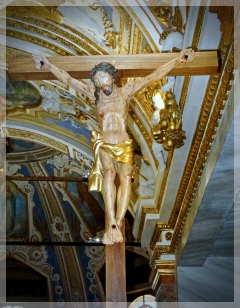
Locarno-Madonna del SassowIn any cathedral or art museum, we’ll find many pictures of Jesus and even rather graphic depictions of Him on the cross. None of them, however, tell us anything about His appearance because they were created long after His time. Still, in a world where we seem to memorialize everything with pictures, you’d think one of Jesus’ followers would have sketched Him while blessing the children, giving the Sermon on the Mount, or feeding the multitude! 1st century rabbis in Judah, however, vehemently objected to the depiction of human figures because the second commandment prohibited making a “graven image.” With its Jewish roots, this prohibition carried into the early church and inhibited early Christian art.

At first, Jesus was represented indirectly by symbols such as the peacock, lamb, dove, and anchor. One of the most common was the ichthus (fish) because the Greek word served as an acronym “Jesus Christ, Son of God, Savior.” While making the sign of the cross dated from sometime in the second century, because of its connection with the horrific death of criminals, the cross did not became a symbol of Christianity until the 4th century; crucifixes and other depictions of the crucifixion did not occur until the 6th.

One earlier depiction of Jesus’ crucifixion, however, does exist. Crudely scratched into a stone wall, it was discovered in 1857 during an excavation of the Paedagogiumon (a school for the training of slaves) on Rome’s Palatine Hill. Dating from around 200 AD, it shows a man (or boy) worshiping a figure on a cross; the figure, however, has the head of an ass. The inscription reads, “Alexamenos worships his God.” This derisive graffiti gives us an idea of the way early Christians were ridiculed for worshiping a man who had been executed as a criminal.

Along with claims of onolatry (donkey worship), the early Christians had to deal with several other disparaging, malicious, and false accusations such as incest, cannibalism, and drinking the blood of infants. Roman orator Marcus Cornelius Fronto (c. 100-160) wrote that Christians were “initiated by the slaughter and the blood of an infant” and that Christianity was “foolish” because, “they worship a crucified man, and even the instrument itself of his punishment” and “are said to worship the head of an ass.”

This was the world—a world that misunderstood, slandered, ridiculed, hated and persecuted them—of the early Christians. And yet, they proceeded in faith and spread the gospel. I wonder how the 21st century church would do in similar circumstances! As for Alexamenos, the fellow mocked by that ancient graffiti—more graffiti was found on a wall in an adjacent room. In Latin it said, “Alexamenos is faithful.”  In the face of opposition, we must be the same!

Think back on those early days when you first learned about Christ. Remember how you remained faithful even though it meant terrible suffering. Sometimes you were exposed to public ridicule and were beaten, and sometimes you helped others who were suffering the same things. You suffered along with those who were thrown into jail, and when all you owned was taken from you, you accepted it with joy. You knew there were better things waiting for you that will last forever. So do not throw away this confident trust in the Lord. Remember the great reward it brings you! [Hebrews 10:32-35 (NLT)]

Copyright ©2021 jsjdevotions. All rights reserved.

THE CAMEL AND THE NEEDLE (Part 2)

Jesus said to his disciples, “I’m telling you the truth: it’s very hard for a rich person to get into the kingdom of heaven. Let me say it again: it’s easier for a camel to go through the eye of a needle than for a rich person to enter God’s kingdom.” [Matthew 19:23-24 (NTE)

camel-GCParadegrounds2wAfter the rich young ruler departed, Jesus compared the difficulty of a rich man entering heaven to a camel trying to squeeze through the eye of a needle. Because of its impossibility, people find this metaphor troubling. To rationalize it, some scholars speculate that a narrow gate called “The Needle” was located in the wall surrounding Jerusalem. Supposedly used after dark when the main gates were closed, it was so small that a camel had to be unburdened of rider and cargo before getting down on its knees to pass through the gate. They interpret the metaphor as meaning that people must leave behind their baggage, repent, and humble themselves to get through the gate to God’s kingdom. While that’s correct and their explanation makes an excellent Sunday school lesson, no historical or archeological evidence exists that such a gate existed.

Other scholars conjecture that the original word was kamêlos, meaning cable or rope, and a copying error caused it to be written kamilos, meaning camel. They prefer an interpretation that, while it may be extremely difficult to get a rope through a needle, it wouldn’t be impossible, especially if Jesus meant a large carpet needle. Be that as it may, it seems improbable that three gospels would have the same transcribing error.

Rather than trying to reason away the difficulty of getting a camel through a needle, perhaps we should take this hyperbole at face value and accept it for what it is—an impossibility! In fact, in the Babylonian Talmud, there is a Persian metaphor about the impossibility of an elephant going through the eye of a needle. Jesus’ listeners may well have been aware of the Persian saying and, since a camel was the largest animal known in Palestine, it would make more sense to Judeans than would an elephant! If we stopped at this verse, it really would seem that the wealthy are automatically barred from God’s Kingdom. But, if wealth blocked us from God, why would He return twice his original wealth to Job? When Zacchaeus gave away half of his wealth, why didn’t Jesus tell him to give away all of it?

The disciples would have been incredulous at Jesus’ metaphor. In their 1st century Jewish world, if anyone could enter God’s Kingdom, it would be a rich man. After all, he could buy all the sacrificial lambs he needed to atone for his sins, easily pay his Temple tax, freely drop money into one of the many Temple receptacles, and even give alms to the poor. If a rich man couldn’t enter the Kingdom, they asked who could.

It is in Jesus’ answer that we begin to understand the fullness of God’s grace: “Humanly speaking, it’s impossible. But everything’s possible with God.” [Matthew 19:26] What the rich young ruler couldn’t understand and the disciples needed to know was that, rich or poor, there is nothing any of us can do to buy our ticket to the Kingdom because God’s Kingdom doesn’t operate on a works or financial system. Salvation on our own terms is impossible.

When Jesus gave His “Sermon on the Mount,” He said, “Blessings on the poor in spirit! The kingdom of heaven is yours.” [5:3] He wasn’t speaking of those who were penniless. Jesus was speaking of those who recognize their spiritual bankruptcy—those who know they have nothing of their own to offer God—those who know how poor they are regardless of their bank balances or investment portfolios.

No man can purchase or earn God’s favor—the most we can do is receive God’s grace with a humble and contrite heart! Thinking that we are rich, however, will keep us from reaching out for that grace.

For you know the grace of our Lord, King Jesus: he was rich, but because of you he became poor, so that by his poverty you might become rich. [2 Corinthians 8:9 (NTE)]

 You say, ‘I’m rich! I’ve done well! I don’t need anything!’ – but you don’t know that you are miserable, pitiful, poor, blind and naked. [Revelation 3:17 (NTE)]

Copyright ©2021 jsjdevotions. All rights reserved.