
Better to spend your time at funerals than at parties. After all, everyone dies—so the living should take this to heart. … A wise person thinks a lot about death, while a fool thinks only about having a good time. [Ecclesiastes 7:2,4 (NLT)]
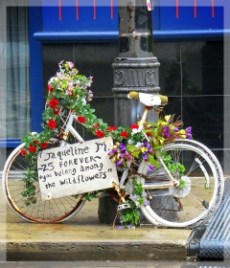 It’s often said that there are no atheists in foxholes. This maxim traces its beginnings back to 1914 and World War 1 when an English newspaper quoted a chaplain at a memorial service for a fallen soldier: “Tell the Territorials and soldiers at home that they must know God before they come to the front if they would face what lies before them. We have no atheists in the trenches. Men are not ashamed to say that, though they never prayed before, they pray now with all their hearts.” When we joined our northern church, it was during the Viet Nam War. I remember a young man in our new member class who’d drawn a low number in the draft lottery. Expecting to be in combat within the year, he confessed wanting to “get right” with God before that time came. Apparently, even the threat of a foxhole is enough to cause some people to rethink their relationship with the Almighty.
Whenever we pass a roadside memorial or ghost bike like the one in today’s picture, I’m reminded of the precariousness of life. There’s a memorial at a corner near us for a young man who died there several years ago. Decorated seasonally by family and friends, it’s a poignant reminder of how unexpectedly a life can be extinguished and how much he is missed. Unlike the fellow in our church class, that young man, the victim of a drunk driver who ran a red light, didn’t have a low lottery number to warn him how near to death he was.
“A funeral provides an indispensable perspective on the universally terminal condition,” said the Reformation Study Bible notes for today’s verses from Ecclesiastes 7. Indeed, everyone is born with the incurable disease of death. I’m of an age where the many notes of condolence I’ve written these last few months make me think I should buy sympathy cards in bulk. These are dark thoughts for an early spring day, yet far too many of us choose to ignore our inevitable fate. Death is the one appointment that none of us will miss. While we have little control over the when of that day, we do have control over how we choose to prepare for the inevitable.
In both this world and the next, what happens after we die depends entirely on what we do now. Once laid out in the mortuary, it’s too late to write a will or accept Jesus. When we’re placed in a casket, we won’t be able to mend fences or make amends and we’ll have missed the opportunity to get right with God. By the time we’re on the other side of the sod or turned to ash in a crematorium, we can’t express our love and forgiveness or decide to accept God’s saving grace.
The problem with foxhole conversions, of course, is that once out of the trenches, they rarely last. Moreover, if we don’t make it out alive, by waiting until the very end to accept Jesus, we’ve missed out on the abundant Kingdom life He offers that begins while we’re here. Getting right with God long before we enter either foxhole or hospice care seems to be the wiser choice. The good news for the saved is that dying doesn’t mean departing from the land of the living. For those who know Jesus, death means departing from the land of the dying for the land of the living.
Depend upon it, your dying hour will be the best hour you have ever known! Your last moment will be your richest moment, better than the day of your birth will be the day of your death. It shall be the beginning of heaven, the rising of a sun that shall go no more down forever! [Charles Spurgeon]

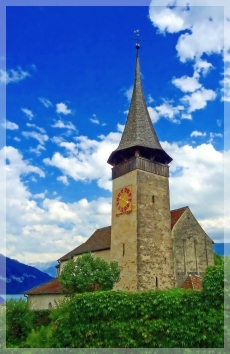 The cornerstone metaphor continues into the New Testament with both Paul and Peter referring to Jesus as the cornerstone of our faith. Nowadays, cornerstones are structurally unneeded and a growing number of commercial buildings no longer have them. Symbolic rather than functional, many serve as time capsules holding material relevant to the building and the year it was built. Because commercial buildings so frequently change hands, even the custom of inscribing the building’s name on a cornerstone is disappearing. The latest practice is a freestanding cornerstone/time capsule resting on a pedestal placed in a prominent part of the building. That way, a new stone can replace the old one every time the building’s owner changes.
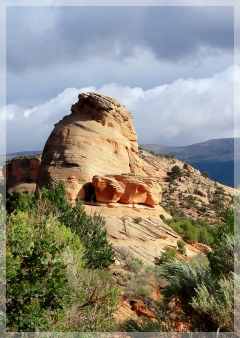 In the Old Testament, “cornerstone” as a metaphor for the Messiah is found in Psalms, Isaiah, and Zechariah. In Zechariah 10, the prophet describes Israel’s need for purification because of their idolatry, fortune-tellers, and false prophets. Holding the nation’s leaders responsible for these transgressions, Zechariah says the people are like lost sheep without a shepherd. Proclaiming the arrival of the ”Lord of Heaven’s Armies” who will look after the flock, the prophet says he’ll come from Judah and describes him as a cornerstone, tent peg, and battle bow.
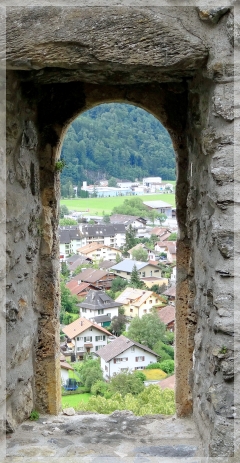 After telling the Parable of the Two Sons, Jesus told one about the Evil Farmers. As parables go, it’s pretty easy to follow. The landowner (God) builds a vineyard (Israel), sets up a protective wall (the Law), and leases it to tenant farmers (religious leaders). When he sends his emissaries (faithful priests and prophets) to collect his rent, the farmers ignored, mistreated and even killed them. The landowner, thinking the farmers would respect his son (Jesus), sends him to the vineyard. Wanting the estate for themselves, the farmers murder him. When Jesus asked his listeners (who were the chief priest and elders) what the landowner would do to the famers when he returns to his land, they responded that he’d kill the tenants and lease the vineyard to new farmers who would honor him with his share of the crop.
 “It’s all about getting a second chance!” said the back of the man’s T-shirt. I then saw the dog paws printed on both sides of the message and realized his shirt was advertising a dog rescue organization. Nevertheless, the shirt’s words made me think of the parable Jesus told the Pharisees about two sons. The vineyard owner told his sons to go work in the vineyard. The first son rudely refused but the second son respectfully promised he’d do the work. As it turned out, the defiant son had a change of heart and went to work in the vineyard while the second seemingly dutiful son never did. Jesus then asked the Pharisees which of the two sons had done his father’s will. Of course, they had to say that the first son, in spite of his initial rebellion, was the obedient one.
 Devotions of the Heart