THE MARBLE (Jonah – Part 4)

I am the LORD, the God of all the peoples of the world. Is anything too hard for me? [Jeremiah 32:27 (NLT)]

snowy egretWhen talking with my husband about the story of Jonah, he said that the fish story was a “little too hard to swallow”— too incredible to believe. Miracles! The Bible is full of them and, since they are supernatural events, they’re all hard to accept as true. Improbability is the nature of miracles. Along with the fish saving Jonah, the story is filled with other miracles: the immediate calming of the storm once Jonah was thrown in the sea, the deliverance of the prophet from the fish safely onto the beach, Nineveh’s immediate repentance, the appointment of the plant, worm and scorching east wind as teaching tools, and even God’s revelation of Himself directly to Jonah! Yet, if we believe the Bible is God-breathed and without error, we don’t have the privilege of picking and choosing which miracles we will believe and which ones we won’t. We have only one choice to make—all or none!

James Dobson tells a story of a prisoner locked in solitary confinement in a pitch-dark cell. Unknown to his jailers, he had a marble. The isolated man managed to maintain his sanity in the blackness by tossing the marble in the air and then finding it again by listening for the sound when it dropped. One day, after tossing the marble into the air, there was dead silence. Sure that the marble must have dropped somewhere, the prisoner asked, “How can that be?” He felt all along the floor but the marble wasn’t to be found. Every day he searched for the missing marble but, unable to solve the mystery, he lost his mind. After the crazed prisoner died, the guard turned on the lights as he entered the cell to remove the man’s body. High in the corner was a large heavy cobweb and, inside the web, was a brightly-colored marble. Looking up at it, the jailer asked, “How can that be?”

Although there was a clear answer to each man’s question, it was one neither man would ever know or understand. That’s our problem with miracles—there is an explanation but one that we never will comprehend. God can do things we can’t—things that we’ll never understand, not that we won’t try to unlock their mystery. Some people explain the parting of the Red Sea by saying the Jews actually waded through a “reed sea” in 6-inches of water. Their explanation falters, however, when they can’t explain how Pharaoh’s army managed to drown in a puddle. Some say that Moses knew the tides, in which case it is still a miracle that the Jews were there during low tide and the Egyptians were fool enough to cross at high tide. Others say a 63-mph wind was blowing that pushed back the water and exposed a land bridge for the Jews. Again, it’s a miracle that Moses was at the right place at exactly the right time to make a safe crossing and that the wind miraculously stopped at the perfect instant to flood the Egyptians.

The existence of a physical explanation for a miracle isn’t necessary and it is useless to expect one. We can’t dismiss the Bible’s miracles as fabricated tales of wonder or base our faith only on those acts of God that can be replicated. Just because something is beyond the scope of a scientific explanation or our limited understanding doesn’t mean it didn’t happen. God created the world and designed the laws of nature and He can follow or suspend those laws as He so chooses. God is God and we are not.

With more than 150 miracles recorded in the Bible, I’m not going to try explaining the how of Jonah being saved by a fish, three men emerging unscathed from a fiery furnace, manna appearing every morning, a widow’s never-ending supply of flour and oil, a burning bush that doesn’t incinerate, Lazarus rising from the dead, or any other Biblical miracle. Finding a logical explanation for what transcends science and nature can make us as crazy as the man with the disappearing marble.

Miracles are not contrary to nature, but only contrary to what we know about nature. [Saint Augustine]

Come and see what our God has done, what awesome miracles he performs for people! [Psalm 66:5 (NLT)]

Let each generation tell its children of your mighty acts; let them proclaim your power. I will meditate on your majestic, glorious splendor and your wonderful miracles. Your awe-inspiring deeds will be on every tongue; I will proclaim your greatness. [Psalm 145:4-6 (NLT)]

Copyright ©2022 jsjdevotions. All rights reserved.

NINEVEH’S FATE (Jonah – Part 3)

The Lord is a jealous God, filled with vengeance and rage. He takes revenge on all who oppose him and continues to rage against his enemies! The Lord is slow to get angry, but his power is great, and he never lets the guilty go unpunished. [Nahum 1:2-3 (NLT)]

Lucerne - city wall - museggmauerWhen God sent Jonah to the Assyrian capital of Nineveh, it was to warn the people that they would be destroyed for their sins. While we tend to focus on the miracle of Jonah and the sea creature, the real miracle in the Book of Jonah is the city’s response to the prophet’s message—Nineveh immediately repented of its sinful ways. Some forty years later, however, the Assyrians were once again back to their old behavior: rejecting God’s authority and worshipping idols. Around 740 BC, they attacked northern Israel and, in 722, they invaded the remaining kingdom and took Samaria, just as both Hosea and Amos had prophesized they would. The northern kingdom’s population was resettled elsewhere in the Assyrian Empire and Samaria became the center of a new Assyrian province.

Nineveh was located along the eastern bank of the Tigris River at what now is Mosul, Iraq. With a circumference of about 60 miles, it was an “exceedingly great city.” With over 1,500 towers and both an inner and outer wall, Nineveh was considered impregnable. That inner wall was over one hundred feet tall and thirty feet wide—an expanse that meant three chariots could ride side by side on it. Believing themselves invulnerable, the people of Nineveh put their faith in the city’s walls instead of God and fell back into their sinful ways. No matter their size, however, neither towers nor walls can protect us from God’s judgment!

Sometime between 663 and 612 BC, the Judean prophet Nahum pronounced God’s anger against Assyria and its capital city Nineveh. By this time, Assyria was the most powerful nation on earth with a reputation for brutality, torture, and oppression. Nahum warned that the Assyrians were being judged for their idolatry, pride, deceit, rebellion, cruelty, slaughter, and injustice. God had given them a chance, but now His patience was exhausted.  He was not about to allow Nineveh’s evil to continue. “What sorrow awaits Nineveh, the city of murder and lies!” declared Naham. [3:1]

In 612 BC, Nineveh was attacked by the Medes, Babylonians, and Scythians who drove the Assyrians out of the city. The city was completely destroyed—literally flattened to the ground and so thoroughly destroyed that archeologists didn’t even discover and identify its remains until the 1840s. The Assyrian empire came to an end and the Medes and Babylonians divided its provinces between them. Indeed, Naham’s prophetic words that, “You will have no more children to carry your name. … There is no healing for your wound; your injury is fatal,” were true. [1:14,3:19]

In Psalm 86:12, we read, “But you, O Lord, are a God merciful and gracious, slow to anger and abounding in steadfast love and faithfulness.” Indeed, God is slow to get angry and will always give His people a chance to repent and change as He did in Jonah’s day with the forty days He gave Nineveh. Let us not forget that Scripture also tells us that God will not let evil go unpunished. Nothing can protect us from His judgment. As Jonah learned, there is no place we can hide from the Lord and, as the people of Nineveh eventually learned, God will settle all accounts. Sin will not go unchecked forever and judgment will come. I don’t know about you, but I’d rather learn God’s lessons from the Bible than from personal experience!

The Lord is good, a strong refuge when trouble comes. He is close to those who trust in him. But he will sweep away his enemies in an overwhelming flood. He will pursue his foes into the darkness of night. [Nahum 1:7-8 (NLT)]

Copyright ©2022 jsjdevotions. All rights reserved

THE ABOUT-FACE (Jonah – Part 2)

Jeroboam II recovered the territories of Israel between Lebo-hamath and the Dead Sea, just as the Lord, the God of Israel, had promised through Jonah son of Amittai, the prophet from Gath-hepher. [2 Kings 14:25 (NLT)]

daisy fleabaneSince Nineveh was famous as the religious center for the worship of Ishtar (Astarte), the goddess of fertility, we might wonder why this pagan city repented after hearing Jonah’s prophecy? Jonah was an Israelite not an Assyrian—he believed in Jehovah and the people of Nineveh were pagans. Some speculate that the Ninevites had learned of Jonah’s miraculous delivery from the fish but Nineveh was about 500 miles from the sea and, since the fish delivered Jonah onto the beach, that seems highly unlikely! Was Jonah such an eloquent speaker that the heathen people of Nineveh would respond to him when, more often than not, the people of Judah and Israel ignored the words of warning they heard from the prophets who were their own countrymen? What caused the king and 120,000 of his subjects to make such an immediate turnaround?

Perhaps a little history lesson explains Nineveh’s response. We know from 2 Kings 14 that Jonah prophesized during the reign of Jeroboam II (793 – 753 BC). While Jeroboam II did “evil in the Lord’s sight,” he was the most notable and longest reigning king of the northern kingdom. For Israel, this was a time of prosperity, power, and military success. Scripture tells us that it was Jonah who prophesized the king’s victory in battles that restored the borders of the northern kingdom to what they were during Solomon’s time. With Jonah’s proven track record of fulfilled prophecies, perhaps his reputation preceded him.

Moreover, in the realm of international politics, while Israel was on the upswing, Assyria was in decline. Having fragmented into various governor-ruled states, there had been a series of rebellions and attempts to usurp the crown. Preoccupied with internal security, the nation also was threatened by the kingdom of Uratu to the north and powerful Israel to the south. When Jonah proclaimed the city’s destruction, he wasn’t talking about an earthquake. The word he used was haphak which meant overthrown or conquered. Considering the political climate at the time, being conquered seemed a likely possibility to Nineveh and its king. Known for their excessive brutality, few armies were as hated as the Assyrians. Perhaps, when facing the possibility of being conquered, the Ninevites repented in the hope they’d escape such merciless treatment at the hands of their conquerors. Putting the story of Jonah’s prophecy into historical context helps us understand Nineveh’s response to the reluctant prophet and why they believed God’s message. Upon learning that their city would be overthrown within forty days, they proclaimed a fast, donned sackcloth as a symbol of their contriteness and remorse, and repented of their wicked ways. In the story of Jonah, we see God’s mercy extended to Gentiles and a concealed prophecy that was fulfilled by Jesus.

Without even seeing the miracle of Jonah’s “resurrection” from the fish, 120,000 Ninevites were saved but, when someone “greater than Jonah” resurrected, His own countrymen refused to listen and believe—even after seeing the empty tomb! Comparing Jesus to Jonah, however, is a bit like comparing the sun to a match or the entire universe to a tiny pebble. We’ve been warned, “Repent of your sins and turn to God, for the Kingdom of Heaven is near.” [Matthew 4:17] What is our response?

But Jesus replied, “Only an evil, adulterous generation would demand a miraculous sign; but the only sign I will give them is the sign of the prophet Jonah. For as Jonah was in the belly of the great fish for three days and three nights, so will the Son of Man be in the heart of the earth for three days and three nights. The people of Nineveh will stand up against this generation on judgment day and condemn it, for they repented of their sins at the preaching of Jonah. Now someone greater than Jonah is here—but you refuse to repent.” [Matthew 12:39-41 (NLT)]

Copyright ©2022 jsjdevotions. All rights reserved.

THE RELUCTANT PROPHET (Jonah – Part 1)

I knew that you are a merciful and compassionate God, slow to get angry and filled with unfailing love. You are eager to turn back from destroying people. … The Lord replied, “Is it right for you to be angry about this?” [Jonah 4:2,4 (NLT)]

sunrise on the GulfThe first thing to clear up when writing about the Book of Jonah is whether it was a fish or a whale. Both the Hebrew word (dahg) and the Greek word (ketos) in later translations were used to describe this sea creature. In 785 BC, at the time of this story’s writing, neither language had a word that could identify the exact species so it could have been a fish, shark, whale or some other now extinct large sea creature. For those who choose to use this discrepancy to attack the Bible’s veracity, it’s probably wise to remember that Linnaeus’ classification of living things occurred in the 18th century and not 2,800 years ago when Jonah was swallowed by something huge in the sea. When learning the story in Sunday school, most of us were told it was a whale. Having seen Disney’s Pinocchio with Geppetto living in a whale’s belly, it was easy to picture Jonah doing the same.
When God told Jonah to prophesy God’s judgment to the people of Nineveh, a powerful and wicked city in Assyria, the prophet immediately set sail in the opposite direction to Tarshish. God sent a great storm that threatened his ship and everyone else on it. Knowing the storm was his fault, the prophet told the crew to save themselves by throwing him into the sea. Once done, the storm immediately ceased and Jonah was swallowed by a great nameless sea creature. Unlike Geppetto, Jonah didn’t build a fire to escape. Instead, he prayed to God, repented his disobedience, and miraculously was delivered onto the beach. My Sunday school lesson ended at that point with the message that there is no hiding from God. There is, however, far more to the story.

Although Nineveh was a powerful and wicked city, Jonah didn’t run away because he was afraid for his own safety or that his message would be rejected. He was afraid that the people of Nineveh actually might listen to God’s word, repent and be saved! His contemporaries were the prophets Amos and Hosea—men who prophesized that Israel would be conquered, exiled, and forced to serve Assyria. Why would Jonah want to save the very people who eventually would defeat his nation?

Once safely on the beach, God again told Jonah to deliver His message to Nineveh and this time Jonah reluctantly obeyed. After being told that within forty days their city would be destroyed, the Ninevites immediately repented of their wicked ways but, instead of being pleased about their salvation, Jonah was angry. He threw himself a pity-party because God would not destroy the city. Although God mercifully gave Jonah a second chance when he repented, Jonah didn’t want to share God’s mercy and forgiveness with his enemies.

With one more lesson for Jonah to learn, God planted a leafy plant above his head to shade the despondent prophet as he waited to see what would happen to the once sinful city. Grateful for the shade, Jonah became upset when God caused a worm to destroy the tree and a scorching east wind to blow. God pointed out that Jonah was angry about the death of a tree he never planted and then asked a question. “Nineveh has more than 120,000 people living in spiritual darkness…Shouldn’t I feel sorry for such a great city?” [4:11]

Jonah begrudged God’s mercy shown to a hostile pagan nation. Sometimes we are like Jonah—although we want to be saved, we want to see our enemies suffer and be punished. While we want God’s love, mercy, forgiveness, and compassion, we’re not willing to share it with the people who have hurt us. This story was a lesson for Israel—that their purpose was to be a blessing to all nations by sharing God’s message—and later a lesson for the church—that Jesus’ came to save Jew and Gentile alike. Let’s remember that Jesus isn’t our own private savior; He’s meant to be shared. We all belong to Him and His mercy is a gift for everyone and anyone who repents and believes.

If I announce that a certain nation or kingdom is to be uprooted, torn down, and destroyed, but then that nation renounces its evil ways, I will not destroy it as I had planned. And if I announce that I will plant and build up a certain nation or kingdom, but then that nation turns to evil and refuses to obey me, I will not bless it as I said I would. [Jeremiah 18:7-10 (NLT)]

Copyright ©2022 jsjdevotions. All rights reserved

SIFTING

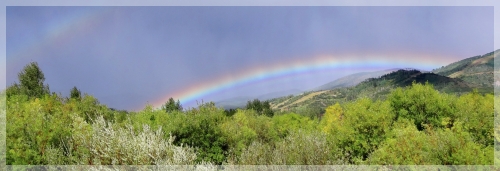
rainbow over SteamboatSimon, Simon, Satan has asked to sift each of you like wheat. But I have pleaded in prayer for you, Simon, that your faith should not fail. So when you have repented and turned to me again, strengthen your brothers. [Luke 22:31-32 (NLT)]

I have told you all this so that you may have peace in me. Here on earth you will have many trials and sorrows. But take heart, because I have overcome the world.” [John 16:33 (NLT)]

‘Cause what if Your blessings come through raindrops?
What if Your healing comes through tears?
And what if a thousand sleepless nights are what it takes to know You’re near?
What if my greatest disappointments or the aching of this life
Is the revealing of a greater thirst this world can’t satisfy?
And what if trials of this life-
The rain, the storms, the hardest nights
Are Your mercies in disguise? [Laura Story]

One of the benefits of my thrice weekly PT appointments for the last several months has been the time I spend alone in the car with the radio tuned to the Message on SiriusXM. Sometimes I uninhibitedly sing along with the contemporary Christian praise music and other times I quietly ponder the songs’ words. As I listened to Laura Story’s song “Blessings,” I pondered the many storms, tears, disappointment, and sleepless nights that turned out to be God’s “mercies in disguise.”

In 2006, just two years into her marriage, Laura Story nearly lost her husband to a brain tumor. Although he survived, disabilities remained from his surgery and the future once envisioned by the young couple changed significantly. Among other things, instead of being a stay-at-home mother, Story became breadwinner and caregiver. Her song “Blessings” was written as a reminder that God remains faithful even when things don’t turn out the way we envisioned. “Life is filled with things you don’t expect, but the Bible tells us to respond by trusting God and continuing to worship Him,” said the singer/songwriter. “God has grown us up, deepened our faith, our awareness of our great need for Him as a savior, daily.”

We’ve all experienced those unexpected and uninvited changes—the storms of life—that necessitate changing our expectations and revising our concept of normal. One such event happened in my life fourteen years ago. The details are unimportant but, as I listened to Story’s song, I saw how it was, indeed, a blessing in disguise. At the time, I mourned the end of a dream—the loss of what I envisioned in the future for myself and my family. But, as weeks stretched into months and months into years, the old vision was laid to rest. I wasn’t the only one affected and everyone in that storm lost something as it rained down on us. Nevertheless, just as Jesus was with the disciples in the midst of that storm on the Sea of Galilee, He was with me in that storm, and He will be with us in the storms to come.

When Jesus warned Peter that he’d be run through the sifter, He was telling the disciple that he’d be going through an ordeal and put to the test—a test that would separate the grain from the chaff—the good from the bad. For me, those years were a long season of sifting—sorting out priorities, persevering with what seemed like unanswered prayers, dealing with hardened hearts, accepting what I couldn’t change, learning to step back and allow God to do His work, and trusting the future to Him. It actually was a season of sifting for all involved as resentment and bitterness were separated from forgiveness, animosity from love, doubt from faith, weakness from strength, anger from understanding, excuses from accountability, fear from courage, and deceit from truth.

Years later, after plenty of sifting and what Paul would call character strengthening, the storm abated and we finally saw the rainbow at its end. Granted, life is not the same as it was but that doesn’t mean that it isn’t good and probably even better because of that storm.

As it turns out, I now can call one of the darkest times of my life a true blessing and I think the others affected would agree. Of course, the end of one storm doesn’t mean there won’t be others. Nevertheless, we can face them with confidence because, like Laura Story, we’ve learned that the “trials of this life—the rain, the storms, the hardest nights” can be God’s “mercies in disguise.”

We can rejoice, too, when we run into problems and trials, for we know that they help us develop endurance. And endurance develops strength of character, and character strengthens our confident hope of salvation. And this hope will not lead to disappointment. For we know how dearly God loves us, because he has given us the Holy Spirit to fill our hearts with his love. [Romans 5:3-5 (NLT)]

Copyright ©2021 jsjdevotions. All rights reserved.

SIBLINGS

And when they were in the field, Cain rose up against his brother Abel and killed him. Then the Lord said to Cain, “Where is Abel your brother?” He said, “I do not know; am I my brother’s keeper?” [Genesis 4:8-9 (ESV)]

brothersThe story is told of a Sunday school teacher who was teaching her class about the Ten Commandments. “What is the commandment about parents?” she asked. “Honor thy father and mother,” was the quick reply. “Is there a commandment about brothers and sisters?” the teacher queried. One little boy shouted, “Thou shalt not kill!” While we know we’re not supposed to kill them, how should we treat them?

When we look at sibling relationships in the Bible, we don’t see a lot of good examples. Starting with Cain and Abel, Cain’s anger over God’s acceptance of Abel’s offering led to the Bible’s first homicide. When Ishmael teased his younger half-brother Isaac, he and his mother were evicted from Abraham’s home. Then we have sisters Leah and Rachel who continually competed for Jacob’s attention. The twins Jacob and Esau were at odds from birth and, after stealing his brother’s birthright, Jacob had to flee for his life. Resentment and jealousy caused Miriam and Aaron to complain about Moses’ leadership, jealousy led Joseph’s brothers to sell him into slavery, and after Jehoram became king, he killed all six of his brothers. David’s brothers didn’t respect him, Martha and Mary had disagreements about priorities, and Jesus’ brothers failed to believe in Him at first. Among the disciples, Peter and Andrew were brothers as were James and John, but we know that the disciples argued about which of them was the greatest! Clearly, sibling rivalry, jealousy, and conflict has a long history in mankind.

Siblings can be one of the greatest blessings in life but they also pose one of the greatest challenges of childhood. Even as adults, sibling relationships can be difficult to navigate. We know each other’s weaknesses and fears; we know what upset our siblings in the past and what buttons to push to annoy them now. We often know each other’s deepest secrets and most embarrassing moments and, unfortunately, can wield that information like a sword. Siblings easily can be tactless, rude, and cruel with one another in a way they’d never be with their friends. When we’re with siblings, we may even revert to old roles and behaviors from our childhood days.

While siblings share parentage and history, true brothers and sisters share far more than genetics and memories. If we want to have brothers and sisters, instead of just siblings, we might look to the example of Joseph who saved the lives of the same brothers who betrayed and abandoned him! He literally became his brothers’ keeper.

In spite of whatever happened in the past, if we want brothers and sisters, we need to relinquish any long-buried resentment and practice forgiveness (along with a fair amount of forgetfulness). When siblings disappoint as they inevitably will (as will we), our love will keep us from despairing in or giving up on them. An accident of birth may give us siblings but there’s nothing accidental about choosing to love and it is choosing to love that turns a sibling into a brother or sister.

When Cain asked God, “Am I my brother’s keeper?” the Hebrew word was hashomer. From the root word shamar, it meant protector, guardian, defender, and caretaker. What do you think God’s answer was?

Do not nurse hatred in your heart for any of your relatives. [Leviticus 19:17a (NLT)]

Love each other with genuine affection, and take delight in honoring each other. … Do all that you can to live in peace with everyone. [Romans 12:10,18 (NLT)]

Copyright ©2022 jsjdevotions. All rights reserved