
 This is the Lord’s doing, and it is wonderful to see. This is the day the Lord has made. We will rejoice and be glad in it. [Psalm 118:23-24 (NLT)]
My biggest fear is waking up to find what matters
Is miles away from what I spent my life chasing after.
Is my story gonna have the same two words in every chapter?
What if, what if? …
What if today’s the only day I got?
I don’t wanna waste it if it’s my last shot.
No regrets, in the end
I wanna know I got no what ifs! [Matthew West]
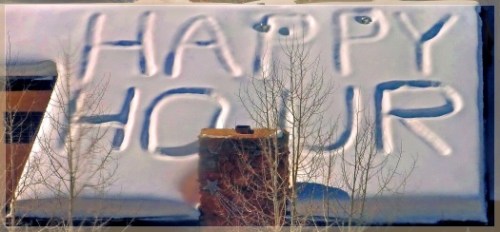
While enjoying discounted drinks and small plates during a local “happy hour” with our old skiing buddies, we reminisced about the many happy hours we spent together in Colorado. One of our favorite lunch (and “happy hour”) spots used to publicize their “happy hour” by spelling out the words in the snow on their rooftop. Since the pub was located right beneath the gondola, skiers couldn’t avoid seeing the message as they rode up the mountain. Tourists would speculate how the words got there and most assumed there were specially placed heat tapes beneath the letters. The letters, however, were carefully stomped out after every major snowfall by a friend who had more enthusiasm than common sense as he jumped from letter to letter on the sloped roof.
For many of us, “happy hour” probably means discounted, beer, wine and cocktails, half-price appetizers, and maybe some entertainment between the hours of 4 and 7. But, is a happy hour really about three hours of discounted drinks and food or a great band?
Today, while listening to Matthew West sing, “What if today’s the only day I got? I don’t wanna waste it if it’s my last shot!” I pondered what makes any of our hours truly happy ones. It certainly isn’t cheap drinks and food! What kinds of things would an hour of happiness encompass? If you had only a few hours remaining in life, how would you spend them? What would you do to make that hour a happy one? I doubt you would spend them eating and drinking in a bar.
Henry Ward Beecher said, “The art of being happy lies in the power of extracting happiness from common things.” I have to agree. When I think about happiness, my happy hour includes things like God, family, friends, peace, service, generosity, love, hope, faith, worship, salvation, smiles, hugs, laughter, a few silly games with the grands, and maybe a butterfly or two. There are no discounted drinks, chicken wings, peanuts, popcorn, guacamole, salsa, or chips in the scenario because they have nothing to do with true happiness and joy. Also missing from that picture are things like wealth, success, and fame along with quarrels, resentment, conflict, anger, regret, guilt, heartache, disdain, bitterness, fear, hatred, and animosity. In short, a happy hour is one spent in gratitude. It was gratitude for all that God gave us, not the discounted drinks, appies, or sunshine and powdery snow, that made those hours so enjoyable back in Colorado and continue to do so in Florida!
The man who stomped out those letters on the rooftop? When in his mid-forties, his hours were unexpectedly cut short by a freak accident. I’m sure his family would agree that happy hours should never be limited to a few hours at the end of the day. How will we choose to spend whatever is left of our hours to make them happy ones—the kind of hours truly worth having and remembering? After all, today could be our “last shot!”
Do not look back on happiness, or dream of it in the future. You are only sure of today; do not let yourself be cheated out of it. [Henry Ward Beecher]
 Recently, long-time friends visited for a few days. They used to live across the street from us when we wintered in Colorado but, like us, their skis are long gone. The memories, however, are still fresh. As happens with old friends, we started reminiscing about blue bird days on the mountain, making first tracks down a slope of fresh powder, our favorite runs (for one person it was the “lunch run”), winter carnivals, and the people who made our mountain town so special.
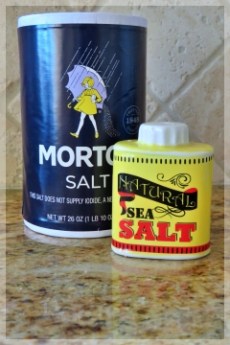 Today, when someone is called the “salt of the earth,” the speaker probably means he or she is a dependable, unpretentious and honest person—someone of moral integrity. That is well and good as far as it goes, but Jesus meant more than that when He called us to be “the salt of the earth.”
 Eighteen years after the kingdom divided and Jeroboam became king of the northern kingdom of Israel, Rehoboam’s son Abijah became king of Judah, the southern kingdom. As Solomon’s grandson and David’s great-grandson, Abijah was part of David’s dynasty; Jeroboam was not. Although 1 Kings called Abijah a sinner, 2 Chronicles recorded the one highpoint of his short reign. War broke out between Israel and Judah and Judah’s warriors were outnumbered two to one. As the two kings squared off, Abijah shouted out to Jeroboam and his army. Referring to the “covenant of salt” between God and David, Abijah called Jeroboam a traitor, his men scoundrels, and charged Israel with rebellion against the Lord’s chosen Davidic dynasty of kings. Their rebellion hadn’t been against Solomon or Rehoboam; they’d rebelled against the kingdom of the Lord! Continuing with his tirade, Abijah charged the northern kingdom with apostasy because of their idolatry and illegitimate priests. After pointing to Judah’s faithful worship, he warned Israel they would not succeed because God was with Judah. Indeed, in spite of overwhelming odds, Scripture tells us “God routed Jeroboam and all Israel” and the Judeans were victorious because they “relied on the Lord, the God of their ancestors.”
 For many in the Christian community, last Wednesday marked the beginning of Lent, a season in remembrance of the forty days Jesus fasted in the wilderness and was tempted by Satan. For them, Lent is a penitential season of repentance, fasting, and self-denial leading up to Easter. The idea of fasting as a form of preparation for Resurrection Sunday comes from Jesus’ statement, “But the time will come when the bridegroom is taken away from them; and when that day comes, they will fast,” found in Mark 2:20.
 When talking with my husband about the story of Jonah, he said that the fish story was a “little too hard to swallow”— too incredible to believe. Miracles! The Bible is full of them and, since they are supernatural events, they’re all hard to accept as true. Improbability is the nature of miracles. Along with the fish saving Jonah, the story is filled with other miracles: the immediate calming of the storm once Jonah was thrown in the sea, the deliverance of the prophet from the fish safely onto the beach, Nineveh’s immediate repentance, the appointment of the plant, worm and scorching east wind as teaching tools, and even God’s revelation of Himself directly to Jonah! Yet, if we believe the Bible is God-breathed and without error, we don’t have the privilege of picking and choosing which miracles we will believe and which ones we won’t. We have only one choice to make—all or none!
 Devotions of the Heart