
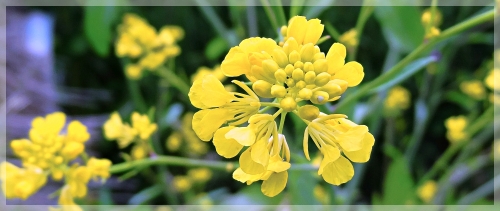
The Kingdom of Heaven is like a mustard seed planted in a field. It is the smallest of all seeds, but it becomes the largest of garden plants; it grows into a tree, and birds come and make nests in its branches. [Matthew 13:31-32 (NLT)]
Following the Parable of the Four Soils and the Parable of the Weeds, Jesus told a third parable of growth by comparing the Kingdom of Heaven to a mustard seed. I know little about farming and soil but I’m familiar with black mustard, (Brassica nigra), the kind of mustard grown in Palestine in Jesus’ day. Its clusters of bright yellow flowers are a common sight in the meadows, thickets, vacant lots, and fallow fields in my home state of Illinois.
Both times Jesus mentioned the mustard seed, He referred to its small size. When comparing the size of our faith to that of a mustard seed, He told us even if our faith were as small as a mustard seed that, “Nothing would be impossible.” When comparing the Kingdom of Heaven to a mustard seed, He called it the “smallest of all seeds.” Having admired the mustard seed charm my sister had on her bracelet, I questioned His statement. While it was small, I knew other seeds are even smaller. Surely the One who was there at creation’s beginning knew that the almost dust-like seeds of orchids and begonias are smaller. Additionally, while the mustard plant can grow as tall as 10 to 12 feet, it’s not a tree!
Jesus, however, wasn’t teaching botany, He was telling a parable and hyperbole (an exaggerated statement not taken literally that’s used to emphasize a point) was a common technique in rabbinic teaching. Jesus used it when speaking of recognizing a speck in our neighbor’s eye but not seeing the log in ours, Pharisees straining the gnats out of their water while drinking a camel, and trying to put a camel through a needle. When we look at the original Greek, however, we find less exaggeration. Jesus refers to the mustard seed as the smallest seed which a man sows in his field. While not the smallest seed in existence, mustard was the smallest seed that would have been sown in a Palestinian field. Jesus says it grows larger than a lachanōn (a garden herb or vegetable) and, indeed, black mustard does seem like a tree when compared to most herbs! That a seed measuring less than a tenth of an inch can grow 1,440 times its original size into a 12-foot plant in just one season is impressive and that was His point!
While most of America’s farmers consider this pervasive plant a noxious weed, it’s been cultivated as a crop for thousands of years in the Holy Land. Its seeds were powdered or made into a paste for medicinal and culinary purposes. Unlike most of us, Jesus’ listeners were familiar with mustard’s characteristics. As I describe those qualities, consider how they might apply to God’s Kingdom here on earth.
With its narrow clusters of small yellow flowers, mustard isn’t a showy flower—one might even call it a humble little thing. Nevertheless, a golden field of mustard is a thing of beauty. For a variety of scientific reasons, black mustard has a competitive advantage over most other plants. It’s one of the first plants to spring up after a fire and can out-compete anything else growing in the same field. It produces thousands of seeds every season and mustard’s long-lasting seeds can survive underground for as long as 50 years. An annual, while it dies at the end of a season, it regenerates at the next rainy season.
Although mustard was welcome as a cash crop in Palestine, because of its characteristics, black mustard is considered invasive in 44 of the 48 contiguous states. Nevertheless, in spite of the Midwest’s farmers’ persistent efforts to eradicate it, black mustard returns every year. Nature Collective describes it as “an ornery guest that refuses to take the hint.” In spite of persecution from Jewish leaders and Rome, the early church was just as defiant, determined, and persistent as black mustard!
Jesus’ listeners would have been familiar with the plant’s beauty and ability to self-seed, lay down a deep root system, and grow almost anywhere, along with mustard’s knack of surviving and thriving in less-than-ideal conditions. Jesus’ point was that from small and humble beginnings, the Kingdom of Heaven—Jesus’ domain as Messiah—would gradually grow into a large and beautiful entity. Once seeded, nothing seems to stop mustard and the same goes for the Kingdom!
May our faith be as persistent, hardy, determined, steadfast, and as difficult to destroy as the mustard seed!
 Following the Parable of the Sower and the Soils, Jesus told another parable about the coming of the Kingdom. In the Parable of the Weeds, after the farmer plants wheat, his enemy sows weeds in the same field. Jesus’ hearers would have known the weed likely was darnel. Called wheat’s “evil twin,” it looks and behaves much like wheat. When wheat is consumed it gives life but, when darnel is consumed, this inedible look-alike causes nausea and even death. Sowing weeds in a field was an act of sabotage and Roman law specifically prohibited doing so with darnel. When nations went to war, agricultural vandalism was a common practice. Olive trees were cut down, grape vines destroyed, and fields were salted so nothing would grow.
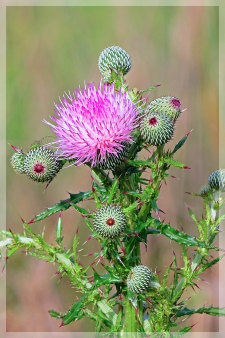
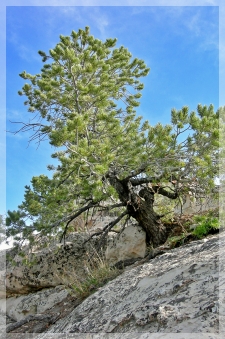 The Synoptic gospels (Matthew, Mark, and Luke) all repeat Jesus’ parable of the Sower and the Soils. As the farmer sows his seeds, some lands on the packed soil along the footpath. The birds steal the seeds so nothing takes root. Some seeds land on a thin layer of dirt over underlying rock. Although the seeds quickly sprout, without deep roots, they wither and die. Other seeds land among the thistles and thorns. Although they take root, the fast-growing weeds crowd them out. Only the seeds that fall on fertile soil take firm root, grow into maturity, and bear fruit. Rather than teaching Agriculture 101, by comparing those soils to the various ways God’s message is received, Jesus was teaching about evangelism.
 I appeal to you, dear brothers and sisters, by the authority of our Lord Jesus Christ, to live in harmony with each other. Let there be no divisions in the church. Rather, be of one mind, united in thought and purpose. [1 Corinthians 1:10 (NLT)]
 By now, the visiting family has returned home; the jelly beans, Peeps, and chocolate eggs have been eaten; the Easter lily has wilted; the baskets and bunny décor are back in their boxes; and the hardboiled eggs are long gone. While Easter has been put away for another year, its message didn’t end with the resurrection.
 As a way of emphasizing the penitential nature of Lent, hymns with alleluia or hallelujah were not sung at our church during Lent’s forty days. With the exception of Palm Sunday’s All Glory, Laud, and Honor, the hymns for the last six weeks were rather slow, somber, and introspective and I missed the more joyful upbeat hymns I enjoy. Easter service, however, opened with Christ the Lord is Risen Today and the twenty “Alleluias” we sang in five verses made up for their long absence.
 Devotions of the Heart