JEPHTHAH’S VOW (Judges 11 – Part 1)

Don’t trap yourself by making a rash promise to God and only later counting the cost. [Proverbs 20:25 (NLT)]

oleanderOne of the most disturbing stories in the Bible is found in Judges 11. Before leading the army into battle with the Ammonites, Jephthah made a rash vow to the Lord—if given victory, he’d make a burnt sacrifice of the first thing to come out of his house to meet him upon his return. God granted Israel victory but, when Jephthah returned home, it was his daughter who came out to greet him. When the anguished Jephthah told her of his vow, the girl willingly accepted her fate. She only asked for one thing—to go into the hills with her friends to mourn that she’d never marry or know the joy of motherhood. When she returned, “her father kept the vow he had made and she died a virgin.”

Vows before a battle were not unusual, but Jephthah’s wasn’t typical. First, his motive was selfish. A victory meant personal power for this man. Having been denied his rightful inheritance and banished from the land, Jephthah only agreed to lead the army after the elders promised that he’d rule over Gilead if victorious. Although Jephthah’s reckless vow specified a burnt offering, it didn’t specify what it would be. In their Midrash commentaries, the rabbis asked what he would have done had it been an unclean animal like a camel, ass, or dog. Moreover, although his house included rooms for the animals, livestock usually didn’t greet people coming back from war, people did! Either the impulsive man didn’t consider the possibility it could be a person or that didn’t bother him.

Although a vow could be a sign of surrender to God in faith, Jephthah’s was abhorrent to the Lord. Rather than surrendering his fate to God, Jephthah was making a bargain with Him. Like Jephthah, do we ever bargain with God? Promising that if He does His part then we’ll do ours isn’t submission to Him—it’s manipulation and God can’t be manipulated. Moreover, there’s nothing we could offer God that could obligate Him to us in any way. By putting a price tag on His grace, we’ve insulted him by cheapening that grace. This appalling story reminds us that there are tragic consequences when religion is reduced to deal-making with God.

Offerings were supposed to be made joyfully but Jephthah’s vow meant he was willing to suffer if the Lord gave him victory. Although God firmly rejected human sacrifice in both Leviticus and Deuteronomy, Jephthah had a pagan’s understanding of Jehovah and was willing to do anything to guarantee Israel’s victory. During this time, when “all the people did whatever seemed right in their own eyes,” the Israelites were worshipping more than the Lord. They also were serving the pagan gods of the Canaanites. Human sacrifices to those gods were routine and Jephthah’s rash vow indicates his willingness to make a human sacrifice to become Gilead’s ruler.

Starting in Judges first chapter, when the people fail to drive the Canaanites from the land, the book describes Israel’s failures. By the second chapter, they’re already serving Baal and Ashtoreth. Although Deborah was the best of the bunch, the character of the judges deteriorates bit by bit until their story ends with rape, murder, and civil war! The entire book suggests that, rather than rejecting the idolatry and practices of the pagan people surrounding them, Israel adopted them. The story of Jephthah’s sacrifice of his daughter is meant to be horrible and shocking because it is the quintessential example of what happens if we do what’s right in our own eyes. When we do whatever seems right in our own eyes, we soon end up doing what is evil in the eyes of God—with nothing but tragic consequences!

In those days Israel had no king; All the people did whatever was right in their own eyes. [Judges 17:6 (NLT)]

Copyright ©2023 jsjdevotions. All rights reserved.

CONVERSATIONS WITH ESHA (2) – ONLY ONE WAY

Enter by the narrow gate. For the gate is wide and the way is easy that leads to destruction, and those who enter by it are many. For the gate is narrow and the way is hard that leads to life, and those who find it are few. [Matthew 7:13-14 (ESV)]

one wayLike Christians, Hindus believe that, when the body dies, the soul does not. Unlike Christians, however, Hindus believe that, after death, the soul lives on in an astral body until it is reborn in another physical body. This cycle is continually repeated until the soul reaches a certain state of perfection (moksha) and is released from the bondage of birth and death. At that time, like a drop of water that eventually merges into the ocean, the soul will finally merge into God and become one with its creator. Of course, once absorbed by the sea, the drop would cease to exist.
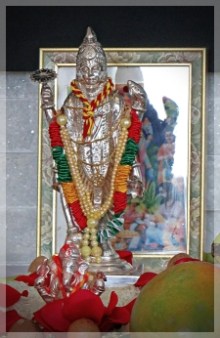
Rather than being absorbed into the Supreme Being, when Christians die, their souls immediately enter into God’s presence and, at the resurrection of believers, their new bodies will be raised and reunited with their souls. Non-believers, however, do not end well and the parable of the rich man and Lazarus makes it clear that they don’t get to return to earth for another go-around. If there’s any doubt, Hebrews 9:27 tell us that, “each person is destined to die once and after that comes judgment.”

In spite of Hinduism’s belief in reincarnation and moksha, perhaps the biggest difference between my friend Esha’s religion and Christianity is that, while she finds Christianity a valid religion, as a Christian, I cannot say the same for Hinduism. Today, Esha used an analogy to explain the universalism of Hinduism. Just as we can get into Disney World from all directions and eight different entrances, she believes there are many equally acceptable routes and gateways to God. Instead of all roads leading to Rome, all roads lead to God. I respectfully disagreed but recalled her analogy later that day when sending a friend directions to my house.

While people can come to my community from all directions, they can enter from only one road, must go in through one gate, and are required to have their name on a list to be admitted. That’s a little more like the one way and narrow gate of Christianity. Esha is correct that Disney World has several entrances, but Jesus made it clear that there only is one entrance into heaven and getting to that entrance depends on taking the right road. Fortunately, God allows U-turns. Just because we started on the wrong path doesn’t mean we have to end in the wrong place.

Nevertheless, there’s a sense of urgency in Jesus’ words in today’s verse. The verb form for the word translated as “enter” was what scholars call the “aorist imperative.” It was used for urgent, positive, one-time commands (which is why some translations say “stive to enter”). Jesus was emphatically telling people not to procrastinate or sight-see before getting on the right road. No one knows when their engine will fail or Jesus will return. While Hinduism maintains that people get multiple opportunities to do life right, Jesus tells us we have only one life in which to get on the right road!

All religions are not paths to the same end for the simple reason that religions with distinct mutually exclusive doctrines like Christianity, Hinduism, Buddhism, and Islam cannot all be valid! Either Jesus was right when He claimed to be the only path to God or He was wrong! While it sounds like spiritual elitism to say that Christianity is the only way, it’s more like simple arithmetic—there can’t be two right answers! Where there is contradiction, there is error.

Christ’s narrow gate has nothing to do with bigotry, discrimination, or a rating system of people or works. When it comes to entering His Kingdom, the gate isn’t wide enough to accommodate any other philosophy or belief; there’s no wiggle room. The narrow gate has one very specific requirement for entrance—faith in Jesus Christ! That’s the only way to get one’s name on the entrance list. With only one correct road, one narrow gate, and one Lord and Savior, Christianity is exclusive. Nevertheless, because the path to eternal life is open to anyone who asks and believes, Christianity is inclusive! All are invited; sadly, not all will enter.

Which way are you going? What road are you on?

Since no man is excluded from calling upon God, the gate of salvation is open to all. There is nothing else to hinder us from entering, but our own unbelief. [John Calvin]

Jesus said to him, “I am the way, and the truth, and the life. No one comes to the Father except through me. [John 14:6 (ESV)]

There is salvation in no one else! God has given no other name under heaven by which we must be saved. [Acts 4:12 (ESV)]

Copyright ©2023 jsjdevotions. All rights reserved.

CONVERSATIONS WITH ESHA (1) – IT’S NOT ALL THE SAME

There may be so-called gods both in heaven and on earth, and some people actually worship many gods and many lords. But for us, there is one God, the Father, by whom all things were created, and for whom we live. And there is one Lord, Jesus Christ, through whom all things were created, and through whom we live. [1 Corinthians 8:5-6 (NLT)]

I recently met Esha while walking and we occasionally stop to chat. Although the bindi (mark) on her forehead told me she is a Hindu and the cross I wear told her I am Christian, our different faiths have not prevented us from talking about God and our beliefs. My younger son’s marriage brought many Hindus into our extended family and I try to understand this complicated religion.

When talking with my Hindu friends like Esha, they often say, “It’s all the same God.” While there is, indeed, only one God, the true God is not the one about whom they speak. Esha, like most Hindus, believes in one supreme god (often called Brahman) who manifests himself in a sort of hierarchy of lesser gods. Different Hindus worship different gods according to their own needs and perspective. One person may worship Ganesha while another Vishnu or Shiva.

Christians, however, believe that there is just one God and, as diverse as Christians are, we all worship the same God. While God is one in essence, He has three persons: God the Father, God the Son, and God the Holy Spirit. As Father, He is creator of all things, all-powerful and all-knowing; as Son, He is Jesus Christ: God in human form who lived on earth; and, as Holy Spirit, He is invisible, yet present in people and across the world. These three persons, however, are not lesser gods or worshipped apart from one another. While each personage is distinct and fully and completely God, they are simultaneously and eternally just one. Christians worship one true God who eternally exists as Father, Son, and Holy Spirit.

Although most Hindus see their supreme god as genderless, the lesser gods are viewed as being male, female, androgynous, or even gender-fluid. Although God presented as a man with Jesus’ incarnation, God is a spirit and, as such, has no bodily parts, size, or weight. In spite of speaking of God as “our Father” and referring to Him with male pronouns, God is genderless. That we’re created in God’s image doesn’t refer to His physical characteristics. We are made in God’s image because He endowed us with His spiritual characteristics—we have mind, intellect, emotions, will, and moral capacity.

My friend Esha often speaks of God being everywhere and we agree on that point. God is omnipresent. He is everywhere all at once—throughout the entire universe—from the deepest depths of the ocean to beyond the farthest star known to man! He fills every part of heaven and earth with His holy presence. While there is no place God does not inhabit, Esha and I disagree on exactly how God does that. As a Hindu, she believes that God is in everything and everything is in God. To her, God is some sort of transcendent force or energy. Since this energy inhabits the universe, the universe is God and anything found in the universe is God. As a result, if the universe should cease to exist, so would God.

While Esha and I agree on God’s omnipresence, we disagree on His nature. Rather than  some sort of supernatural force or energy, God is a being! While evidence of God’s character and magnificence is found in His creation, He is as distinct from His creation as a painter is from his painting. God doesn’t need the universe to exist. As its creator, God would exist even if the universe ceased to exist!

There is only one true God, but the gods of faiths like Hinduism, Islam, Jainism, Confucianism, and a host of other isms are not Him! That does not mean that we can’t be friends and respectful of one another’s beliefs. Let us remember that the same God made us and, regardless of our beliefs, we all are God’s children. Nevertheless, let’s never fall for the line that “It’s all the same God!” when it isn’t God at all.

And we know that the Son of God has come, and he has given us understanding so that we can know the true God. And now we live in fellowship with the true God because we live in fellowship with his Son, Jesus Christ. He is the only true God, and he is eternal life. [1 John 5:20 (NLT)]

Copyright ©2023 jsjdevotions. All rights reserved.

BROWSERS, CONSUMERS, & INVESTORS

And all the believers met together in one place and shared everything they had. They sold their property and possessions and shared the money with those in need. They worshiped together at the Temple each day, met in homes for the Lord’s Supper, and shared their meals with great joy and generosity—all the while praising God and enjoying the goodwill of all the people. And each day the Lord added to their fellowship those who were being saved. [Acts 2:44-47 (NLT)]

Galena ILOur cottage was near a charming little town known for its history, architecture, and resorts. A popular summer destination, its Main Street was flooded on weekends with tourists checking out the various stores. Chef I’s shop usually was bursting with browsers enjoying samples of his salsas, hot sauces, mustards, BBQ sauces, seasonings, rubs, marinades, fruit preserves, salad dressings, and dips. Although some tasters purchased a jar or two to take back home, they were just browsers. Having purchased something on a whim, they wouldn’t return unless they happened to come back to town.

Sometimes, we have people who are browsers in our churches. While they may pause for a sample, possibly show up on Easter and Christmas, or return when the mood hits, they are simply passing through. A church can’t count on the browsers to keep its doors open!

A little lunch café in our town was regularly patronized by Ron. Although it offered a wide variety of menu items, Ron went there specifically for their “Pig n’ Pineapple” sandwich (pork cutlet, pineapple slice, bacon, mozzarella, onion, and mayo). When the diner stopped serving it, Ron stopped patronizing them. Although he’d gone there regularly, he wasn’t a loyal regular. He didn’t care about the café—only the sandwich—and Ron never returned.

In our churches, we have people who are consumers like Ron. They find one thing they like but, rather than a sandwich, it may be the choir, music, youth group, vacation Bible school, worship time, food bank, or afternoon Bible study. If, for some reason, that thing changes, stops, or they no longer need or want it, like Ron, they disappear. For example, when our church met at the beach, some people regularly stopped and worshipped with us before taking their place in the sand immediately after service. Of course, we only saw them on good beach days and, when hurricane Ian closed the beach and dislocated us, they disappeared! We haven’t moved far, still meet outside, and have a lovely setting overlooking a lake but, since they were consumers who came more for the location than anything else, they didn’t follow us! Just as Ron abandoned a restaurant for lack of a sandwich, they abandoned our church for lack of a beach! They were no more committed to us than Ron was to that café. They were looking to be served rather than serve and to use rather than develop. A church needs more than consumers, it needs commitment.

My friend Maria started as a browser at a resort-wear shop known for its distinctive prints but, after trying on the clothing, she turned into a consumer. Even though everything wasn’t always to her liking, she became loyal to the brand. In fact, Maria became so committed to the store that she started working there. Taking advantage of her employee discount, she became a walking advertisement for the brand. Better than the discount, however, was discovering her knack for helping customers find the perfect outfit and her joy in doing so. Finding the business true to its core values of things like excellence, integrity, continued improvement, making the world a brighter place, and having fun in the process, Maria even took some of her earnings to purchase stock in it.

A church can’t survive on browsers and consumers—it needs people like Maria—people who become committed—who invest their time, talents, and finances in its success. Rather than mere consumers, they become participants, workers, and shareholders in their church. Like Maria, they may not find everything to be a perfect fit or design; nevertheless, they remain committed. Rather than discovering and employing hidden talents as did Maria, they can discover and use their spiritual gifts! Instead of receiving an employee discount or a dividend, people’s cups will overflow with spiritual blessings when they become shareholders in the church. Rather than being a walking advertisement for a clothing brand, they become walking advertisements for Christ and His church.

We are the “living stones” of God’s spiritual temple but we’re no more than bits of gravel when all we do is browse or occasionally stop and shop! Are you a browser, consumer, or a shareholder in God’s kingdom?

And you are living stones that God is building into his spiritual temple. What’s more, you are his holy priests. Through the mediation of Jesus Christ, you offer spiritual sacrifices that please God. [1 Peter 2:5 (NLT)]

Copyright ©2023 jsjdevotions. All rights reserved.

THE NECESSARY THING

How amazing are the deeds of the Lord! All who delight in him should ponder them. Everything he does reveals his glory and majesty. His righteousness never fails. [Psalm 111:2-3 (NLT)]

plumeriaWhile walking in the Botanical Gardens, I left my husband on a bench by the lake while I went back to get a few more photos of the plumeria. After getting my last shot, I returned to find him gazing out at the water. When I disturbed his reverie with a touch on the shoulder, he looked up and said, “I was just enjoying Him!” I knew exactly who he meant.

There are plenty of things Scripture tells us to do with God. We are to love, hear, follow, worship, praise, and obey Him. We’re also told to put our hope in Him, rest in Him, have faith in Him, glorify Him, and honor Him with our lives. We are to cast our cares on Him and seek, work for, and fear the Lord. But, we also should delight in Him—not just delight in his word, works, love, and gifts—but delight in His very presence!

That morning, my husband was delighting in God and relishing quiet time in His company. He was enjoying God’s presence the way two old friends might—by sitting together silently and savoring their companionship. My husband had focused on God while I was focusing so intently on the flowers that I missed a moment to delight in the One who made those blossoms. Even though I got some photos for this blog, my husband’s time was better spent than mine and I was reminded of Martha and Mary.

When Jesus visited, Martha was anxious about having such an honored guest and His disciples in her home. Busy with the meal preparation and responsibilities of serving so many people, she expected her sister Mary to help. Mary, however, was sitting at the Lord’s feet and listening to Him teach. When Martha complained to Jesus, He told her that only one thing was necessary and that Mary had chosen it.

The Greek word translated as “chosen” was eklégomai, meaning to make a deliberate choice with a planned outcome. Mary didn’t end up at Jesus’ feet on a whim or because she was lazy; she purposefully chose to break social norms so she could do the “one necessary thing.” The Greek word translated as “necessary” was chreia, meaning the things that are required for sustenance on a journey or absolutely necessary for life. Mary made a deliberate choice to sit at the Lord’s feet so that she would have the one thing required on life’s journey. Jesus, however, never identified that one necessary thing. Is it hearing His word, listening to His voice, and learning at His feet? Is it seeking the Kingdom of God? Is it being occupied with Jesus rather than being occupied  for Him? Is it as simple as delighting in His presence?

God generously gave us the capacity to enjoy and delight in Him as well as the life He’s given us. Let’s not get so caught up in the business of the day that we miss doing just that. When Mary sat at the Lord’s feet, she deliberately chose the better over the good and the essential over what seemed important at the time. This week, let’s choose to do the same thing. Let us be still, know that He is God, and delight in His presence!

Being wrapped up in God’s work can easily become a shabby substitute for being wrapped up in His presence. [Mary Southerland]

The one thing I ask of the Lord—the thing I seek most—is to live in the house of the Lord all the days of my life, delighting in the Lord’s perfections and meditating in his Temple. [Psalm 27:4 (NLT)]

Copyright ©2023 jsjdevotions. All rights reserved.

WAITING

Wait patiently for the Lord. Be brave and courageous. Yes, wait patiently for the Lord. [Psalm 27:14 (NLT)]

Be still in the presence of the Lord, and wait patiently for him to act. [Psalm 37:7 (NLT)]

tri-colored heron - breedingWhen writing about Nehemiah recently, I thought about waiting. From the time he learned of Jerusalem’s broken-down walls until he spoke to the king, three months passed. Day in and day out, Nehemiah was at the king’s side but remained silent about his concern. Trusting that God would provide the opportune time, Nehemiah patiently waited at the king’s side until God provided the perfect moment when the king inquired about his cupbearer’s sadness. Had I been Nehemiah, would I have trusted God’s timing and kept silent for ninety days? What about you?

Although David was between ten and fifteen when Samuel anointed him Israel’s king, it was not until he was thirty that he became Judah’s king. He waited until he was thirty-seven before he finally reigned over a united Israel. Rather than spending years running from Saul, David had an opportunity to speed up things when he was hiding with his men in the back of a cave and Saul came in to relieve himself. Without Saul knowing, David got close enough to stab him but he didn’t. Instead, he cut off a piece of Saul’s robe. Although he’d been promised the throne, David knew he was not to gain it by assassinating his king. He patiently waited for God’s appointed time. When he penned the words about waiting for the Lord in Psalms 27, 37 and 40, David was speaking from experience. Had I been David, however, I’m not so sure I wouldn’t have taken that early opportunity to claim the crown. What about you?

After Elijah told Ahab that God had determined there would be a drought until the prophet gave the word, he fled. The Lord told his prophet to hide by the Kerith Brook where he could drink from the brook and be fed by ravens. Because of the drought, the brook gradually dwindled into a rill and then a trickle until it was nothing but a dry gully. Nevertheless, as Elijah watched the water disappear, he faithfully remained there until God sent him to Zarephath. Had I been Elijah, would I have waited there patiently as I watched the brook turn to mud? I suspect I would have panicked and gone searching for water. What about you?

Joseph was just 17 when he was given two dreams about his family bowing down in submission to him, but at least twenty years passed before they actually did bow before him. Thirteen of those years, Joseph spent as a slave or a prisoner. Nevertheless, even though it looked like his vision would never materialize, he continued to trust in the Lord and interpret dreams, even while sitting in a prison cell and forgotten by Pharaoh’s cup-bearer. Had I been Joseph, I might have thrown myself a pity party and stopped believing those dreams. What about you?

Through no fault of his own, Joshua had to wait until an entire generation died before entering the Promised Land. Had I been Joshua, would I have trusted God that I would live long enough to see Canaan or gone ahead with Caleb? What about Simeon and Anna who waited decades for the Messiah? After so many years of disappointment, would I have grown weary of the fruitless wait and not gone to the Temple that day? What about you?

Although our timing and God’s timing are rarely the same, He always is right on time! He has complete control over the events in our lives and orders them according to His plan—even if that means we must delay getting a project started, hide in a cave, grow thirsty by a dwindling stream, sit in a prison cell, delay nearly forty years, or wait a lifetime to see the Messiah! Although these Biblical heroes all exhibited patience, they couldn’t have done so without faith! Rather than allowing themselves to be overwhelmed by their disappointment, distress, or challenging circumstances, they had unwavering confidence in God’s promises, love, and divine plan.

Trusting even when it appears you have been forsaken, praying when it seems your words are simply entering a vast expanse where no one hears and no voice answers…waiting patiently while seemingly starving to death, with your only fear being your faith might fail…this is genuine faith indeed. [George MacDonald]

 I waited patiently for the Lord to help me, and he turned to me and heard my cry. He lifted me out of the pit of despair, out of the mud and the mire. He set my feet on solid ground and steadied me as I walked along. He has given me a new song to sing, a hymn of praise to our God. Many will see what he has done and be amazed. They will put their trust in the Lord. [Psalm 40:1-3 (NLT)]

Copyright ©2023 jsjdevotions. All rights reserved.