
Like an eagle that rouses her chicks and hovers over her young, so he spread his wings to take them up and carried them safely on his pinions. [Deuteronomy 32:11 (NLT)]
He fills my life with good things. My youth is renewed like the eagle’s! [Psalm 103:5 (NLT)]
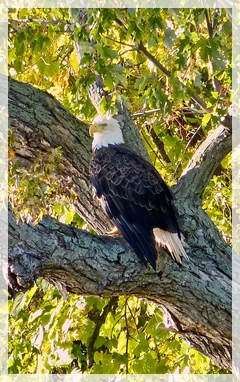 The eagle is mentioned more than any other bird of prey in the Bible. References are made to its swiftness of flight, ability to soar high in the air, excellent vision, the way it sets its nest in high places, and the strength of its wings. The above two verses about eagles, however, are more figurative than literal and have no scientific basis. Although mother eagles do hover over their young, they cannot carry them. A bald eagle’s lifting power is only about a third of its weight. An eaglet ready to fly is as heavy as its parents. If Mrs. Eagle tried to carry junior, they’d both fall! The second verse about being renewed like an eagle is probably connected to an ancient belief that every ten years the eagle disappeared into the sun, dove down into the sea with the setting sun, and emerged young again. There’s a similar urban myth that at 30 years of age, the eagle flies to a high mountain top and makes the difficult decision between death or the painful plucking out of all of its feathers and the destruction of its beak and talons. After waiting several months for everything to grow back again, it will be transformed and the refreshed bird will be able to live another 30 years. Not so; like the rest of us, when it’s time to grow old and die, the eagle has no choice. Like other birds, however, when the eagle molts, old worn feathers will drop and new ones will replace them.
The Bible’s figures of speech have more scientific basis when they refer to the eagle’s wings and ability to fly. Isaiah tells us that trusting in the Lord will allow us to soar on wings like eagles. An eagle’s wing span can be over seven feet and yet those powerful wings weigh less than two pounds. Nevertheless, pound for pound, an eagle’s wings are stronger than the wings of an airplane! By using the wind and updrafts that come off hills and mountains, the eagle’s wings can carry it as high as 10,000 feet and move it faster than thirty-five miles an hour. During migratory season, those wings can easily carry an eagle over 125 miles in a day.
Isaiah is correct: trusting in God truly will allow us to fly like eagles. With faith in God, we will have strength and stamina and, like the eagle, we can rise to great heights. Just as the eagle uses the wind to propel himself up and through a storm, we can use God’s power to fly through the storms of life. When we trust in the Lord, we can soar like eagles. May you soar today!
You cannot fly like an eagle with the wings of a wren. [William Henry Hudson]

 After it was returned by the Philistines, the Ark of God had been neglected in Kiriath-jearim for twenty years. Fresh from victories over the Philistines, David decided to bring the Ark back to its rightful home in Jerusalem. It certainly seemed like a good idea at the time. Unfortunately, ignoring the law’s clear instructions that the Ark could only rest on poles and carried on the shoulders of Levites, David had it placed on a cart pulled by oxen. The oxen stumbled, the cart tipped, and Uzzah reached out to steady it. Under Hebrew law, touching the sacred Ark was a capital offense and Uzzah was immediately struck dead. The Ark should never have been on a cart and it was David’s disobedience and carelessness that caused the man’s death. Nevertheless, David’s reaction was to get mad at God.
 You have heard that it was said, “Love your friends, hate your enemies.” But now I tell you: love your enemies and pray for those who persecute you, so that you may become the children of your Father in heaven. For he makes his sun to shine on bad and good people alike, and gives rain to those who do good and to those who do evil. [Matthew 5:43-45 (GNT)]
 Ezekiel proclaimed God’s message to the Jewish exiles in Babylon. As the Lord’s prophet, he was commissioned to deliver words of both judgment and hope. Some of the exiles recognized him as a prophet but more did not. Although they found Ezekiel’s message entertaining, they had no intention of putting his words into practice. There’s a lesson here for today’s churches: pews filled with people there only for the music, amusement, food, or activities mean nothing if God’s word is not planted in people’s hearts.
 When writing yesterday’s devotion (“It’s Curtains”), I couldn’t help but feel a brief pang of regret because I never had those conversations with my parents before they died. The thoughts, “Please forgive me. I forgive you. Thank you. I love you,” may have been assumed but never were spoken. I was fifteen when my mother succumbed to cancer. I saw her that day in hospital but, when I walked out that afternoon, I was sure I’d see her again when I visited the following day. I never thought the next time I saw her she’d be lying in a casket. When people would say, “She looks so good,” I wanted to shout at them and say, “She doesn’t look good; she looks dead!” Five years later, I was in the same funeral home and surrounded by many of the same mourners. That time, it was my father’s body lying so still in the front of the room. Two day earlier he’d been hunting pheasants when his heart failed; he died in the middle of a corn field. I’d seen him just a few weeks before that and never thought our farewell was the final one. Did my parents know how much I loved them? Did they know how sorry I was for my failings? Did they know I forgave them for theirs? Did they know how thankful I was for the life they gave me?
 Devotions of the Heart