GATEKEEPERS

“For my house shall be called a house of prayer for all peoples.” The Lord God, who gathers the outcasts of Israel, declares, “I will gather yet others to him besides those already gathered.” [Isaiah 56:7b-8 (ESV)]

cardinal

In the Old Testament, the Levites acted as gatekeepers. Among their many duties, they maintained decorum, enforced the laws of ritual cleanliness, directed worshippers to the correct area, and prohibited entry to anyone considered defiled or unclean (such as lepers, eunuchs, or Gentiles). The gatekeepers placed a large stone between the Court of the Gentiles and the Women’s Court to remind the unclean they would die if they passed it; if they entered into the Temple area, they would be dragged out and killed.

Gatekeepers who determine one’s fitness to worship remind me of my response to Jimmy, about whom I’ve previously written. A man with what could be called a colorful past, Jimmy started attending our Florida church last March. I admitted in “It Takes All Kinds” that I was less than enthusiastic when my husband invited him to church after meeting him in the park. A bit of a character, Jimmy is a recovering addict/alcoholic and, while not homeless, he lives on the fringe of society. Although I knew my misgivings were unchristian, as I got to know him, I quickly learned they also were unfounded. After starting to attend our church, he began coming to Bible study, bringing his well-worn Bible with him, and often joined our group for fellowship after class. Early this summer, when Jimmy asked to be baptized, ten others from our church joined him in the Gulf of Mexico for that sacrament.

During the summer, Jimmy went north to be with family but kept in touch with our pastor. He wrote about meeting a man in the park who was new to recovery. When the fellow asked Jimmy how he managed to stay sober, his reply was simple and to the point: Jesus! Our new Christian became a witnessing disciple. Jimmy recently returned to Florida and was warmly welcomed by all when he joined us for Sunday worship; I felt honored to take his hand during prayers.

The story is told of a homeless man, disheveled and dirty, who entered a church Easter morning. The service had just started and the pews were jam packed. As the man walked up the aisle in search of a seat, people avoided eye contact and no one made room for him in the pews. Once at the front of the church, the man sat down on the floor near the altar rail. As an usher, dressed in a black suit with a boutonniere in his lapel, made his way up the aisle, the parishioners were sure that he would quietly ask the man to leave (as any good gatekeeper would do). Instead, to the surprise of the congregation, the usher handed the man both program and hymnal and sat down beside him.

Although more and more churches now use security people to protect personnel and worshippers, we no longer have Levites to keep the unclean out of worship. If we did, our churches would be empty because we’re all soiled by sin! While we don’t have official gatekeepers, let us all be cautious of being unofficial ones. What would have happened to Jimmy if we had gatekeepers in our churches? What of his new friend? The best part of any man is what’s found in his heart and we’ll never know what’s in his heart until we take the time to know the man.

May the church be the place of God’s mercy and love, where everyone can feel themselves welcomed, loved, forgiven and encouraged to live according to the good life of the Gospel. And in order to make others feel welcomed, loved, forgiven and encouraged, the church must have open doors so that all might enter. And we must go out of those doors and proclaim the Gospel. [Pope Francis]

Do not neglect to show hospitality to strangers, for thereby some have entertained angels unawares. [Hebrews 13:2 (ESV)]

And the King will answer them, “Truly, I say to you, as you did it to one of the least of these my brothers, you did it to me.” [Matthew 25:40 (ESV)]

Copyright ©2018 jsjdevotions. All rights reserved.

OUTSIDE THE BOX

Lowdermilk Park - Naples FLI appeal to you, dear brothers and sisters, by the authority of our Lord Jesus Christ, to live in harmony with each other. Let there be no divisions in the church. Rather, be of one mind, united in thought and purpose. [1 Corinthians 1:10 (NLT)]

Now I say to you that you are Peter (which means ‘rock’), and upon this rock I will build my church, and all the powers of hell will not conquer it. [Matthew 16:18 (NLT)]

Since she is new to town, I invited Alice to our church. “What denomination?” she asked. When I told her we were non-denominational she thought I meant we were a church of whatever the individual wanted to believe and asked, “Do you mean Unitarian?” I assured her we’re Bible-based Christians but, unable to wrap her mind around the concept, she rattled off a set of questions. No hierarchy, bishops or diocese? No formal liturgy? No membership requirements or official canons or procedures? Who tells you what to believe? To whom are you accountable?

In Letters to the Church, Francis Chan asks the reader to imagine someone on a desert island, having no experience with Christianity, with only the Bible as reference. Asking first how this person might picture church and worship, he then asks the reader how his church and worship stack up to those first century expectations. Here in Florida, we attend two different churches and one fits Alice’s expectations: denominational, organizational hierarchy, church campus, sanctuary, chapel, liturgy, hymnals, pews, pulpit, choirs, choir director, organ, meeting rooms, video screens, stained glass, sound system, and several services. While Alice would identify it as a traditional church, that marooned person and the Apostle Paul probably wouldn’t recognize it.

Because I love the liturgy and hymns, we do attend that church Saturday nights. The church to which I invited Alice, however, is the church I think of as home. Less than a year old, while the early church met in homes, we meet in a city park and, since we’re in Florida, we can meet there all year long. Although non-denominational, we do have a core set of Bible-based beliefs and, to maintain doctrinal, financial, and leadership accountability, we belong to several Christian organizations. We have no formal liturgy, prayer books, hymnals, sound system, or choir (although the birds usually sing throughout the service). Rather than stained glass, we have palm trees, sea grapes, blue sky, and the Gulf of Mexico decorating our sanctuary. When we meet for Bible study, we rent a room in a community center. By today’s standards, our “outside the box” church is anything but traditional but I think the Apostle Paul would easily recognize it.

Last week, our similarity with the 1st century church came to mind when we met together at the community center for an early Thanksgiving dinner. Everyone brought a dish to share and, along with more than enough food, there was laughter, joy, and plenty of fellowship. I think Paul would have recognized Christ’s church as the sixty of us ate dinner, prayed and, in true early church tradition, partook of communion as a family.

Whether we are part of a traditional or unconventional church, let us remember that Christ’s church is not about a building but rather a group of believers. A church structure without a family of believers is not a church whereas a family of believers without a building is one! Christ’s church, regardless of where or how it worships, exists wherever two or three are gathered together!

For where two or three gather together as my followers, I am there among them. [Matthew 18:20 (NLT)]

Copyright ©2018 jsjdevotions. All rights reserved

WHO’S IMPORTANT?

So God created human beings in his own image. In the image of God he created them; male and female he created them. … Then the Lord God formed the man from the dust of the ground. He breathed the breath of life into the man’s nostrils, and the man became a living person. [Genesis 1:27,2:7 (NLT)]

SK8 Church Steamboat COOur family business makes products used in skateboards and many boarders are familiar with our name. After skiing one day, as my husband got on the bus, he was greeted by a boarder who spotted our company logo on his cap. “Yo, dude!” he called. Pointing to the cap, he asked, “You know those people?” When my husband replied he was “those people,” the fellow responded as if he’d met a celebrity and excitedly introduced my spouse to his pals. Soon they all were in an animated discussion of trucks, decks, wheels, and grip tape. The woman next to me, curious about the commotion in the back of the bus and not wanting to miss a celebrity sighting asked, “Is that someone famous? Is he important?” I replied, “He’s no one,” adding, “It’s just a skateboard thing.”
Later, I realized I’d given the wrong answer and not just because my husband is incredibly important to me. The better answer would have been, “He’s not famous but he is important.” Then, I should have added that she and I were just as important, as was everyone else on that bus, because we’re all important to God! I could have told her that real importance and value have nothing to do with fame, wealth, possessions or power. It has nothing to do with how we look, what we’ve done, where we work, what others think of us, or even what we think of ourselves.

Whether or not we were planned by our parents, we’re not accidents; God knew us all before we were born! Made in His image, we are God’s handiwork and precious in His sight. It was his breath that filled our lungs with life and His spirit that lives within us. Our names are etched on the palm of His hand, He’s promised to strengthen and help us, and He knows everything about us, including the number of hairs on our heads. If God carried an iPhone, our pictures would be on it and our numbers would be listed in His “favorites.” We are so loved by God that He sacrificed His only Son for us! As Christians, Jesus counts us among His friends and we’ve been adopted by God. As His children, we are recipients of a priceless inheritance. As followers of Christ, the God of the Universe has taken up residence in our hearts. Now that’s what I call important!

God does not love us because we are valuable. We are valuable because God loves us. [Fulton J. Sheen]

You made all the delicate, inner parts of my body and knit me together in my mother’s womb. Thank you for making me so wonderfully complex! Your workmanship is marvelous—how well I know it. You watched me as I was being formed in utter seclusion, as I was woven together in the dark of the womb. You saw me before I was born. Every day of my life was recorded in your book. Every moment was laid out before a single day had passed. How precious are your thoughts about me, O God. They cannot be numbered! I can’t even count them; they outnumber the grains of sand! And when I wake up, you are still with me! [Psalm 139:13-18 (NLT)]

Copyright ©2018 jsjdevotions. All rights reserved.

LOVE LIKE A CHILD

And do everything with love. [1 Corinthians 16:14 (NLT)]

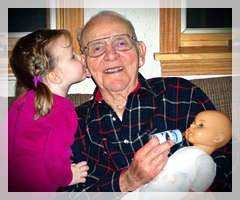
GrandpaI actually thought the prayer’s words that Sunday asked God to show us what children can teach us about love. Looking through old photos of my children and grands later that day, I thought about the ways children love. Unconcerned with decorum (or potential lawsuits), they’re demonstrative: touching freely and unabashedly. They cuddle and climb on laps, hold hands, and spontaneously give hugs and kisses. They burrow under the covers with us and aren’t bothered by morning breath or bed head. It doesn’t matter if they’re soaking wet from the sprinkler or their faces are covered with jelly or chocolate nor do they care if we’re sweaty and dirty from working in the garden or dressed in our finest for a night on the town. Children know that touch, whether a high-five or hug, is an important part of love.

Children don’t need words to express their love—rather than talking about it, they show it. In his nineties, Grandpa was frail, nearly deaf, and partially blind by the time the first great-grand arrived. Nevertheless, they didn’t need to talk; the little one knew how to speak with love and the two of them communicated silently, playing games only they understood. Another grand sought out a shy child in her pre-school who wouldn’t speak at all. The girls became fast friends because they didn’t need words to communicate. Perhaps children don’t need discussion because they know that loving actions speak far louder than do words.

Children love with gifts and service and the adults they love become the recipients of a wide assortment of shells, dandelions, painted rocks, pot holders, feathers, rubber band bracelets, drawings, beaded jewelry and pinch pots. As for service: my grands have been known to fight over who gets to help me water the plants, set the table, wipe my counters, dust the furniture or help fold the laundry. Children know that giving of self is a fundamental part of love.

Children love unconditionally and with forgiving hearts. Both of our foster daughters continued to love (and defend) the parents that failed them time and time again. They’d wait all afternoon for the promised visit that never happened only to faithfully wait again the following week. They loved even when the love was undeserved and forgave what seemed unforgivable (and I pray they still do). Children love without judgment.

Children love with generosity and without embarrassment. Last year, when the cousins were at our house, the eldest boy introduced the little ones to the dress-up box. After helping them into princess and pirate get-ups, they wanted him to dress up, too. There was just one costume that fit him and the little guys begged him to wear it. Without complaint, the fourteen-year old donned a Cinderella dress for his young cousins and allowed them to accessorize it with a lady’s hat, purse, and beads. He did this with a smile because children love generously, unselfconsciously, and with joyful laughter.

It wasn’t until I was done with this devotion that I re-read the words to that Sunday’s prayer and discovered it asked God to show us what children can teach us about Him. I thought of the story about a little girl who was busily drawing a portrait. When the teacher asked who it was, she replied, “God.” Reminding her that no one knows what God looks like, the girl said, “They will when I’m done!” God is love and children certainly know how to love; perhaps the face the little girl drew was that of a child. Indeed, children can teach us a great deal about both love and God.

Dear friends, since God loved us that much, we surely ought to love each other. No one has ever seen God. But if we love each other, God lives in us, and his love is brought to full expression in us. … God is love, and all who live in love live in God, and God lives in them. [1 John 4:11-12.14b (NLT)]

Copyright ©2018 jsjdevotions. All rights reserved.

HEAR AND UNDERSTAND

Anyone with ears to hear should listen and understand. … The seed that fell on the footpath represents those who hear the message about the Kingdom and don’t understand it. Then the evil one comes and snatches away the seed that was planted in their hearts. … The seed that fell on good soil represents those who truly hear and understand God’s word and produce a harvest of thirty, sixty, or even a hundred times as much as had been planted! [Matthew 13:9,19,23 (NLT)]

While there’s nothing wrong with my hearing, I can’t always understand what’s being said. For example, when my husband tells stories, he prefers pronouns to nouns. Yesterday, I didn’t know whether the “he” to whom he was referring was the newsman, Uber driver, passenger, angry motorist, shooter, or police officer. Without knowing which man did what, the story was confusing so I kept asking for clarification. As it turned out, the Uber driver, who was also a policeman, shot the gun!

With their heavy accents and unfamiliar cultural references, I sometimes have difficulty understanding my son’s Indian in-laws and must ask them to repeat or explain before I finally get their meaning. My brother-in-law has Parkinson’s and speaks slowly, softly, and often stops in the middle of a sentence. But, if I give him my undivided attention and am patient during his long pauses, I can follow what he’s saying. I even have trouble with friends from the deep South who manage to make a one syllable word have two, a two syllable word have one, and use a charming set of unfamiliar idioms! Nevertheless, these are people I love so I try to understand them.

I’m the first one to admit it’s not always easy to understand Scripture. Then again, it’s not always easy to understand my family and friends but I take the time to do it. Understanding Scripture is no different than trying to understand people’s voices and, as happens with people, sometimes it take a little (or a whole lot) of effort to comprehend what is being said. Admittedly, with family and friends, there are times (as with the newsman/Uber driver/passenger/angry motorist/shooter/police officer story) when all that effort really isn’t worth it. However, I’ve never felt that way about anything written in Scripture; there, the message is always worthwhile!

Admittedly, some days I finish my Bible study more confused than when I began and there are times I want to give up. Yet, if I’ll make an effort to understand the people I love, it only makes sense that I’ll do the same thing with the God I love. God was pleased when Solomon asked for wisdom so I’m sure He’ll give us the discernment, self-discipline, patience, and ability to understand His word if we ask. He’s already provided us with countless study Bibles, assorted translations, plenty of commentary, pastors, teachers, and study groups to help us on our way.

Jesus told us to hear and understand. The best place to hear Him is in Scripture but, unless we open our Bibles and read them, we won’t hear Him. If we don’t hear Him, how can we ever understand?

“Anyone with ears to hear should listen and understand.” Then he added, “Pay close attention to what you hear. The closer you listen, the more understanding you will be given—and you will receive even more. To those who listen to my teaching, more understanding will be given. But for those who are not listening, even what little understanding they have will be taken away from them.” [Mark 4:23-25 (NLT)]

Copyright ©2018 jsjdevotions. All rights reserved.

WHAT’S YOUR GIFT

There are different kinds of spiritual gifts, but the same Spirit is the source of them all. There are different kinds of service, but we serve the same Lord. God works in different ways, but it is the same God who does the work in all of us. [1 Corinthians 12:4-6 (NLT)]
barred owl - painted bunting - penguin

When I was writing about the peacock’s unpleasant scream yesterday, I pictured him complaining to the owl that the wren has a nicer voice. The wren chirped back her complaint that, unlike the peacock, she was small and nondescript. Hearing them, the penguin complained about his plain black and white feathers but the colorful painted bunting countered that she was unable to swim. The pelican joined the grumbling and whined that he couldn’t flit from flower to flower like the hummingbird who then expressed jealously over the pelican’s large bill. When the bald eagle protested not having long legs like the ostrich and the ostrich expressed envy at the eagle’s ability to soar high in the sky, the wise owl hooted at them all to be quiet.

Unlike the other birds, the owl did not grumble about what many would consider his shortcomings: his dull color, asymmetrical ears, and farsightedness. Explaining that his dull color gives him camouflage, the lopsided ears allow him to locate prey at night, and his farsightedness makes him an excellent hunter, he told the other birds to be thankful for their gifts. He reminded each bird of what made it special: the peacock’s beautiful tail, the wren’s ability to sing and trill, the penguin’s powerful flippers and streamlined body, the bunting’s unique coloring, the pelican’s skill at diving from heights of 30-feet, the hummingbird’s capability of flying backwards, the eagle’s eyes that can spot a rabbit two miles away, and the ostrich’s gift of running faster than any other bird. Rather than complaining about what they didn’t have, they should appreciate their own unique God-given gifts and use what they were given with wisdom, joy and thanksgiving.

Like the birds, we too have gifts: both the talents we were given at birth and the spiritual gifts we received from the Holy Spirit. Those talents and gifts are as unique as a peacock’s tail or the wren’s song. Some gifts, like the strong legs of an ostrich or a pastor’s inspired preaching are rather obvious. Others, like the owl’s lopsided ears or the healing embrace of someone gifted with empathy are less apparent. Rather than complain, as did the birds, we should take inventory of our many gifts and talents, appreciate and develop them, and use them enthusiastically and wisely to glorify God. Let’s appreciate what we have and accept that there will always be some things, like singing or soaring, that are best left to others.

Our purpose should be to discover the gifts He has given us and to use those gifts faithfully and joyfully in His service, without either envying or disparaging the gifts we do not have. [John MacArthur]

A spiritual gift is given to each of us so we can help each other. … It is the one and only Spirit who distributes all these gifts. He alone decides which gift each person should have. [1 Corinthians 12:7,11 (NLT)]

Copyright ©2018 jsjdevotions. All rights reserved.