
Your words were found, and I ate them. Your words became a delight to me and the joy of my heart, for I bear your name, Lord God of Armies. [Jeremiah 15:16 (CSB)]
“Son of man,” he said to me, “feed your stomach and fill your belly with this scroll I am giving you.” So I ate it, and it was as sweet as honey in my mouth. [Ezekiel 3:3 (CSB)]
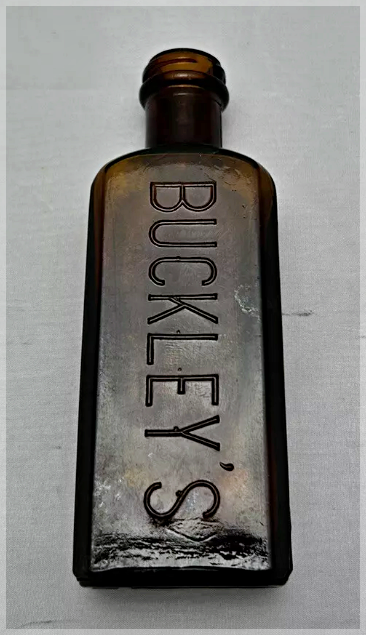 Back in 1919, pharmacist W.K. Buckley created a concoction to treat coughs, colds, and bronchitis called Buckley’s Original Mixture. Buckley’s elixir was tremendously effective but its flavor was horrid. Nevertheless, their nasty tasting blend of things like menthol, camphor, Canadian balsam, and pine needle oil is still being sold more than 100 years later. The mixture’s longevity is due as much to the company’s straightforward and humorous “awful taste” ad campaign as it is to its reputed efficacy. With the slogan, “It tastes awful. And it works!” Buckley’s is described by consumers as “the worst tasting, foulest smelling, yet most effective cough remedy.” Apparently, it is. Despite ads admitting, “People swear by it. And at it,” consumers continue to endure Buckley’s ghastly flavor. Never having used Buckley’s (and not about to try), this is not an endorsement!
While nowhere as unpleasant tasting as Buckley’s Mixture, many Christians tend to treat imbibing in God’s word as they might taking a dose of it or some other nasty tasting medication: hard to swallow and consumed only out of necessity! While Scripture’s writers sometimes likened God’s word to food or wrote of its taste, they never described it as “drinking turpentine and transmission fluid mixed together, with a hint of menthol and petroleum” as do some of Buckley’s customers!
While the Bible can be said to be “good for what ails you” and “just what the doctor ordered,” reading Scripture isn’t like taking a dose of Buckley’s or castor oil. God’s word never should be treated as a horrible-tasting medicine—something taken only when absolutely necessary. Peter likened God’s word to milk while Paul and the writer of Hebrews compared it to both milk and solid food (like meat). Job reported treasuring God’s words more than his daily food and Jeremiah, Ezekiel, and the Apostle John all wrote of eating God’s word. And, unlike those who consumed Buckley’s, there were no complaints about its foul taste. In fact, Jeremiah found God’s words a delight and the joy of his heart while Ezekiel and John said they were “sweet as honey” in their mouths. In fact, Psalms 19 and 119 refer to God’s words as even “sweeter” than honey!
When God fed the hungry Israelites in the Sinai desert, His provision included more than earthly food. Along with manna, He gave them something beautiful with which nourish their very souls—His Word! When Israel arrived in the Promised Land, the manna stopped but God’s voice didn’t; He provided mankind with a feast from Genesis through Revelation—and that feast remains with us today. As Moses told the Israelites and Jesus repeated to His followers, “Man must not live on bread alone but on every word that comes from the mouth of God.”
While God’s Word has been described as “sweet as honey” in one’s mouth, unlike cotton candy and sugary sodas, there’s more to it than a sweet taste. Rather than empty calories, God’s words were described by Charles Spurgeon as, “full of substance—they are spirit, they are life, they are to be fed upon by the spiritually hungry!” Remembering that God spoke all of creation into existence with His Word, it shouldn’t come as a surprise that God’s Word is what sustains us, as well! Fortunately, the words of Scripture are sweeter and much easier to consume than Buckley’s disagreeable mixture!
The Bible is not an end in itself, but a means to bring men to an intimate and satisfying knowledge of God, that they may enter into Him, that they may delight in His Presence, may taste and know the inner sweetness of the very God Himself in the core and center of their hearts. [A.W. Tozer]
 While there are no hard and fast rules about prayer except to believe in it and do it, some people use acronyms to help organize their prayers. The PRAY method stands for Praise, Repent, Ask, and Yield while the ACTS method formats prayer into Admiration (praise), Confession, Thanksgiving, and Supplication (asking God for what is needed). A TACOS prayer structure is Thanks, Adoration (or Applause), Confession, Others, and Self. Rather than an acronym, I was taught “The Hand of Prayer” as a girl. Beginning with the thumb, the order was Praise, Thanksgiving, Confession, Intercession (prayer for others), and Petition (prayer for oneself).
 By forgiving people’s sins, Jesus was placing Himself in the role of God because only God can forgive sins. Had Jesus not been God, it would have been blasphemy. When He raised the dead, multiplied food, stilled storms, and healed incurable diseases, Jesus was doing other things that only God could do. His incredible claim that He could bring Himself back from the dead, something only God could do, was another way Jesus claimed His divinity. The undeniable proof of His claim came Easter morning when Jesus demonstrated power over both life and death. The tomb was empty and people saw the risen Christ—they heard Him speak, watched Him eat, saw His wounds, and touched Him. The forty days the resurrected Jesus remained on earth, however, is about more than proof of his claim to be God; it’s about proof of our relationship to God.
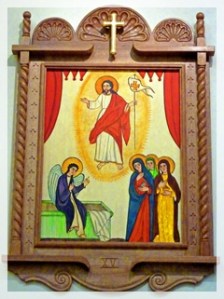 Found in almost every Roman Catholic church (and some Protestant and Orthodox ones), are the Stations of the Cross—a series of fourteen icons or carvings on the walls—each of which depict a moment in the Passion of Christ. Created to help people contemplate the events leading up to Christ’s crucifixion, they start with His death sentence from Pilate and end with His dead and battered body being laid in the tomb. Because Good Friday and Jesus’ death aren’t the end of the story, some churches have begun adding the resurrected Christ as a 15th station.
 While touring an historic house, the elaborately set dinner table reminded me of the large formal dinner parties we had in our younger (and more energetic) days. I’d start preparing the table in advance by adding extra leaves to the table, gathering the extra chairs, and ironing out the creases in the damask tablecloth. From the cupboard in the basement, I’d haul up the crystal salad plates, my mother’s Lenox china, and the hand-painted Bavarian service plates and Czechoslovakian dessert plates that were my grandmother’s. I’d spend hours polishing the silverware and serving pieces. The service plates were set out, the silverware laid, the crystal wine and water goblets carefully placed at each setting, and the napkins artfully folded. I’d set out the silver candlesticks, put in fresh candles, get flowers from the florist, and create what I hoped would be the perfect Martha Stewart-worthy table setting. There was plenty more work to do in the kitchen. I’d spend days perusing recipes, planning the menu, making lists, purchasing food, and preparing it all. I loved doing it because I loved the people for whom I did it. Nevertheless, as nice as my guests were and as much as they enjoyed themselves, I’m not sure they truly appreciated how much effort went into everything that on that table.
 In my last post, I pondered why Jesus chose the men he did as his apostles. As we enter Holy Week and the events leading to the Lord’s arrest and crucifixion, I wonder specifically about Judas Iscariot. We don’t know what Jesus saw in Judas when he was chosen as one of the twelve or even what was in Judas’ heart in the beginning of Jesus’ ministry. We only know that discontent, ambition, and greed had entered his treacherous heart by the end.
 Devotions of the Heart